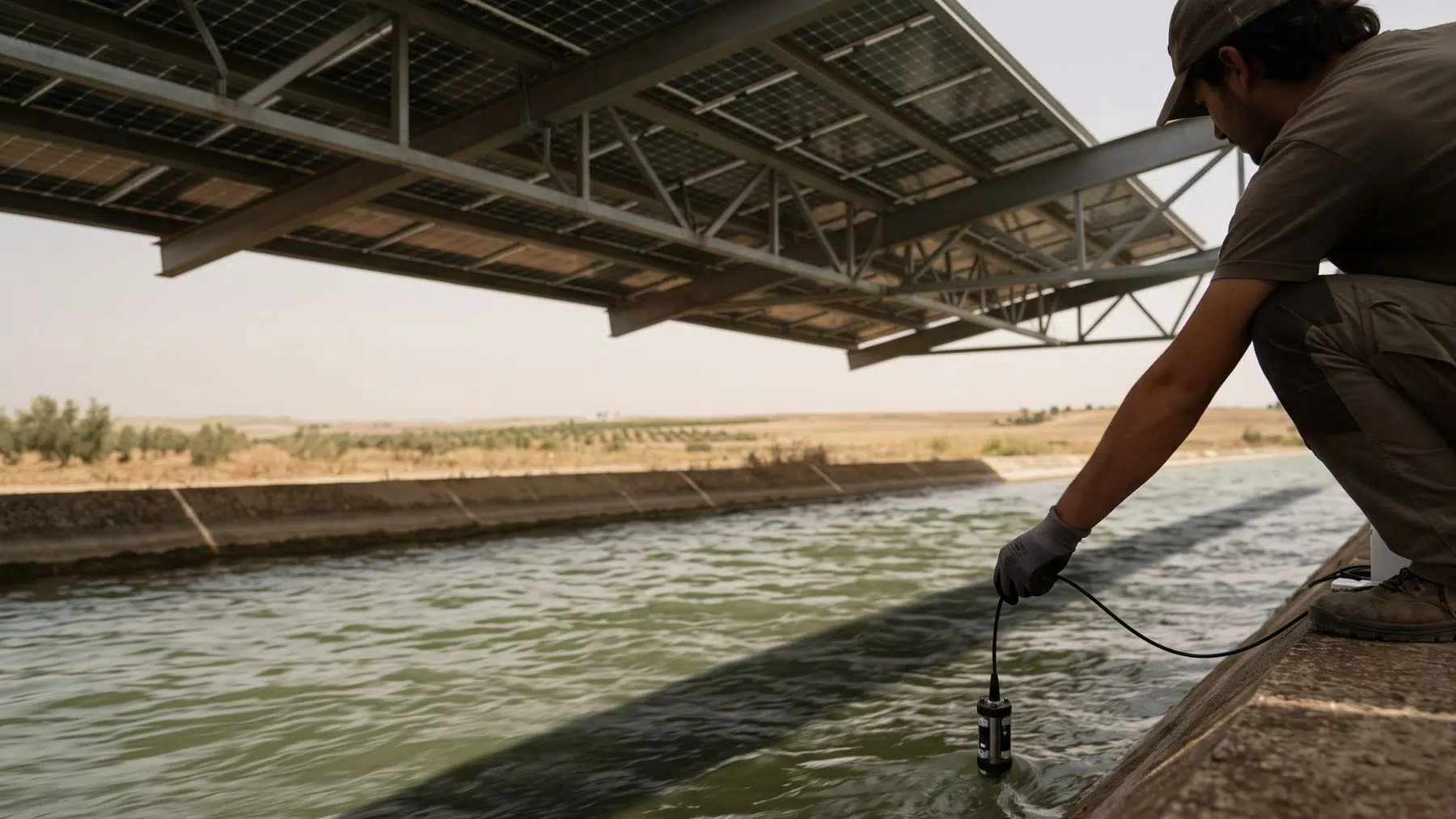
The water runs fast and green between two concrete walls in Stanislaus County.
Above it, a steel canopy stretches the full width of the channel.
The shade it throws lies flat across the surface, wall to wall.
Underneath, the canal is doing something no canal in this valley has done before.
It is holding onto its own water.
The whole structure began as a spreadsheet.
Four thousand miles of open water in a dry state
California moves most of its water through open channels.
Roughly 4,000 miles of canal carry it from the rivers out to the farms.
Every one of those miles sits under some of the hardest sun in the country.
Water lifts off the surface all summer, and nobody ever gets to use a drop of it.
It is the oldest loss in western irrigation and the one nobody has ever billed anyone for.
Weeds and algae thrive in the warm shallow flow, and districts spend millions a year cutting them back out.
Meanwhile the state has to put new solar somewhere.
Farmland is contested, desert sits far from the demand, and every acre proposed starts its own fight.
The canal banks were already owned, already cleared, and already running past the farms.
The doctoral student who put a number on it
Brandi McKuin worked the problem as a doctoral student at the University of California, Merced.
Her question was narrow. What changes if solar panels go over the canals instead of onto open ground.
She modeled evaporation, shade, panel temperature, land value and construction cost in one accounting.
The results ran in Nature Sustainability in 2021.
Covering all 4,000 miles would save up to 63 billion gallons of water a year.
The same canopies would carry roughly 13 gigawatts of generating capacity.
That is enough electricity to run a city the size of Los Angeles for nine months.
And it would take no new land at all.
From a model to eighty thousand square feet of steel
A paper is not a canal, and the distance between them is where most good ideas stop.
This one kept going.
The Turlock Irrigation District, which operates 250 miles of canals, agreed to host a pilot.
The state Department of Water Resources funded it, Solar AquaGrid developed it, and UC Merced stayed on to measure whatever happened.
Project Nexus launched in 2022 and broke ground in 2024.
One wide array at Hickman crosses 115 feet of open channel in a single span.
Two narrower arrays cover 25 foot sections at the Ceres Main, and an iron flow battery stores what they make.
Together the three canopies shade close to eighty thousand square feet of moving water.
Construction finished in April 2026, and the governor came out to the canal bank to say so.
Five years had passed between the published calculation and the ribbon.
What one irrigation season actually measured
The pilot has now run a full irrigation season with instruments in the water.
Evaporation under the canopies fell by as much as 70 percent, according to the university.
Aquatic weed growth dropped by about 85 percent along the shaded stretches.
That second figure is the one the irrigation district watches most closely, because weed control is a bill that arrives every single year and never gets smaller.
The exchange also runs in both directions.
A solar panel loses output as it heats up, and moving water underneath draws that heat away.
The canal cools the array while the array shades the canal, which is how the district frames the pilot.
Neither effect had to be engineered in, and both turned up in the data.
What the pilot has not answered yet
Several things are still missing, and they matter.
Neither the installed capacity nor the construction cost has been published.
Spanning 115 feet of moving water takes far more steel than bolting a panel to a post in a field, so the cost per watt runs higher.
The 63 billion gallons remains a model result rather than a measurement, and it assumes the entire network gets covered.
The full research report from the monitoring team is due later this year, and it will carry the first published output figures.
Until it lands, the honest claim stays small. Two short reaches of canal in one county behaved the way the model said they would.
Public argument will follow regardless, the way it trails a solar site or an offshore project long after the engineering is settled.
What makes this project unusual is that the standard objection does not reach it.
Nobody lost a field, a view or a habitat to build it, because the canal was already cut.
A doctoral student wrote that down five years ago, and the water is now proving her right.
Read the whole thing?
Get the week's signal, not the noise
Our sharpest reporting on energy, climate and nature — free, once a week.