
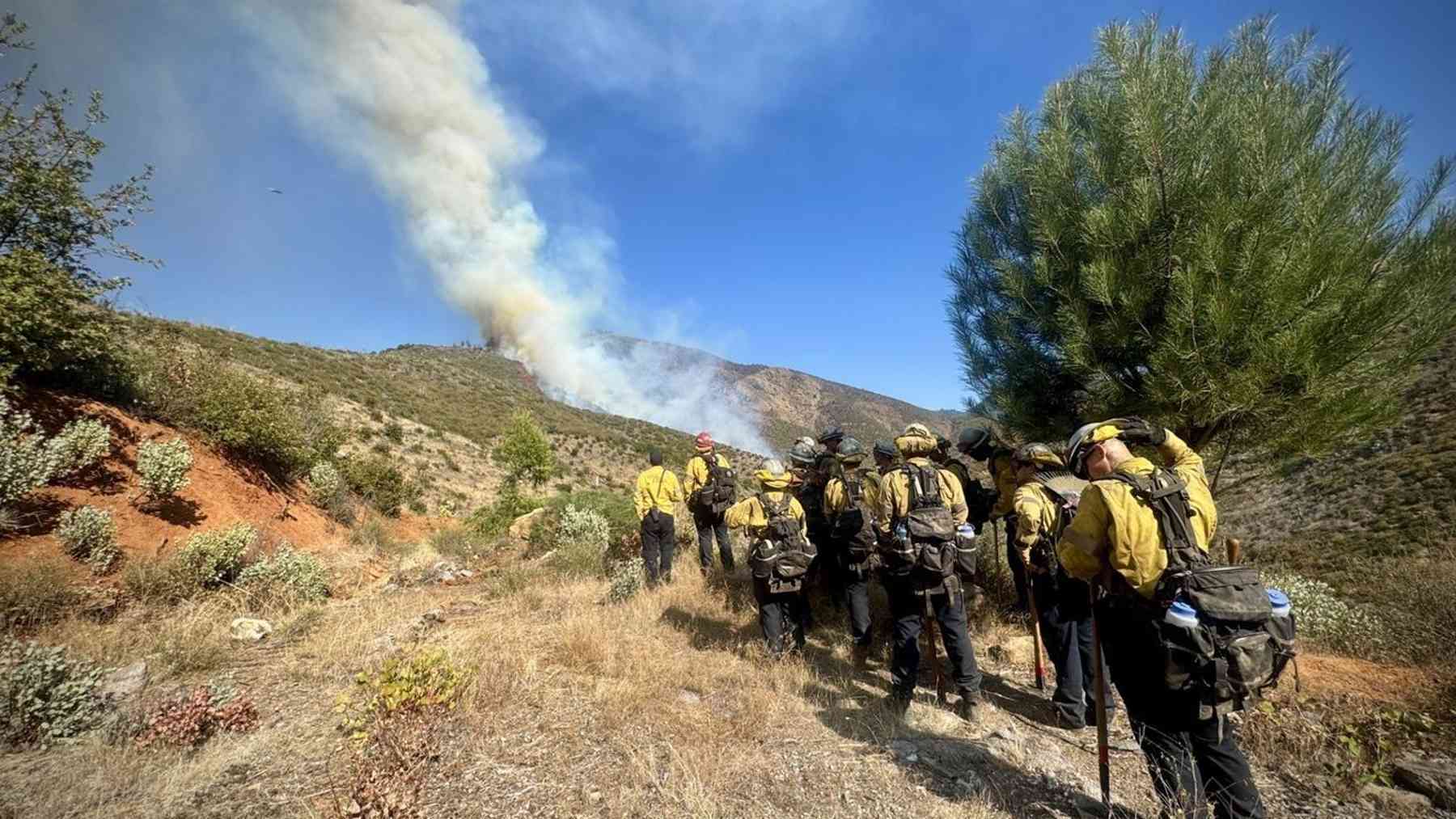
The ridge above French Gulch, California looked close to boxed in on Monday afternoon.
Air tankers had laid retardant across the slope.
From a distance it read like a line nothing could cross.
Then embers lifted off the hottest part of the burn.
They rode the wind past the retardant and landed in unburned brush beyond it.
Small new fires were soon burning on the far side of a barrier meant to stop exactly that.
Why embers can fly straight over a line built to stop fire
Fire retardant works by coating vegetation so it resists ignition when flame reaches it directly. That is a ground level defense, built to blunt a fire crawling or running along the surface. It does nothing to stop what is already airborne, and on the Fork Fire, Cal Fire reported that the blaze had reached the top of the ridge and that windblown embers were starting small spot fires ahead of the main fire.
So the mechanism here is ordinary fire behavior, not a flaw in the chemical itself. Rising heat and wind can carry burning bark and needles out ahead of a flame front.
Air moving upslope in steep country helps push those embers farther still. Those short range embers do not care where the retardant line sits, because they are already past it before they touch the ground again.
Cal Fire described the fire as burning at a moderate to critical rate of spread in steep and rugged terrain, conditions the agency said were making the work challenging for firefighters.
A ridge road, a scorched gulch and 200 people standing between them
French Gulch is a small former gold mining town west of Redding, sitting in backcountry covered by Cal Fire’s Shasta-Trinity Unit. The fire started near the 12,000 block of East Fork Road at 1:17 p.m. Monday and, by shortly before 2 p.m., had grown to an estimated 30 acres.
By early afternoon the incident commander reported that the fire had reached the top of the ridge and was spotting out ahead of retardant lines. Close to 200 personnel, ground crews and air resources combined, were assigned to it, with tankers working the fire’s edges through the daylight hours.
Cal Fire Shasta-Trinity Unit Battalion Chief of Law Enforcement Matt Alexander told KRCR that crews were making progress slowing the fire despite its active behavior, and that the winds had to be watched. “We have crews in place that have fought fire in this area before,” he said, describing resources already familiar with that stretch of country.
How fast a modest fire can still outrun its own containment lines
By Monday afternoon the fire stood at 46 acres and 5 percent containment, and late in the day Cal Fire reported retardant surrounding the incident. Officials said it carried the potential to reach 200 acres, more than four times the ground it had burned by that point.
That gap between the numbers matters. Retardant lines buy time and steer a fire’s direction, but they are not a sealed wall.
A blaze throwing embers can open new fronts faster than hand crews can cut fresh containment line around them. Evacuation warnings stayed in place for two zones nearest the fire’s edge, and East Fork Road was closed at Trinity Mountain Road.
Close to 300 electric customers in the French Gulch area lost power while the fire was active.
What kept the gulch’s homes out of the fire’s path this time
No structures were reported threatened, and no injuries were reported among residents or firefighters. Crews were expected to remain overnight and into the following days to monitor the fire and work toward containment on ground that had already thrown embers past one line.
That overnight watch is its own acknowledgment of the mechanism at work. A line of retardant can look complete from a ridge road, the way an eastern Iowa balloon can read a sky that still produces a surprise downpour hours later.
The numbers on a map rarely capture what the wind is doing in the gaps.
Why this small fire still matters for a dry California fall
The cause of the Fork Fire remained under investigation as crews worked the perimeter. What is already documented is simpler and arguably more useful: retardant went down around the fire, and the fire still put embers already airborne on the far side of it.
That is not a failure of the tool, it is the edge of what the tool is built to do.
Seasonal drying shapes wind driven fire behavior well beyond one Shasta County ridge, in much the way the Great Lakes region shifts with each autumn.
For French Gulch, the honest ending is an ordinary one: a fire still only partly contained, a ridge still being watched overnight, and a reminder that in steep country, the air above the line can matter as much as the line itself.
Read the whole thing?
Get the week's signal, not the noise
Our sharpest reporting on energy, climate and nature — free, once a week.


