
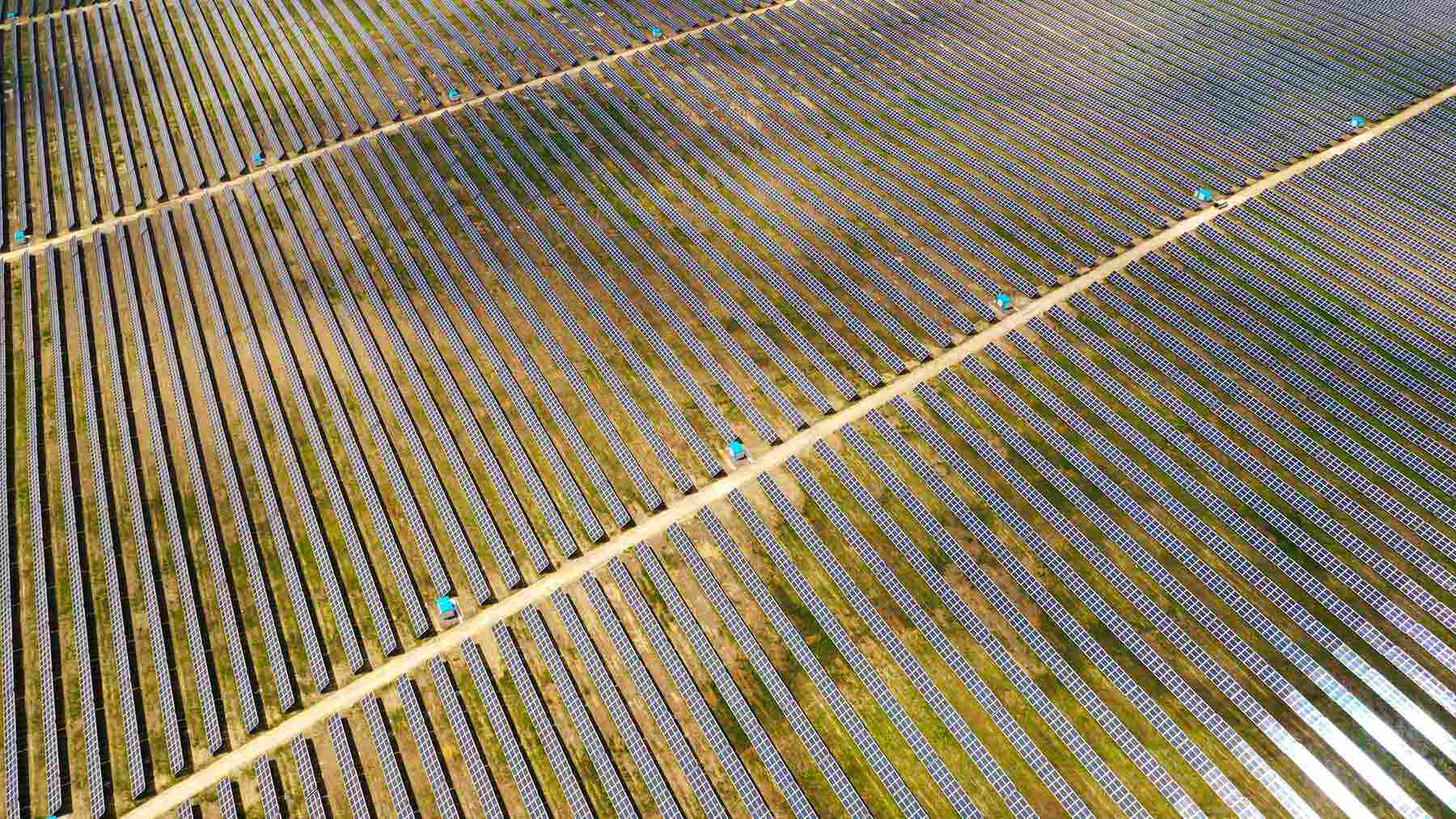
Wildlife biologists studying resident pronghorn in southwest Wyoming documented behavioral modifications due to a large solar power facility.
Five years of GPS data gathered from these animals’ movements showed that pronghorn herds gradually moved farther away from the 80-megawatt Sweetwater solar power plant. It was surrounded by security fencing in an ideal sagebrush prairie range.
The number of weekly encounters of individual animals within 328 feet of the perimeter fence went from 0.90 to only 0.05.
Tracking pronghorn movements across sagebrush habitat
Highly accurate GPS tracking collars were attached to dozens of wild pronghorns in Wyoming’s Red Desert area.
The transmitters recorded highly accurate satellite coordinates every two hours before, during, and after the development of the Sweetwater array.
Initially created movement maps revealed that the collared herds had the freedom to move about the sagebrush prairie that was eventually developed as the solar energy farm.
Setting up the 6.6-foot chain-link fence topped with three strands of barbed wire cut off movement paths across native spring and summer range.
The security fencing directly excluded pronghorn from habitat within the array’s footprint while prompting localized avoidance of surrounding areas.
High-tech GPS collars revealed a sustained shift in space use, with resident animals increasingly avoiding the landscape surrounding the facility.
Quantifying long-term avoidance around perimeter fences
Statistical spatial modeling was used to determine how often pronghorns wearing a collar came within 328 feet of the facility boundary fence.
In the beginning construction phase, curious and displaced animals would graze close to the recently built chain-link security fence.
Approaches to the fence were at 0.90 times per week per individual in the early facility development stage.
Five years after construction was completed, approaches became steadily less frequent, reaching 0.05 times per week.
Pronghorns steadily increased the distance buffer from photovoltaic paneling and fencing.
The decline of approaches indicates that the displacement problem was increasing and not decreasing with time. Time led to spatial avoidance and not habituation.

Altering seasonal migration paths around solar arrays
Resident pronghorn altered their spatial distribution to avoid the 700-acre industrial solar facility during the spring and summer study periods (April 1 to September 30).
Animals on adjacent public lands maintained a buffer zone around the security fence, reducing their use of habitat near the development.
By shifting away from the installation, pronghorn concentrated their activity in remaining available pastures, which can increase grazing competition on surrounding sagebrush range.
This spatial avoidance effectively expanded the facility’s ecological impact zone beyond its physical boundary, reducing usable habitat for resident herds during the warm season.
Re-evaluating wildlife habituation assumptions
Renewable energy project planners tend to rely on the assumption that native wildlife populations adapt to renewable infrastructure over time.
Five years of empirical field data reveal that resident pronghorn at this facility did not habituate to the solar array over the study period.
Pronghorn exhibited continual behavioral avoidance during the spring and summer months, with no indication of habituating to the operational facility over the five-year post-construction monitoring period.
Avoidance of operational solar installations limits usable habitat for wildlife.
The long-term avoidance creates an extended ecological impact area extending well beyond the installation’s physical boundary.
Distance, not familiarity, determined long-term animal responses.
Identifying limits of single-site solar tracking studies
GPS tracking near Sweetwater has shown that fenced solar farms impact the patterns of pronghorn habitat use.
Information collected from one 80-megawatt farm in Wyoming cannot be extrapolated to predict the behavior of various ungulates within different terrains.
Biologists are yet to determine the effect on animal movement that unfenced or wildlife-friendly solar farms would have.
Weather conditions and the presence of predators at various times of the year may also affect herd navigation through industrial facilities.
Cumulative impact evaluation for many proposed solar farms is necessary as the number of such developments increases.
Behavioral displacement is evident in one farm study, but mitigation efforts require comparison studies from various farms.
The full study can be read here: Sawyer, H., Smith, K. T., Robb, B. S., & Merkle, J. A. (2025). Ungulate use before and after utility‐scale solar development. Ecological Solutions and Evidence, 6(3), e70071.
Read the whole thing?
Get the week's signal, not the noise
Our sharpest reporting on energy, climate and nature — free, once a week.


