State wildlife officials are working along the Upper Mississippi River to rescue one large-species endangered fish.
The lake sturgeon was once abundant throughout Illinois. From the early 1900s, dams, overfishing, and habitat destruction put the species on the endangered list.
Today, there’s a longstanding conservation plan in place at a major industrial facility near Cordova. Can a nuclear power plant “fish nursery” help rebuild a wild population that takes nearly 30 years to mature?
How rearing endangered fish can be done alongside nuclear infrastructure
In 1984, the Quad Cities Clean Energy Center in Illinois started an on-site fish hatchery. It is operated and funded by Constellation Energy, the 75% owner of the energy facility. In 2001, following security changes after September 11, the facility was moved outside the main fenced-off industrial area. The hatchery became open to the public for educational visits and to state agencies for research projects.
The Illinois Department of Natural Resources transferred 21 eight-inch juvenile sturgeon to the Quad Cities facility in late 2025. They came from broodstock reared by the Department of Conservation after hatching at the Jack Wolf Memorial Fish Hatchery.
There is a broader state recovery campaign taking place, targeting historical lake sturgeon waterways like the Sangamon, Mackinaw, and Vermilion rivers. This transfer was part of that initiative.
It takes a lot of patience to reestablish a self-sustaining population. The females take as long as 27 years to mature to the spawning stage, and this only happens once every four to seven years after that.
Biologists stocked larger juveniles to give the slow-growing fish a better shot at surviving river predators like bass.
A dietary transition to accelerate growth rates
It is a heavy strain on conservation budgets to raise young sturgeon. Their usual diet at the hatcheries is live bloodworms and brine shrimp, which drive up production costs.
The Quad Cities hatchery manager, Dr. David Bergerhouse, and Jeremiah Haas, an aquatic biologist, came up with a different strategy. Together, the pair have 65 years of facility experience.
They trained the 21 juvenile sturgeon to eat commercial feed pellets rather than the costly bloodworms and shrimp and ensured that their nutrition was still balanced. The pay-off came quickly, according to the Illinois Department of Natural Resources. The fish doubled in size before their release in the spring, reaching an average length of 16 inches. The largest of them was 20 inches and 2.2 pounds.
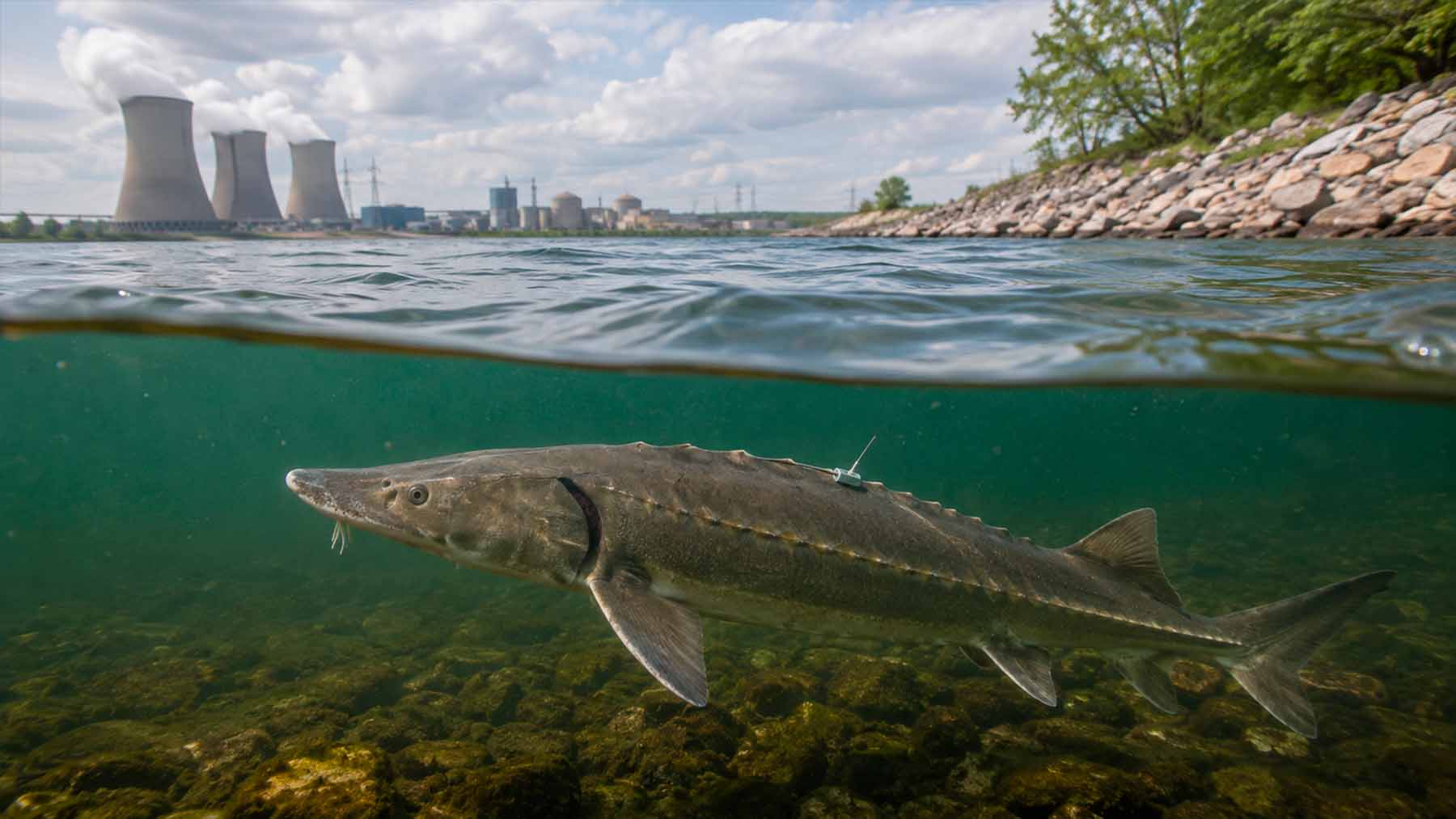
To track their survival, the sturgeon were fitted with passive transponder tags. The device is similar to a pet microchip. Researchers can track growth rates and river navigation over a lifespan that could reach beyond 100 years.
Balancing restoration goals against industrial cooling impacts
While the sturgeon release marks a clear conservation win, the nuclear plant creates a heavy ecological tradeoff.
To cool its reactors, the Quad Cities facility pulls massive volumes of river water through intake pipes. Jeremiah Haas estimates these cooling intakes entrain and kill between 200,000 and two million gizzard shad every year.
The stocking program originally grew out of efforts to mitigate this recurring fish loss. Now, regulatory requirements are shifting.
Updated conservation technology to meet regulations
Under a 2014 Environmental Protection Agency rule, facilities using large intakes must install updated technology, such as modified screens, to protect aquatic life. As Constellation Energy completes these hardware upgrades over the next five years, its legal obligation to fund mitigation restocking could end, leaving the hatchery’s future uncertain.
Ultimately, saving Illinois lake sturgeon depends on protecting spawning grounds and restoring fish passage around river dams. While these 21 tagged sturgeon may swim Midwestern rivers for decades, state biologists stress that true recovery means establishing self-sustaining populations that reproduce naturally.
Understanding how energy sites manage river species highlights broader challenges across industrial waterways. Similar monitoring efforts are expanding along Midwest watersheds, where regional hatcheries track migratory fish to help native populations recover near heavy infrastructure.
Read the whole thing?
Get the week's signal, not the noise
Our sharpest reporting on energy, climate and nature — free, once a week.