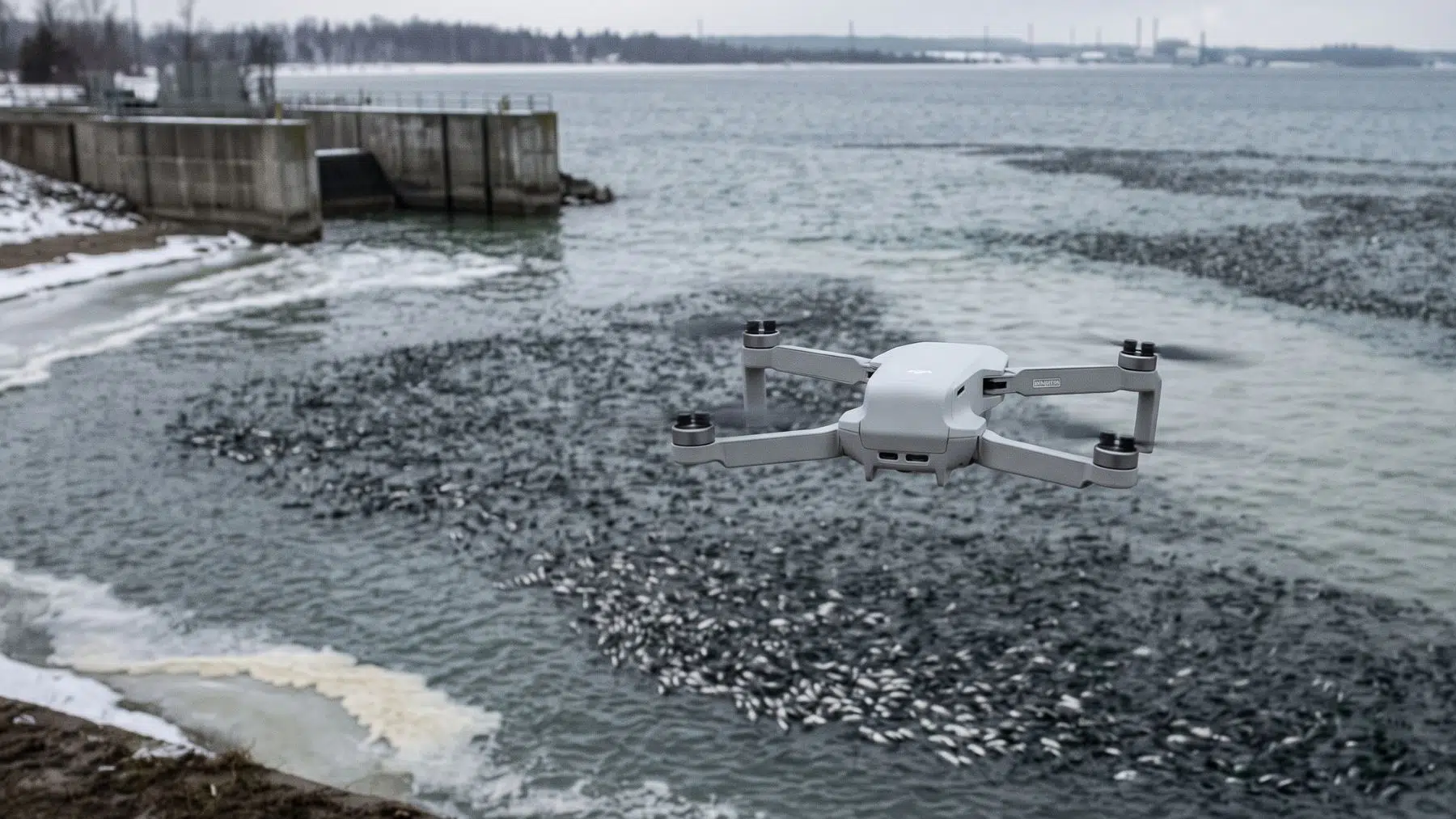
One winter morning, a drone lifted off over the eastern shore of Lake Huron.
Below it, near a nuclear plant, the water held a dark, swirling mass.
It stretched for what looked like the length of several city blocks.
Millions of small fish were packed so tightly they looked like a single living cloud.
From the air it looked like a lake bursting with life.
It was really nothing of the kind.
Within weeks the same fish began washing ashore dead by the million.
What first looked like abundance was really a slow motion warning.
The lake was not thriving, it was concentrating its trouble in one spot.
A nuclear giant and its hidden heat
The plant is Bruce Power, on the Canadian side of Lake Huron near Kincardine.
It is the largest nuclear plant in North America.
Like every big reactor, it needs a constant flood of cool water.
Eight reactors run there, enough to power millions of homes.
It pulls that water straight from the cold lake to cool its reactors.
Then it pushes the used water back out, several degrees warmer than before.
Day and night, that outflow paints a warm streak across the shallows.
That warm plume spreads a pocket of warm water into an icy lake.
In the dead of winter, that warmth becomes a powerful magnet.
Fish from across the bay crowd toward it.
To a cold fish, that plume feels like the only warm room for miles.
The drone footage that looked like abundance
That is where the drone found them, gathered in the millions.
The footage showed a dense shimmering school hugging the warm outflow.
People online called it a fish city, and it looked almost miraculous.
For a moment it seemed the battered lake had roared back to life.
In a lake that can often feel empty, here was life piled on life.
But that crowd was not a sign of a healthy lake.
It was a crowd with nowhere safe to go.
The warm water that drew the fish in also held them in place.
And right beside them sat the plant’s giant water intake.
The same current that fed the plant was drawing the fish toward it.
What the warmth is really doing
The fish in that cloud were mostly gizzard shad.
They are a warm water species living near the edge of what they can survive.
Gizzard shad cannot handle prolonged cold, and Lake Huron turns brutally cold.
So they chase every scrap of warmth they can find.
In a warming climate, more of them have pushed north into these waters.
The plant’s plume offers exactly that, right up until it does not.
When a reactor slows or the flow shifts, the warm blanket vanishes.
The stunned fish are hit with sudden lethal cold.
Others are simply pulled into the intake and trapped.
Either way, the warm refuge turns into a death trap within hours.
The count nobody wanted to see
By early 2025, the true scale of the loss became clear.
The bodies piled up along the shore from the Sauble River down to Goderich.
The Saugeen Ojibway Nation estimated between 3.5 and 4.5 million shad had died.
Nearly all of them perished in the plant’s intake channel.
In February, Bruce Power pulled a unit offline after finding the channel choked with fish.
The First Nation, which shares this shore, sounded the alarm.
They warned that the warm trap could catch far more than shad.
Rare lake sturgeon and other fish drift into the same heat.
That makes the die-off a warning about the whole shoreline, not one fish.
What the drone filmed as a city was really a gathering at a trap.
What the fish city really signals
The deeper story is not about one plant on one winter.
It is about a Great Lake that has been remade from the bottom up.
Invasive mussels have stripped much of the plankton from the water.
Native fish that once filled these depths have thinned out badly.
Into that gap, warm water shad have boomed and crashed.
A lake ruled by such wild swings is a lake out of balance.
So the fish city is a symptom, not a sign of plenty.
It shows a food web leaning hard on one fragile, boom and bust fish.
Like the turbines of an offshore wind farm, the plant reshapes the water around it.
It is the same hidden cost as a fox pushed off its den by solar panels, one change rippling through everything.
In the end, the saddest part is that the crowd first looked like good news.
Read the whole thing?
Get the week's signal, not the noise
Our sharpest reporting on energy, climate and nature — free, once a week.