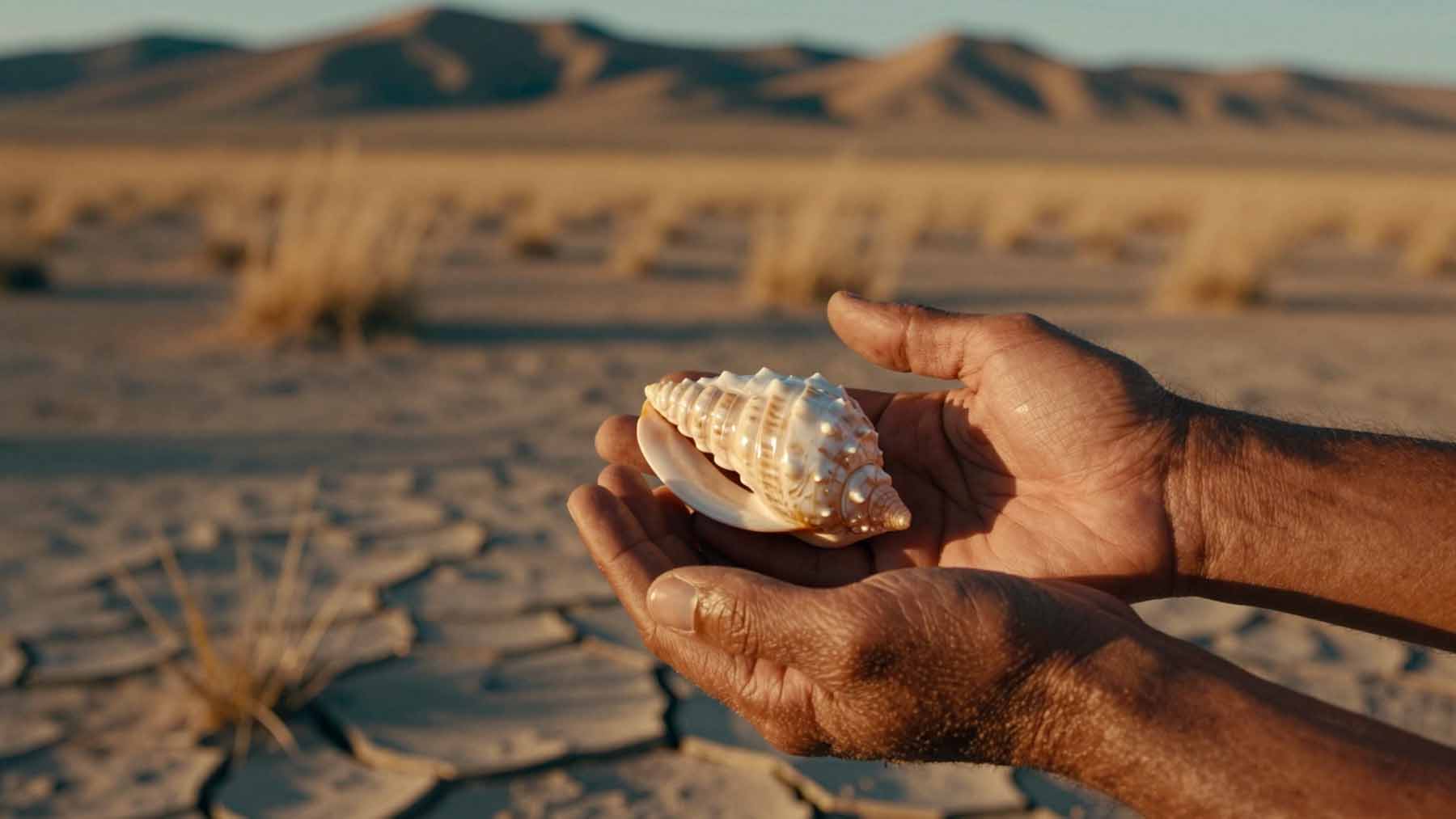
At two archaeological sites in inland California, researchers found something that didn’t fit: beads carved from the shell of the giant rock scallop, a creature that lives below the tide line along the Santa Barbara Channel — hundreds of miles away. The animal is hard to reach, and its shell is notoriously difficult to shape. Whatever moved these objects so far from the sea, it wasn’t chance.
A bead that shouldn’t be there
Turkey Flats and Lichtenstein are both inland California sites, far from the Santa Barbara Channel — the natural habitat of the giant rock scallop. The distance alone raises questions, but the animal’s biology makes those questions sharper. Giant rock scallops live below the tide line, putting them out of easy reach even for skilled coastal harvesters. Once collected, their shells present another obstacle: thick, dense material that resists shaping.
That combination — hard to harvest, hard to work — meant finished beads were never common. Rare by definition. In the ancient world, rarity tends to carry meaning, and an object that costs real effort to produce doesn’t travel hundreds of miles by accident.
The oldest bead of its kind
Radiocarbon dating placed the Turkey Flats bead at approximately 8,500 years ago, making it the oldest giant rock scallop shell bead ever identified. The number stands on its own. Archaeologist Barry A. Price of Applied EarthWorks, Inc. puts it in a wider frame, though.
“It’s cool that this is the oldest of its kind identified so far,” Price said, “but cooler still to view it as part of a broader Early Holocene cultural landscape seemingly well-established in this locale as much as 10,000 years ago.”
Radiocarbon dating works by measuring the decay of carbon-14 in organic material. Because the decay rate is predictable, researchers can calculate how long ago a living organism died. Applied to shell, it tells us when the scallop was harvested — and roughly when the bead entered circulation. At 8,500 years old, this object predates most of what people typically picture when they think of organized trade.
Five thousand years of tradition
The second bead, from the Lichtenstein site, dates to 3,674 years ago. Set that beside 8,500, and the gap — more than five millennia — becomes the real story. These weren’t isolated finds. The crafting and trading of giant rock scallop shell beads persisted across generations, through cultural shifts, across landscapes that changed around them, according to Phys.org.
That kind of continuity suggests the beads carried lasting social weight. Among the Chumash, Salinan, and Yokuts peoples of the region, researchers believe these objects functioned as markers of high status. Something communities kept producing and exchanging for thousands of years wasn’t casually decorative — it held meaning that each generation chose to preserve and carry forward.
Isotopes trace the shells’ origins
To figure out where the shells came from, researchers used isotope analysis — a technique that reads the chemical signature a material absorbs from its environment. Water temperature, salinity, and local geology all leave traces, and those traces vary by location, letting scientists narrow down a shell’s geographic origin with reasonable precision.
The Turkey Flats shell pointed to southern California. The Lichtenstein shell pointed to central or southern California. Both results are consistent with the Santa Barbara Channel region — the known range of giant rock scallops along this coastline. The shells didn’t come from somewhere unexpected. They came from the coast and moved inland, far inland, by human hands.
A trade route stretching hundreds of miles
Barry A. Price’s leading hypothesis is direct: “There’s a more-than-reasonable chance the beads were manufactured on the Channel Islands and moved northward via networks of trade that could have extended hundreds of miles.” The Channel Islands fall within the scallop’s habitat range and have a well-documented history of bead production among Chumash communities.
Price also considers an alternative. People from the Channel Islands or the Santa Barbara coast may have carried the beads inland as personal ornaments — objects worn on the body rather than exchanged through formal trade networks. Either way, the implication holds: people were moving across vast distances, maintaining relationships, carrying objects of value with them.
What these two small beads reveal is a California that was anything but isolated 8,500 years ago. Communities were connected, goods moved, and social meaning traveled with them. The full shape of that world is still being mapped — and each find like this one adds another point to the picture.
Read the whole thing?
Get the week's signal, not the noise
Our sharpest reporting on energy, climate and nature — free, once a week.