There are signals in the forest you’ve never seen.
They’re not sounds. Not scents. Not movement.
They glow.
Not in a way your eyes can detect—but in a way that other animals might read instantly, like a message written in light.
For years, scientists suspected something like this existed.
Now, they’ve finally found it in the wild.
So what exactly is sending these hidden signals?
How nature hides entire layers of communication
Animals don’t rely on just one sense to survive.
They use combinations—sound, smell, movement—to send and receive information constantly.
But there’s a limit to what humans can perceive.
We see only a narrow band of light. Beyond that, entire layers of the natural world remain invisible to us.
Ultraviolet light is one of them.
Many animals can detect it.
And for some, it plays a role in communication that we’re only beginning to understand.
Because what looks ordinary to us… might look completely different to them.
A familiar animal with a hidden trait
The discovery didn’t happen in some remote, unexplored region.
It involved an animal most people already know well.
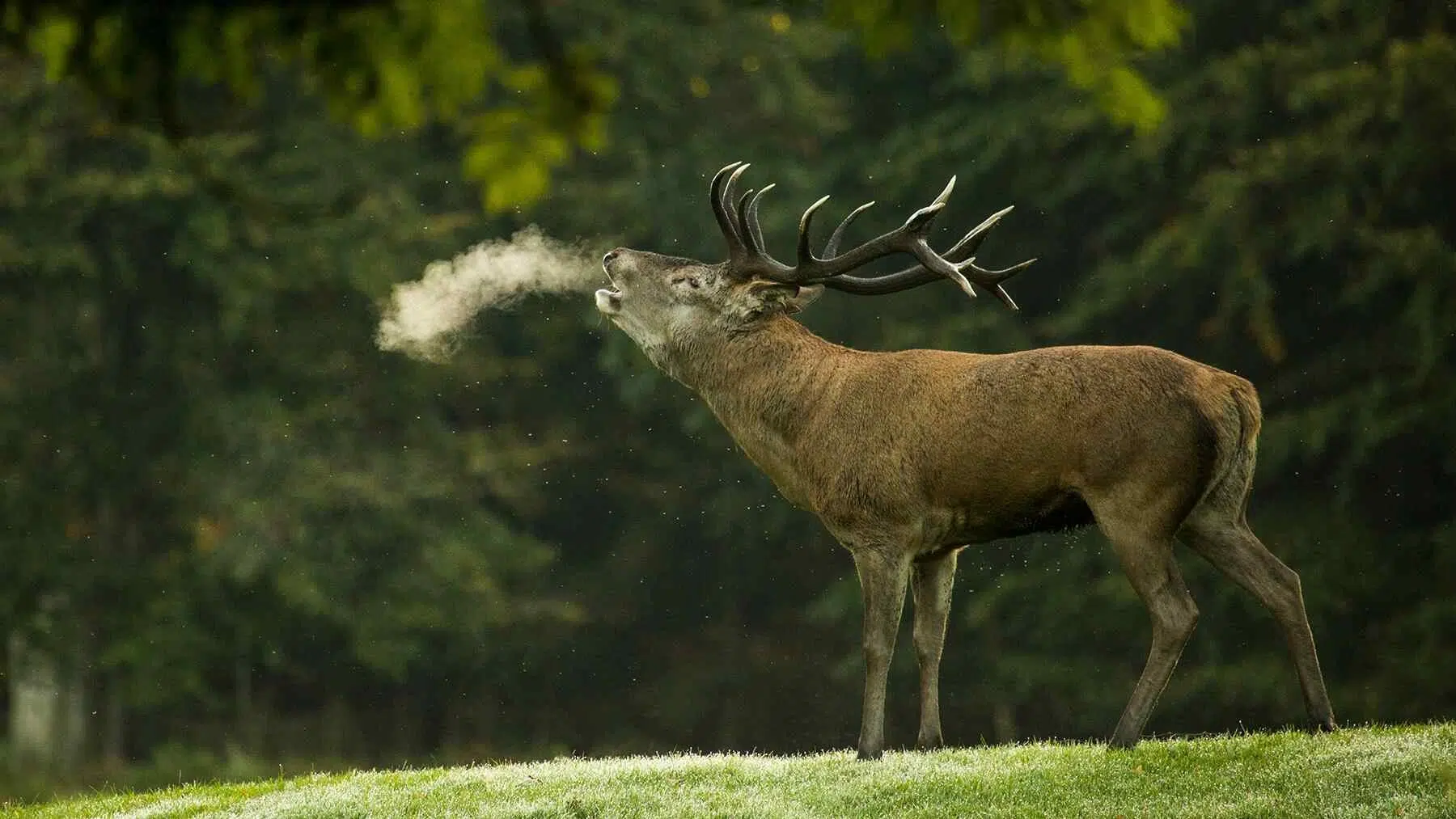
The white-tailed deer.
Common across North America, it has been studied for decades. Its behavior, diet, and movement patterns are well documented.
Or so it seemed.
Researchers began focusing on a specific part of the deer’s body—the tarsal glands on its legs, known for scent marking.
That alone wasn’t unusual.
But then they asked a different question.
What if scent wasn’t the only signal being sent?
What scientists saw when they changed how they looked
To test the idea, researchers examined deer fur under ultraviolet light.
The kind of light humans can’t see—but many animals can.
What they found was unexpected.
The study “A glow up in deer communication” published by the University of Georgia says that parts of the deer’s body began to glow.
Not faintly. Not subtly. Brightly.
The fur emitted a vivid blue fluorescence, especially on the legs and forehead. Areas that come into frequent contact with trees and vegetation.
These are also the same areas deer use to mark territory.
At that point, the pattern started to make sense.
What appears invisible to us may act as a visible signal to other animals.
A message left behind.
The glowing message hidden in plain sight
The “glow” is caused by natural chemicals and oils in the deer’s fur.
When exposed to ultraviolet light, these substances fluoresce, producing a bright blue color.
To humans, it only appears under special conditions.
But to animals capable of seeing UV light, it could be visible in everyday environments.
That means deer may be leaving visual markers as they move through the forest.
Not just scents—but light-based signals.
Paths. Presence. Territory.
A form of communication layered on top of everything we already know.
And one we’ve completely missed until now.
Why this discovery changes how we understand animal behavior
This finding suggests something larger.
If deer use fluorescence as part of their communication, other species might as well.
The natural world could be filled with signals we simply don’t perceive.
It’s not that they’re hidden. It’s that we haven’t been looking in the right way.
Researchers are now exploring how widespread this phenomenon might be, and what role it plays in survival, mating, and navigation.
Then entire ecosystems may be interacting in ways we’ve never fully understood.
A reminder that nature still operates beyond our view
The white-tailed deer hasn’t changed. What changed is how we looked at it.
And that shift revealed something simple but powerful.
Nature is not limited to what we can perceive.
There are messages all around us—written in forms we don’t recognize, using signals we don’t detect.
And every time we expand our ability to see, we uncover another layer of that hidden world.
In this case, it wasn’t a new species.
Just a familiar one… glowing in a language we’re only beginning to notice.
Read the whole thing?
Get the week's signal, not the noise
Our sharpest reporting on energy, climate and nature — free, once a week.