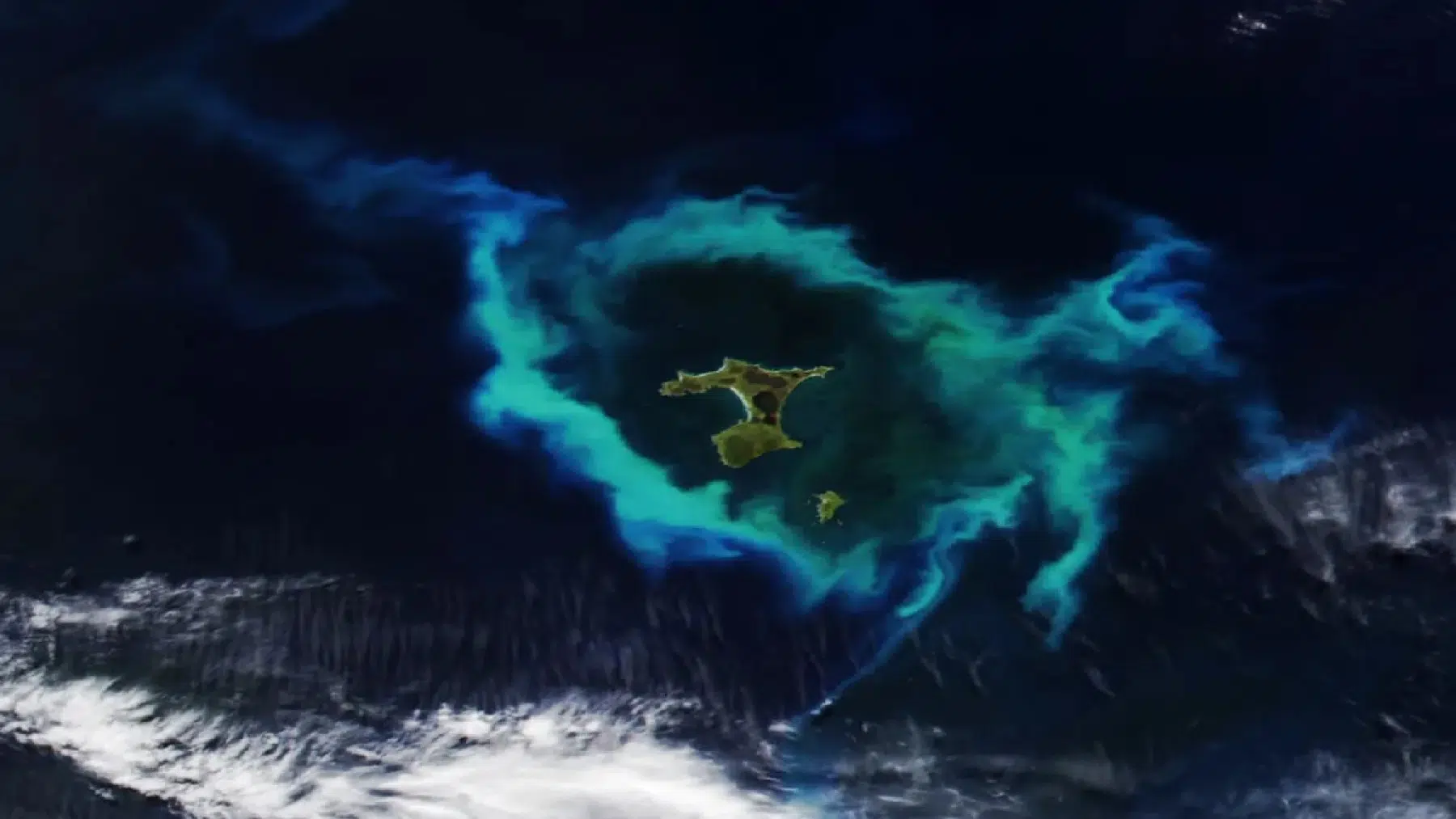
A satellite image taken on January 10, 2026, shows a luminous ring of plankton encircling the Chatham Islands — a remote Pacific archipelago about 520 miles east of New Zealand’s South Island. The circular bloom, one of the largest observed there in recent decades, was captured by the NOAA-20 satellite and stretches far enough to be visible from space with the naked eye.
What’s driving it? An underwater plateau hidden beneath the surrounding ocean. But that same submerged structure carries a far darker legacy — one that has made these islands the site of the deadliest whale strandings ever recorded.
A bloom visible from space
The NOAA-20 image from January 10, 2026, shows something that looks almost too symmetrical to be natural — a bright, circular halo of phytoplankton wrapping around the Chatham Islands like a luminous crown. The bloom consists primarily of coccolithophores, photosynthetic plankton that encase themselves in microscopic plates of calcium carbonate. That reflective armor is what makes them so visible from orbit.
The image was captured using a near-infrared filter, which likely enhanced the bloom’s vivid appearance. Even so, NASA’s Earth Observatory confirmed this wasn’t purely a technical artifact — the bloom would have been clearly visible to the naked eye from space. That’s a meaningful threshold, placing this event among the largest and most visually striking blooms observed around the Chatham Islands in recent decades.
The hidden plateau fueling the glow
The bloom doesn’t appear by accident. Beneath the surrounding ocean lies the Chatham Rise — a shallow underwater plateau stretching up to 900 miles from the east coast of New Zealand’s South Island. It functions like a submerged ramp, deflecting cold, deep water upward toward the surface.
That upwelled water carries dense concentrations of nutrients. During summer months, warmer seasonal currents move in and mix with this cold, nutrient-rich layer, creating a near-perfect growing environment for phytoplankton — sunlight, warmth, and a sudden surge of dissolved nutrients converging at once.
The ecological consequences extend well beyond the bloom itself. Phytoplankton form the base of the open-water food web, filling a role roughly equivalent to plants on land. That foundational productivity has made the Chatham Islands a marine biodiversity hotspot — penguins, albatrosses, seals, sea lions, and commercially significant populations of cod and lobster all depend on this system. The plateau, invisible from the surface, quietly sustains one of the Southern Ocean’s most productive ecosystems.
Where whales come to feed — and sometimes die
At least 25 species of cetaceans are drawn to these waters, according to New Zealand’s Department of Conservation. Orcas, sperm whales, and pilot whales all feed here, exploiting the same biological richness that supports the rest of the food web.
But the shallow waters generating these blooms also create a hazard for large marine mammals. Groups of cetaceans can become disoriented in the shallows, drifting too close to shore and becoming trapped as the tide recedes. Without human intervention, stranding is often fatal.
The Chatham Islands have seen this play out repeatedly — and at catastrophic scale. In October 2022, nearly 500 pilot whales were euthanized after washing ashore over roughly four days. That event, though devastating, doesn’t even hold the record. In 1918, more than 1,000 pilot whales are believed to have died after stranding there — still the deadliest cetacean stranding event in recorded history.
Pilot whales are especially vulnerable because of their social structure. A single injured or disoriented individual can pull an entire pod toward shore. The bonds that help them survive in open water become a liability in the shallows.
An archipelago of abundance and extinction
Cetaceans aren’t the only animals to have met an untimely end here. The Chatham Islands were once home to at least eight endemic bird species, all now extinct — among them the Chatham penguin (Eudyptes warhami). Most disappeared within a relatively narrow window, roughly 150 to 200 years after the islands’ first human settlers arrived from Polynesia in the 15th century.
The pattern is familiar from island ecosystems worldwide: isolation produces extraordinary biological richness, and that same isolation leaves species acutely exposed when circumstances shift.
What makes the Chatham Islands unusual is how starkly both forces remain visible today. The underwater plateau that drives one of the ocean’s most spectacular plankton blooms also creates the shallow, disorienting conditions that have killed whales in numbers unmatched anywhere on Earth. The same nutrient cycles sustaining penguins, seals, and albatrosses once supported species that no longer exist.
A glowing ring captured by satellite is, in one sense, a straightforward story about oceanography — cold water, warm currents, algae finding the right conditions to flourish. It’s also a reminder that the forces shaping an ecosystem don’t distinguish between abundance and risk. The Chatham Rise builds and concentrates life. It also, under the right circumstances, ends it. That tension doesn’t resolve neatly — it continues, season after season, beneath the surface of a very remote stretch of ocean.
Read the whole thing?
Get the week's signal, not the noise
Our sharpest reporting on energy, climate and nature — free, once a week.