
Pull up a piece of old carpet and it looks like it should be simple to deal with.
It is mostly fiber, often the same nylon used in clothing and fishing nets.
But turn it over.
On the back is a thin pale layer that looks like dried glue, and that is close to what it is: a styrene butadiene latex loaded with powdered calcium carbonate, cured hard and bonded to everything above it.
So why can no standard line get past it?
Why a thin coat of glue beats a standard sorting line
The thermoplastic parts of a typical carpet, the nylon or polyester face fiber and the polypropylene backing fabric, are recyclable in principle. The trouble sits between them. That adhesive is a mixture of calcium carbonate and styrene butadiene rubber, cured in place rather than melted, and standard lines are built for materials that sort by density or soften at a known temperature, which a mineral filled cured rubber does neither of those things.
Separation means pulling the face fiber away from the backing, then dealing with the adhesive and whatever grit has settled into the pile over years of use. Published processes describe softening the latex with steam or water, tearing the face fiber out with brushes and serrated rolls, or passing the fiber mixture through hydrocyclones that separate solids by specific gravity. That is purpose built equipment, not something a general waste facility already owns.
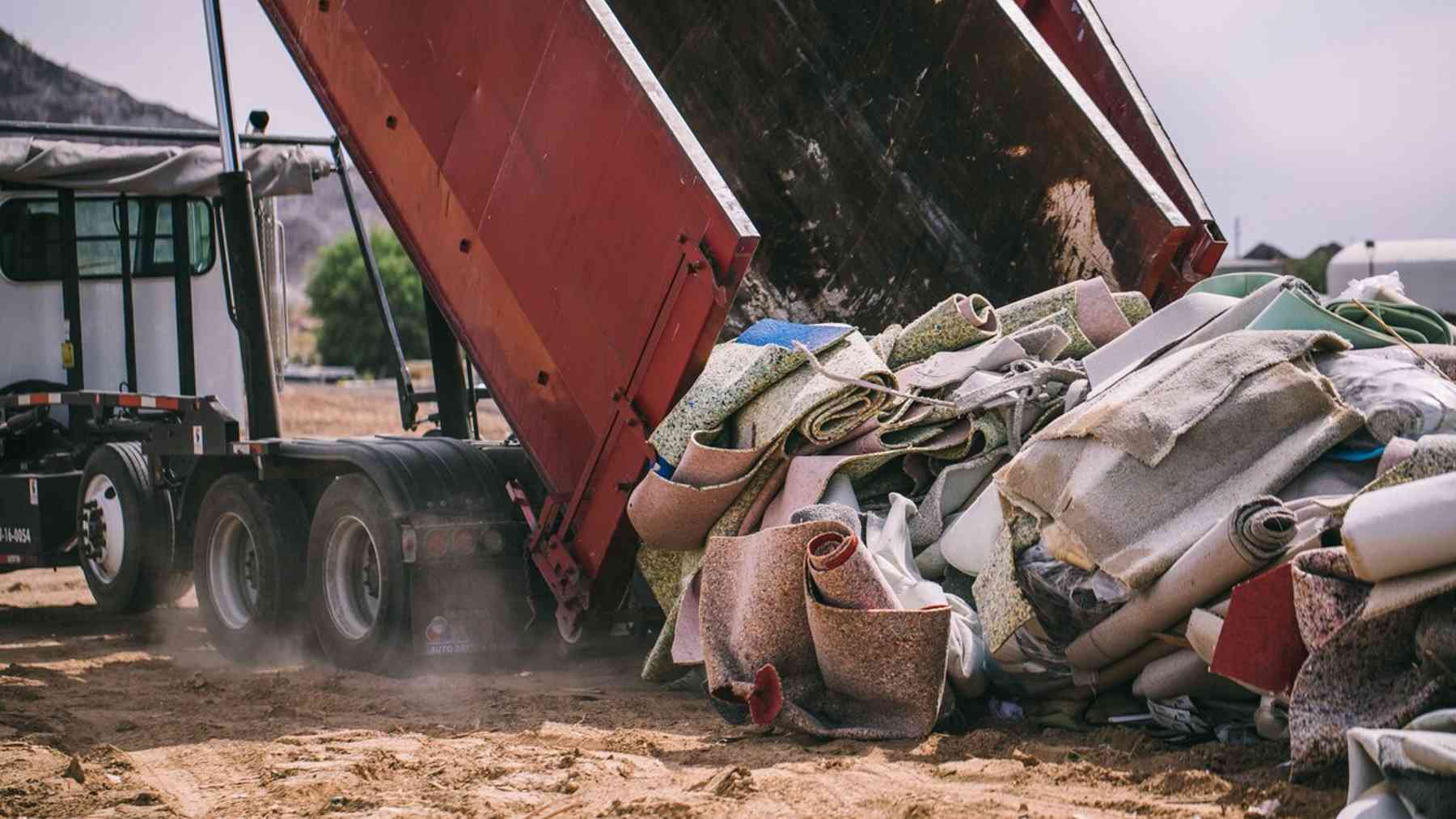
So across most of the country the whole roll goes into the ground intact. The nylon a homeowner imagines being remade into new carpet is, in most places, never separated at all.
What the carpet under your feet actually contains
Most carpet is roughly 20 to 50 percent face fiber by weight, the remainder being backing materials and the adhesive that attaches fiber to backing. That adhesive coating can account for 40 to 50 percent of total weight, and about four fifths of it is filler, usually calcium carbonate. The sellable material is a minority of what arrives on the tipping floor.
The adhesive is styrene butadiene rubber, the same family of synthetic rubber used in tires. Latex systems dominate because they are applied at high production rates and give good fiber to backing adhesion and tuft bind strength. Every property that makes latex useful in a living room makes it a problem in a processing shed.
And the scale is hard to picture. Federal estimates put US generation of carpets and rugs at 3.4 million tons, of which 73 percent was landfilled, roughly 5 billion pounds buried in a single year. It stays there for decades, because conventional nylon is not biodegradable.
The numbers behind the gap
The national carpet recycling rate is low and stubborn. Recycling of carpet fiber, backing and padding came to 310,000 tons, or 9.2 percent of carpet generation, with another 17.8 percent combusted for energy recovery. A national recycling agreement signed in 2002 set a goal of 20 to 25 percent within a decade. Nine rolls in ten are still not recycled.
California passed the first carpet stewardship law in the country, and its program reports very different numbers. The latest annual report to state regulators puts the recycling rate at 37 percent, with 78.5 million pounds collected and 86 percent of that material actually recycled. Revenue comes from the floor itself: an assessment of about $1.05 per square yard on broadloom and $1.49 on carpet tile, reduced by nine cents for products carrying at least 10 percent certified post consumer content.
That revenue funded grants totaling nearly $1.77 million in a single year. The program’s executive director called the result encouraging “despite the global economic headwinds experienced across all recycling sectors.” Recyclers have now collected more than 1.3 billion pounds of old carpet in California since the program started.
Where the fiber goes when it does get out
Most recovered carpet is downcycled rather than turned back into carpet. The bulk is mechanically shredded and pelletized into engineered resins for automotive parts, construction products and carpet backing. Nylon 6 recovered from carpet can be regenerated into new fiber of equal quality, but getting material that far is the hard part.
Reuse sidesteps the latex problem entirely, because a carpet sent to a school gym never needs to be separated at all. In California, 3.5 million pounds of carpet was sent for reuse in a single recent year, more than four times the amount four years earlier. That is still a small slice of the stream, but it is the cheapest slice to move.
Calcium carbonate stripped from the backing is itself a saleable filler, which is why processors chase it alongside the fiber. The same logic shows up in diaper recycling, where recovered materials feed industrial buyers, and in programs targeting glass recycling, which close loops locally rather than shipping low value material far.
What would actually change the number
The deepest fix is not a better machine but a different carpet. Patent literature notes that the dissimilar polymer of latex systems, together with the inorganic filler, reduces recyclability, and some in the carpet industry have sought replacements. Polyolefin systems such as EVA and low density polyethylene are cheap and need no cure. The market has not switched.
Short of a redesign, the California model is the most documented path: a per square yard fee collected at the point of sale, paid into a fund that subsidizes equipment no individual processor can justify alone. The program ended its most recent reporting year with 174 public drop off sites, fifteen more than twelve months earlier.
The program’s operator calls that 37 percent a level not matched anywhere in the world. It still leaves nearly two thirds of the state’s discarded carpet unrecycled, and the latex layer has not been solved. But the gap between 9 percent and 37 percent is wide enough to make the mechanism visible, and a visible mechanism is usually the beginning of a fix.
Read the whole thing?
Get the week's signal, not the noise
Our sharpest reporting on energy, climate and nature — free, once a week.


