

Photovoltaic developers typically make an early call when deciding on the type of mounting system for a field of solar panels.
Some projects move the entire row of panels as the sun crosses the sky.
Others keep the rows stationary and allow the sun to move over them.
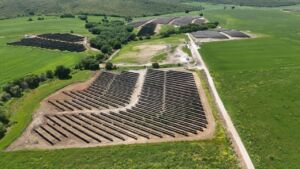
This particular site is doing both.
Engineers developing this solar farm have opted to develop two separate types of structures on the ground.
Thousands of solar panels sit atop those structures.
Why most solar farms choose one structure
A motorized solar tracker adds a number of additional components to a solar panel installation, including motors, bearings, a control system and ongoing maintenance.
While this increases the total amount of energy generated per unit area of land, it also increases the overall cost of installing and maintaining a solar array.
However, a fixed rack does not produce as much electricity as a tracker does because it cannot adjust its angle to optimize the amount of sunlight falling on the solar cells during the daylight hours.
Most projects choose one or the other. The Athamas project has chosen neither.
The layout of this project consists of about 65% single-axis trackers and 35% fixed structures, providing a hybrid approach that balances increased production against increased capital and operating expenditures.
The project also relies on back-contact solar technology.
Instead of running across the front of the cell, the electrical contacts are moved to the back.
That allows for a greater percentage of the solar cell to receive sunlight.
Inside the Athamas and Mykonos projects
These agreements cover two utility-scale photovoltaic farms.
Almyros contains the larger plant, and Farsala is home to the smaller one.
Together, the two projects represent 81.66MW of capacity using 125,280 modules.
Athamas is the larger project at 45.51MW and the biggest solar farm yet developed by Faria Renewables.
Athamas is currently scheduled to connect in 2026.
Mykonos is expected to follow shortly in 2027.
Each of the two facilities will utilize Hi-MO 9 modules provided by LONGi.
Faria Renewables is responsible for developing, constructing and owning each facility.
The electrical tie-in for each of these projects will be significant.
Athamas will provide power directly into the national transmission network via two medium voltage lines and a dedicated high voltage substation.
Why the numbers do not tell the whole story
Utility-scale renewable energy projects often involve disputes related to how much actual electricity was produced compared to how much was theoretically possible given the size of the installed capacity.
Weather, heat and seasonal conditions all affect output.
Just because an array includes a tracker does not mean it will produce more electricity than an equivalent non-tracking array.
The difference in production must equal or exceed the difference in cost to justify adding a tracker.
Athamas appears to be a response to exactly that uncertainty.
Instead of maximizing trackers or minimizing them, the developer chose a compromise.
What the project says about the next phase of Greek solar
Archaeologists uncovered burial monuments dating to Greece’s Archaic period before development began.
Excavation, documentation and preservation work continued alongside the energy project under archaeological supervision.
One looked backwards at history. The other looked forward at generating clean energy.
Athamas is projected to generate about 80 million kilowatt-hours annually.
That level of annual generation equates to enough electricity to serve approximately 16,000 homes and avoid approximately 50,000 metric tons of CO2 emissions annually.
The generation figures matter. The structure underneath them may matter more.
For many years, there has been debate among developers concerning whether fixed arrays or trackers represent the superior method for optimizing solar energy production.
Which combination yields the best results?
Read the whole thing?
Get the week's signal, not the noise
Our sharpest reporting on energy, climate and nature — free, once a week.


