The seafloor a few miles off Block Island, Rhode Island, is mostly sand.
Sand does not suit a black sea bass.
Sea bass need something hard: a ledge, a wreck, a rock pile where a crab can hide and a small fish can shelter from whatever is bigger than it.
Then, in the middle of that flat open bottom, five steel towers appeared.
What grew on them changed the bottom underneath.
What the steel does that sand cannot
A bare steel leg lowered into the ocean becomes a surface in a place that had none. On the Block Island foundations, federal monitoring found that every submerged section of the jacket foundations was completely encrusted by mussels and associated species. Blue mussels dominated along the full vertical extent, with hydroids, algae, sponges and anemones present at lower coverage.
The column fills in layer by layer, like a reef that no geologist planned. Mussels and barnacles cluster near the waterline, filter feeding arthropods occupy intermediate depths, and anemones settle in the darker lower reaches. Dense white rows of shell build sheltered gaps at every level.
This process is called biofouling, the same force that clogs boat hulls and pier pilings. On a foundation it builds a vertical ladder of habitat. Predators such as sea stars, moon snails and crabs, as well as numerous fish, were drawn to the structure and its epifauna. Each rung attracts something that eats it, and something that eats that.
Five towers, 61 species
The Block Island Wind Farm, five turbines located about three miles southeast of the island, was the first offshore wind farm in the United States. The catch recorded around the project spanned 61 species of fish. Butterfish, little skate and scup were among the five most abundant species every year, and longfin squid accounted for roughly 52 percent of all invertebrates collected.
The comparison with unaltered sand is more modest than the fish list suggests. Structure oriented species such as black sea bass and Atlantic cod increased measurably after turbine installation. Common species showed no clear response either way. The turbines did not empty the bottom around them; they changed a small part of it.
The bass that nobody invited
Scientists compared catches near the turbines with catches at similar places outside the project area. The only meaningful effect they found was positive: far more black sea bass congregating around the wind farm, most likely because the species gathers near physical structures. More Atlantic cod turned up too, but not often enough to draw firm conclusions.
The work behind that finding was long. A bottom trawl survey covered baseline years, construction and early operation across seven seasons, designed by local fishermen and scientists as a before after control impact study. It collected nearly 664,000 individual fish representing 61 species. In the two years of highest abundance, schooling species such as butterfish and Atlantic herring accounted for more than 74 percent of the annual catch.
An increase in black sea bass abundance around the foundations was observed between years two and three of operation. Acoustic work has since suggested turbines can aggregate fish at scales up to hundreds of feet, with effects beyond that range sporadic. The bass were not stocked or seeded; the steel simply gave them somewhere to be.
The trawl study also found the results were statistically significant only for structure oriented species. Common sandy bottom species showed no measurable shift, which tells researchers the effect is real for bass and cod rather than a product of sampling noise.
Where the reef effect has limits
Drew Carey, an author of the trawl study and head of the consultancy that ran it, told the Boston Globe the results were encouraging and reassuring, with the caveat that this is a small project. “It doesn’t tell you what 100 turbines are going to be like.” Five foundations are a proof of concept, not a blueprint scaled to every coastline.
The effect is also tightly local. Clear changes to seabed sediments and faunal composition appeared only in the immediate footprint of the foundations, inside roughly 300 feet of the structures. Far field changes in benthic conditions were not evident. Researchers studying floating turbines in European waters have documented the same basic pattern, where structures supply mussel habitat at offshore sites that otherwise lack hard substrate.
What happened here is also a substitution rather than a simple addition. Four years after installation, the footprint had shifted from sandy habitat to habitat characterized by mussel aggregations, sediment fines and changed faunal communities. A non indigenous colonial tunicate was observed on the foundation and on the mussels themselves. Artificial reefs can carry trade offs, and whether more fish at a turbine means more fish overall or fish drawn from elsewhere remains open.
What a steel leg becomes over time
The mussel layer is not decoration. Mussels strain phytoplankton and suspended particles from the water and send much of what they take to the bottom. Modeling has estimated that biofouling mussels can raise benthic organic matter deposition by half at distances of up to about three miles from turbines. That continuous organic input reshapes the chemistry of the sand beneath.
Mussels also fall. Shell litter dropping from the foundations may provide habitat for other species and can be carried to areas further from the structures. Within the footprint of one turbine, mussel aggregations estimated at up to 20 inches deep developed on the seabed and the foundation grate, a bed of shell where there had been bare sand.
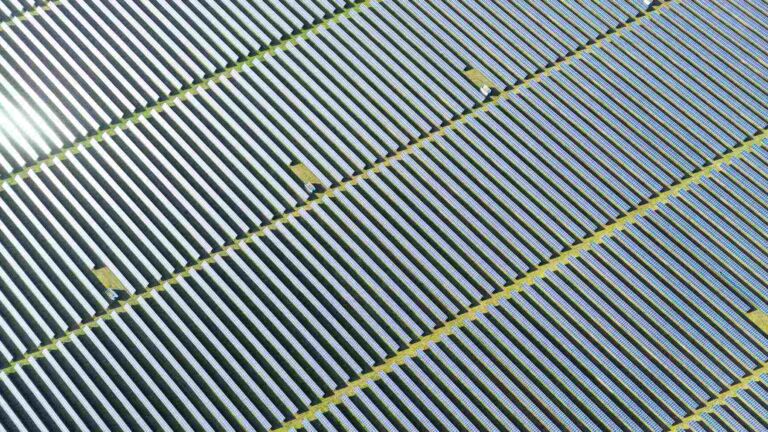
An Illinois solar site offers a rough analogue on land, where monitoring found frogs and butterflies using ground that had recently been industrial. The Block Island foundations do something structurally similar underwater: they hand an animal a surface it did not previously have, then stand there while the animal decides what to make of it.
The colonization is uneven. In the fourth year of monitoring, one turbine carried mussel cover of about 18 percent while two others sat near 50 and 58 percent. The reef the engineers never drew is real, patchy, and so far confined to the ground it stands on.
Read the whole thing?
Get the week's signal, not the noise
Our sharpest reporting on energy, climate and nature — free, once a week.