
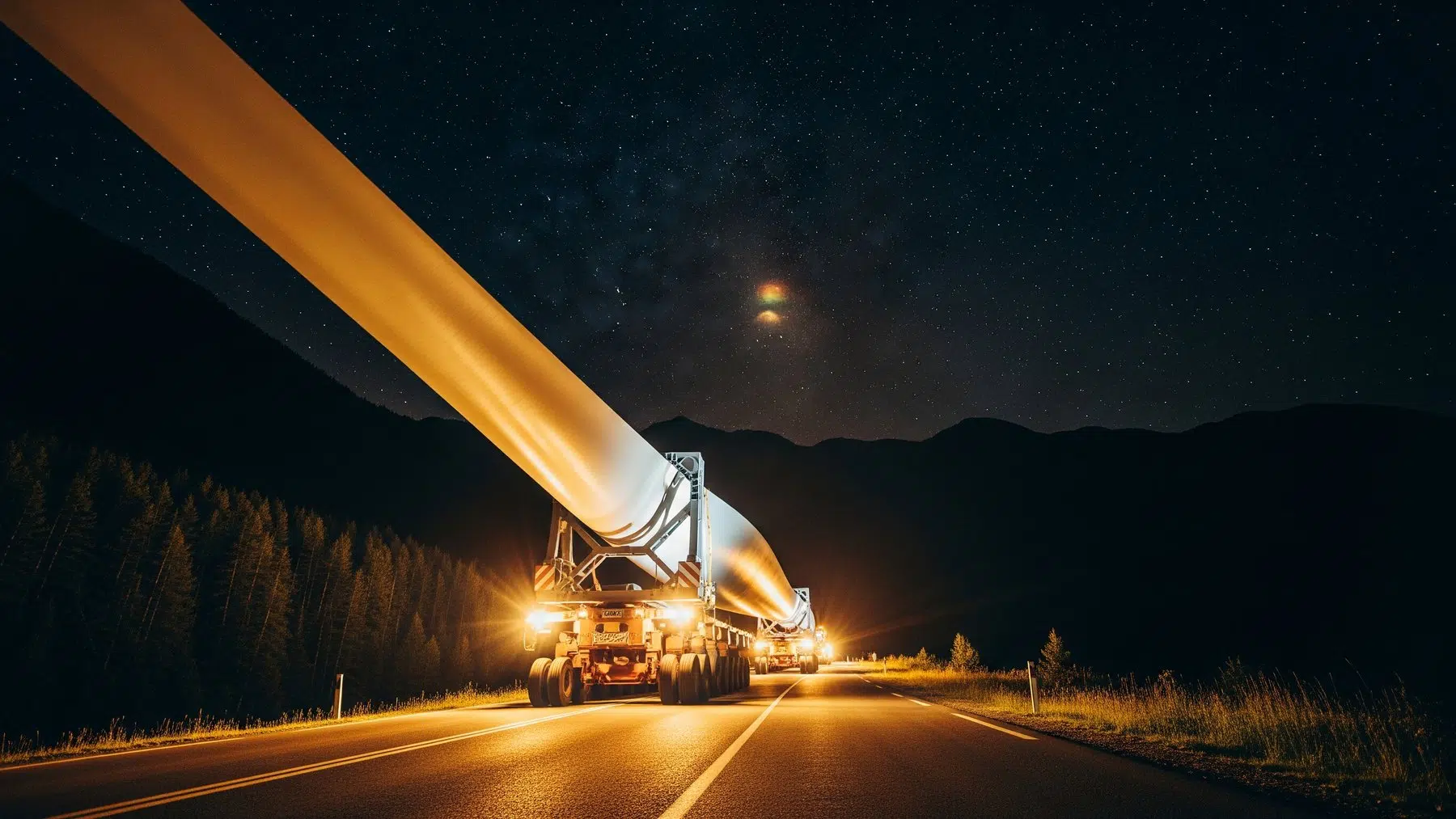
Picture a single white object longer than a jumbo jet, strapped to a flatbed and inching through a sleeping Colorado mountain town at 2 a.m. while a police escort holds every light on green. It moves no faster than a jogger. It takes all night to cover a distance you could drive in twenty minutes. And it is only going to get bigger, heavier, and harder to move, until the answer someone has finally built changes far more than the road.
The road was always the real ceiling
Wind turbine blades have been growing for decades, and for most of that time the roads kept up. Engineers learned to widen loads, reroute convoys around tight bridges, and slip through small towns in the dead of night.
But the road network was always the invisible ceiling on how big a blade could be. In most of the world, onshore blades stop near 70 meters, and that limit comes not from physics or blade engineering but from transportation.
Every extra meter added to a blade means another bridge surveyed, another overpass measured to the centimeter, another small town corner where the truck has to mount the curb just to turn.
An oversize load unlike anything on the highway
The convoys that carry these blades across America are feats in their own right. Permits, police escorts, and route surveys can take months before a single wheel rolls.
Hauling a 70 meter blade already backs up traffic for miles. Whole roads have to be closed, farmland is sometimes crossed to dodge narrow country lanes, and escorts ride along because of the sheer width and weight of the load.
In the United States, anything wider than 8.5 feet needs a special state permit just to move. A single blade convoy can bend the rules of an entire highway for hours, and as rotors grow, the cost of escorts, surveys, and shifting signs and structures near ramps climbs fast enough to kill projects in the windiest regions.
The blades the roads can never carry
Offshore wind already runs blades longer than 100 meters, because barges and ships shrug off the limits that roads impose. But the best wind on land, the high plains, the mountain ridges, the remote prairies, sits nowhere near a port.
That is the trap. The places that need the biggest turbines most are exactly the places the biggest blades can never reach by truck.
So a Colorado company called Radia looked at that wall and decided the answer was not a bigger truck. It was a bigger airplane. Its WindRunner is built to be the largest cargo aircraft ever made, sized to carry blades past 100 meters straight to a remote site and land on nothing more than an 1,800 meter strip of packed dirt or gravel.
The part the engineers did not fully plan for
Here is the turn that has almost nothing to do with aviation. Moving blades by air does more than solve a logistics puzzle. It hands whole landscapes back to the animals.
Every oversize convoy that grinds through a remote valley today rides on roads that fractured habitat for elk, pronghorn, and nesting birds long before a single turbine turned. A blade that arrives by air over a simple gravel strip needs none of that: no new road cut through grassland, no convoy lights flooding a prairie at 3 a.m. and scattering birds off their eggs.
The migration corridors that an elk crossing is built to stitch back together are, in this version, never cut in the first place. The aircraft can reach rough, remote strips no other heavy lifter can use, CNN reported, opening ground that road transport was never going to serve.
When the world runs out of road
The heavy haul industry is not going away. Blades, transformers, and mining machines are the bones of a modern country, and those loads will keep crawling through the darkest hours. But the logic that forces them onto the road is starting to crack.
Bigger turbines also mean cheaper power. Onshore wind costs have fallen about 70 percent since 2009, largely because the machines grew taller and the blades grew longer, Columbia researchers reported in 2025. Radia hopes to fly the WindRunner on sustainable aviation fuel one day, and is targeting a first flight in 2029.
The same tension runs under every oversize convoy still grinding past at walking pace. The midnight crawl through the mountain town may, before long, become a relic of a world that simply ran out of road, and the prairie it once lit up at 3 a.m. may never hear it coming again.
Read the whole thing?
Get the week's signal, not the noise
Our sharpest reporting on energy, climate and nature — free, once a week.


