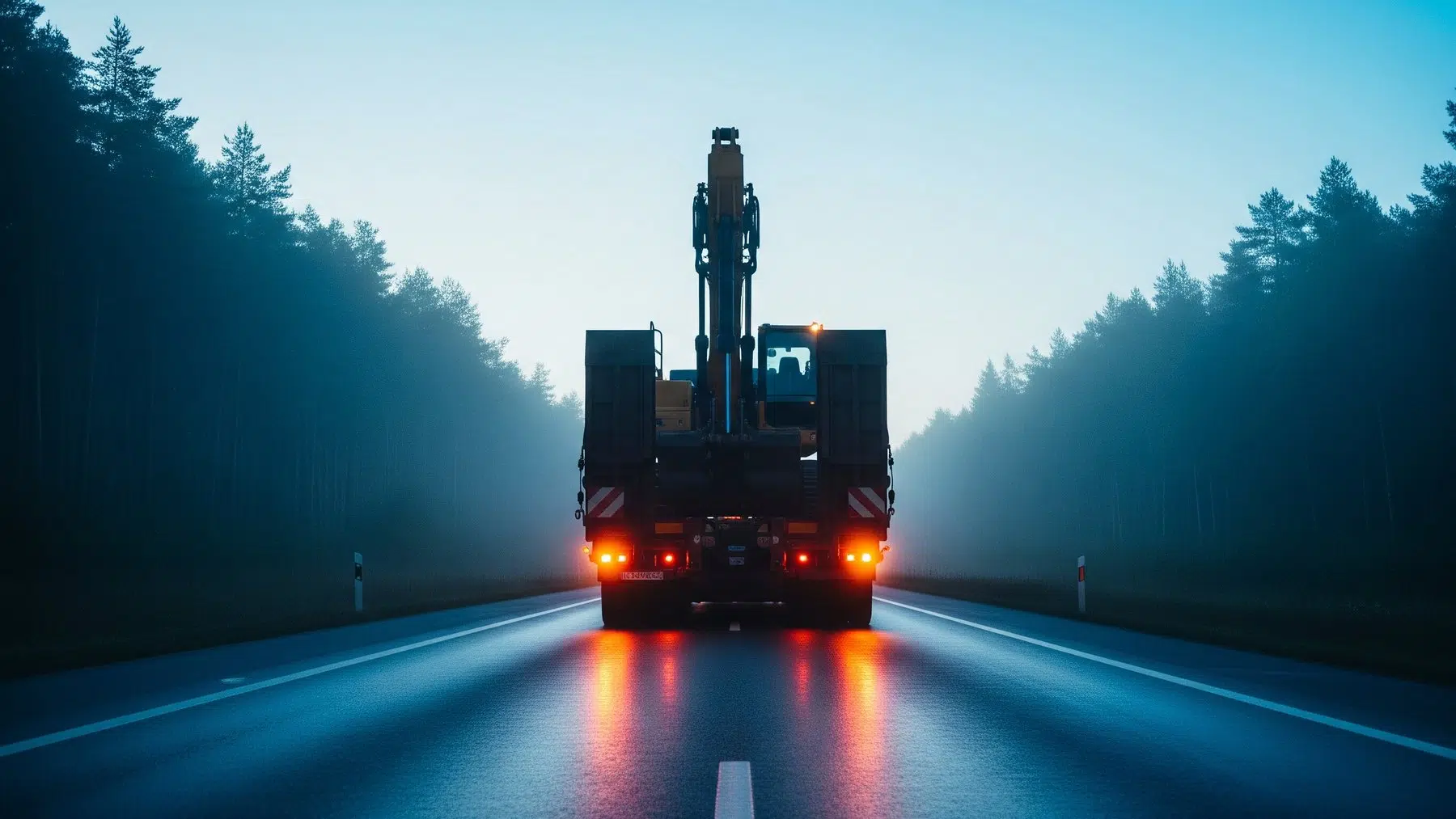
You have probably seen one. A wall of flashing amber lights ahead, a pilot car nudging traffic to a crawl, and then the thing itself rolling past, a machine so vast it seems to belong to a different scale of reality. Most drivers grip the wheel and wait. Almost nobody wonders what happens to the road after it goes. The answer turns out to be one of the stranger stories in modern road ecology.
A machine that rewrites the rules of the road
Moving a giant excavator or a mining machine across public highways is not like moving anything else. These loads can weigh well over 100 tons, and the only way to stop them punching through asphalt is to spread that weight across a train of axles as long as a city block.
So carriers add trailer after trailer, each one carrying a slice of the burden, and the convoy ends up moving at walking pace, usually before sunrise, shepherded by escort vehicles and timed around low bridges. It is engineering theater, oddly beautiful if you let yourself look.
But the part that matters here is not the machine at all. It is the empty space the machine leaves around it, and what comes out of the dark to use it.
The hours nobody drives are the hours everything changes
To move a machine that big, planners do something drastic: they essentially close the road. Oversize convoys are routed in the dead of night, often between midnight and dawn, with whole stretches of highway cleared of ordinary traffic.
That closure, meant purely for safety and logistics, does something the engineers never planned. It opens a dark, empty corridor through a landscape that is otherwise never still.
Roads hurt wildlife in two ways, by striking animals directly and by blocking their movement, and many creatures avoid the verges entirely to stay clear of people. Remove the traffic, even briefly, and that calculus flips. In a study of temporary road closures in Banff National Park, wildlife on the road doubled during the closure while staying flat in nearby reference areas. The animals were waiting for a gap.
The road as a wall, and the wall as a wound
For most creatures living alongside American highways, the road is not a surface. It is a barrier. Of all the structures people have laid across the land, roads carve up habitat the most widely and the most harmfully.
Scientists estimate the United States road system affects the ecology of at least one fifth of the country’s land area. That is an almost unimaginable slice of the continent, divided by asphalt and speed.
Every year about one to two million collisions with large animals happen on American roads, causing roughly 26,000 human injuries, 200 deaths, and nearly 8 billion dollars in damage. Every patch of forest split by an interstate is a population cut off from mates, from food, from the territory it needs. The road keeps dividing even when nothing is on it. Except, briefly, it does not.
The convoy that became an accidental wildlife crossing
Here is the wonder hiding inside that slow, lumbering parade. An oversize load convoy is, in ecological terms, a moving road closure, and a moving road closure is one of the most powerful tools road ecologists have found for letting nature breathe.
Researchers have shown that limiting human use during set hours can raise habitat quality for wildlife while the road still serves people the rest of the time. The giant machine rolling through at 3 a.m. drags an envelope of stillness behind it.
Deer, foxes, black bears, and mountain lions have all been documented stepping onto the road the moment ordinary traffic vanishes, the same instinct that makes a purpose built elk crossing work. An empty highway is an invitation written in asphalt, and the science of temporal road closures shows it with striking clarity.
What the convoy leaves behind
The heavy haul industry is not going away. Wind turbine blades, transformer units, mining machines, the infrastructure of a modern country runs on moving enormous things, and those moves will keep happening through the darkest hours of the night.
So road ecologists are asking a new question: could the nighttime windows already cleared for oversize loads be mapped against known wildlife corridors, so the closures fall exactly where animals need them most? It is the same instinct reshaping how a city reacts when a self driving car rolls through a nesting site. Matching closures to migration timing could turn an industrial necessity into an ecological gift.
The convoy will keep crawling through the dark. The amber lights will keep blinking. And somewhere just off the shoulder, in the tree line the headlights never quite reach, something is standing very still, watching the road go empty, and then, for a few careful minutes, crossing it.
Read the whole thing?
Get the week's signal, not the noise
Our sharpest reporting on energy, climate and nature — free, once a week.