Treasure hunters know that X always marks the spot. In this case, China’s latest treasure is a two-headed monster in the ocean, and X marks the spot where the monster is located, also known as OceanX. The two-headed monster has finally found its way to its final location and is bound to shock some people with its strange effects. Some have called it pioneering, while some have called it highly unlikely. This is what we know about China’s OceanX.
X marks the spot of China’s OceanX
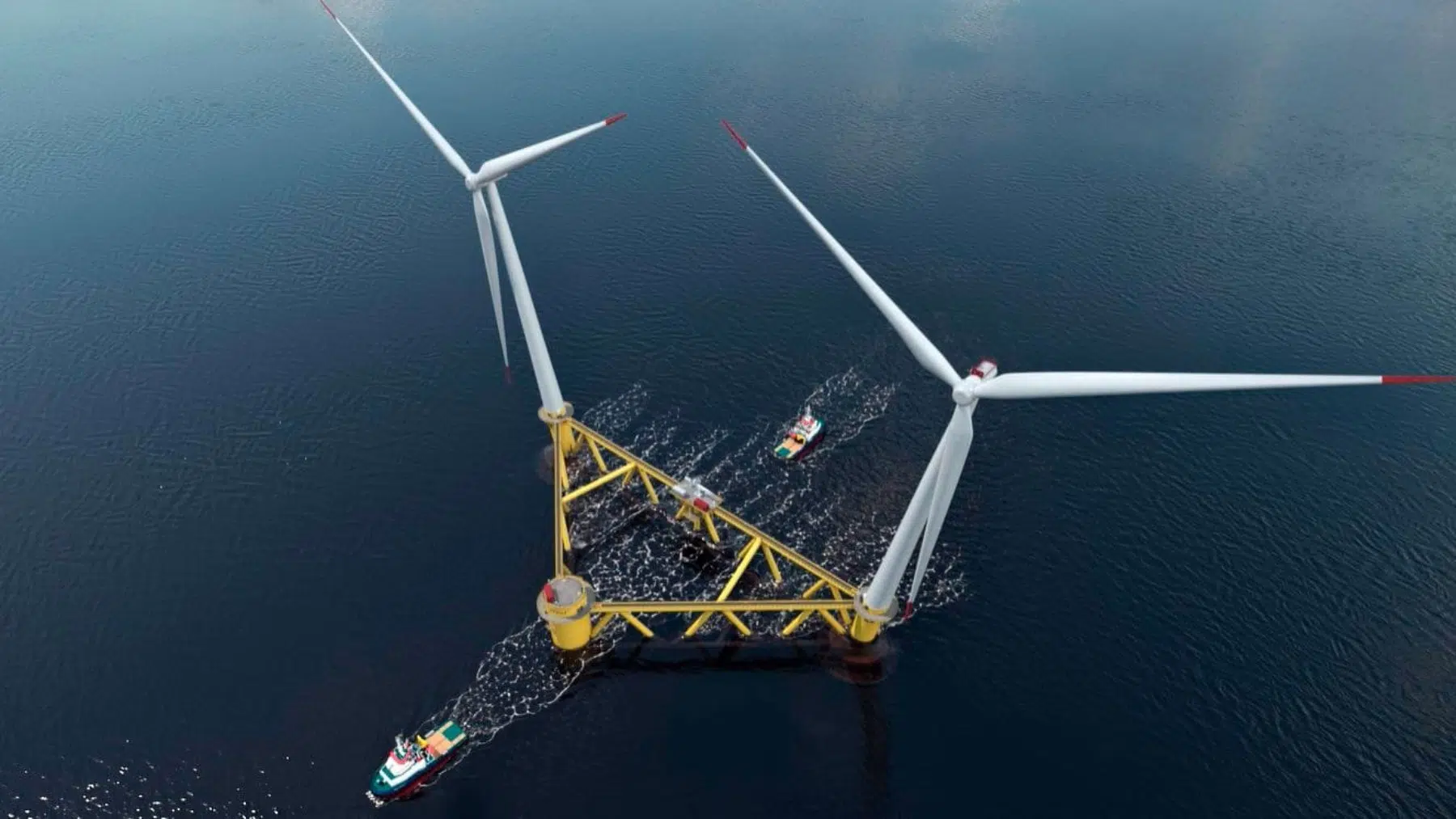
Chinese company Mingyang Smart Energy Group is the country’s biggest private wind turbine manufacturer. Mingyang created the world’s biggest single-capacity floating wind turbine platform, OceanX. The ‘two-headed monster’ traveled 191 nm (220 miles or 354 km) from its building site in Guangzhou, China, to its final location, which can be spotted at the Qingzhou IV Offshore Wind Farm in Yangjiang, Guangdong.
According to a report by Sergio Fdez Munguía from Windletter, OceanX must still undergo much development before it becomes a commercial reality, however, the full-scale prototype is a major step in the right direction. Mingyang is confident that the prototype will succeed, as it is ‘an exceptional engineering piece‘ and its strange effect might even shock some.
The breakdown of OceanX and its power
This two-headed monster must not be taken lightly – literally! OceanX is quite heavy, especially for an offshore wind farm installation. The platform has two MySE16.6(T) wind turbines (hence why we call it a two-headed monster) with three blades. Each blade has a diameter of 597 ft (182 m), and the whole floating platform collectively weighs 15,000 tonnes and can anchor in water over 115 ft (35 m) deep.
The entire platform performs differently compared to traditional turbines because it operates downwind, automatically turning to face away from the breeze for optimal energy capture. As mentioned, the platform has two turbines, and its dual rotors have caused quite a stir. A partnership between Mingyang, Huangpu Wenchong Shipbuilding Company, and China State Shipbuilding Corp led to the design of the dual-rotor, which can produce a combined 16.6 MW of power — significantly more than the 2.5 to 3 MW output of a single traditional offshore wind turbine.
The ‘strange’ effects of OceanX
Mingyang reported the strange effects of OceanX. The platform is allegedly capable of resisting winds of up to 161 mph (260 km/h), a condition categorized as a Category 5 hurricane or typhoon. The platform’s single-point mooring and downwind position enable the rotors to bend without striking the supporting platform, which is designed to survive harsh winds and dangerous seas.
Its unique dual-rotor design and robust construction allow it to operate in conditions that would cause significant problems for traditional wind turbines. This ‘strange’ ability is significantly helpful for areas prone to hurricanes or typhoons, such as Yangjiang, Guangdong, as widespread power outages are usually the result and can create dangers that extend far beyond inconvenience. Food safety, medical needs, vulnerable groups, and public health all suffer without electricity.
It seems China’s two-headed monster is truly a treasure after all. We sincerely hope that the prototype produces the expected results that Mingyang is confident about. OceanX can become revolutionary in harvesting wind as renewable energy and may potentially save lives in natural disaster zones, should it become a commercial reality. Remember, X marks the spot the next time you open up your Google Maps or GPS, and if you are lucky, you might be able to steal a glance at this magnificent two-headed monster.
Read the whole thing?
Get the week's signal, not the noise
Our sharpest reporting on energy, climate and nature — free, once a week.