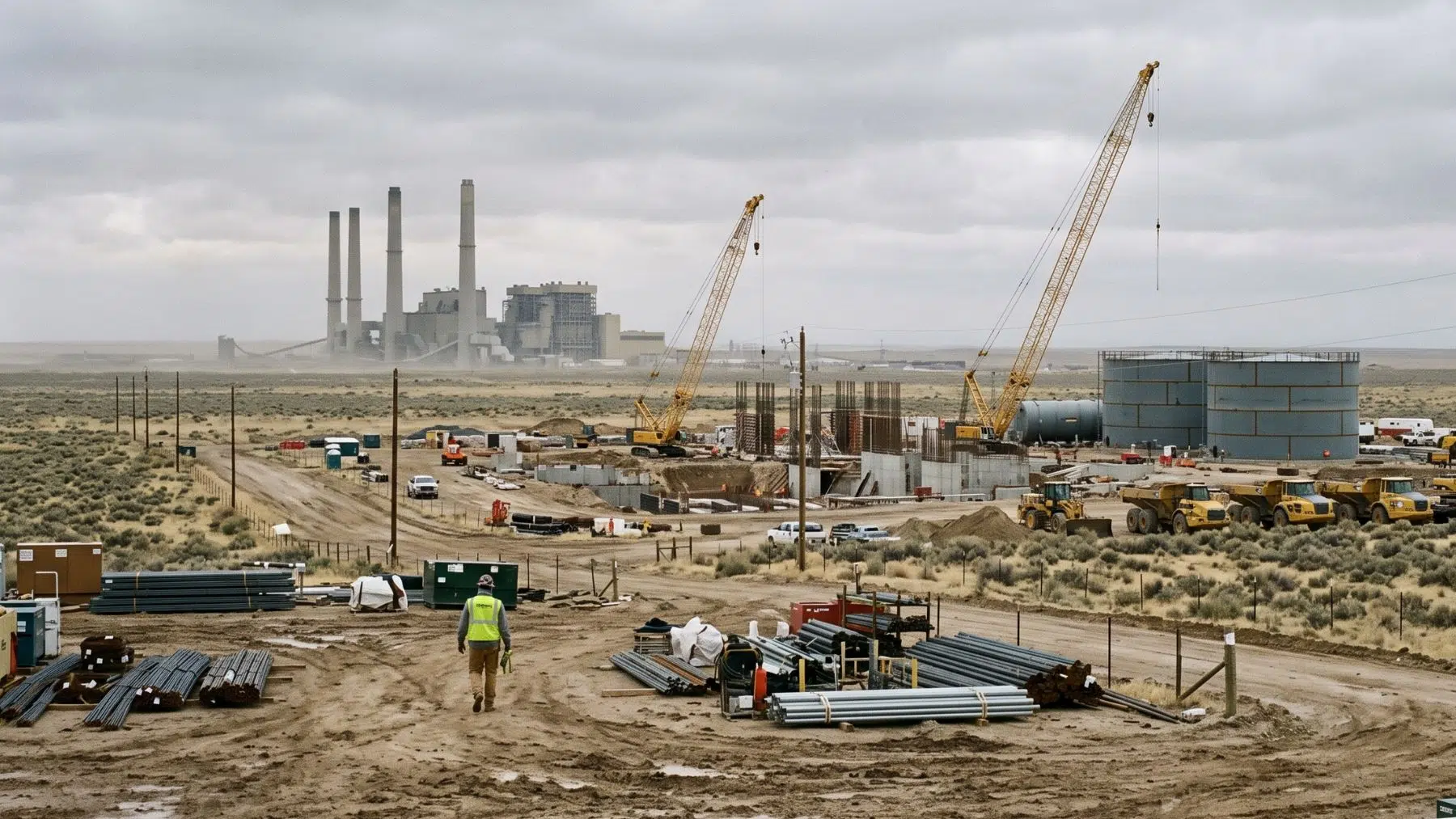
In Kemmerer, a small town in southwest Wyoming, the coal era is slowly ending.
For generations, a nearby power plant burned coal to light the region.
Trains of coal fed its furnaces for the better part of a century.
Now that plant is winding down, and something stranger is rising beside it.
The new machine runs on liquid metal instead of water.
It will store its energy in a giant tank of hot molten salt.
And it can flex its output up and down like a battery.
For a town built on coal, it is a leap into the future.
The old and the new now stand side by side on the same plain.
A town built on coal becomes a nuclear first
Kemmerer is home to only about 2,600 people.
Right next door sits the Naughton plant, which burned coal for decades.
Its stacks are a familiar sight on the wide Wyoming horizon.
As that coal plant retires, a company called TerraPower is moving in.
The firm was founded by Bill Gates to build a new kind of reactor.
Its plant here is named Kemmerer Unit 1, after the town itself.
It is the first advanced reactor of its kind to break ground in the country.
The builders chose a coal town on purpose.
The workers, the grid lines, and the know how were already in place.
A community that knew energy work would not have to start from scratch.
The reactor that runs on liquid metal
Almost every reactor running today is cooled by ordinary water.
That water has to sit under crushing high pressure to keep from flashing to steam.
The Natrium reactor takes a very different path.
It borrows an idea first tested in reactors decades ago.
It uses liquid sodium to carry heat out of the core.
Sodium is a soft metal that melts into a flowing silver liquid.
It can run blazing hot while staying near normal air pressure.
That removes the need for a giant dome to hold back steam.
The whole system can run hot and calm at the same time.
Engineers see the swap as a simpler cooler design.
A tank of salt that acts like a battery
The reactor makes heat around the clock, day and night.
But the grid does not always need that power right away.
So the plant sends the extra heat into a huge tank of molten nitrate salt.
The salt soaks up the warmth and holds it like a thermos.
Nothing is lost while the plant waits for the right moment.
When demand spikes, that stored heat is released on command.
It boils water, spins extra turbines, and pours out more power.
In effect, the reactor charges and discharges like a giant thermal battery.
That flexibility is exactly what the modern grid craves.
Wind and sun come and go, and this reactor can fill the gaps.
The numbers behind the promise
The scale of the plan only lands once the figures come out.
On a normal day, the reactor produces 345 megawatts of power.
When the grid screams for more, the salt lets it surge to 500.
That extra headroom is stored heat, not extra fuel in the core.
It can hold that 500 megawatt burst for more than five hours.
The whole project carries a price tag near four billion dollars.
About half of that comes from the Department of Energy.
In March 2026, it won the first construction permit the country has ever granted a reactor like it.
Ground was broken in 2024, with first power aimed at 2030.
Each step has landed as a milestone for the whole nuclear industry.
The coal workers and what must still be proven
For Kemmerer, the biggest promise is jobs.
Building the plant will take about 1,600 workers at its peak.
Running it afterward will need around 250 permanent staff.
Many of those roles fit the skills of former coal and power crews.
An operator who ran a boiler can be retrained for a turbine hall.
Still, a first of its kind machine carries real unproven risk.
The special fuel it needs has been hard to secure.
Cost and schedule on nuclear projects have a long history of slipping.
Whether this one holds its budget will shape what gets built after it.
Like the towers of an offshore wind farm, the payoff arrives only years later.
It is the same long bet as a fox pushed off its den by solar panels, a gain today weighed against a cost tomorrow.
In the end, for a town that ran on coal, the reactor is a daring second act.
Read the whole thing?
Get the week's signal, not the noise
Our sharpest reporting on energy, climate and nature — free, once a week.