Colorado’s iconic peaks are stripping bare.
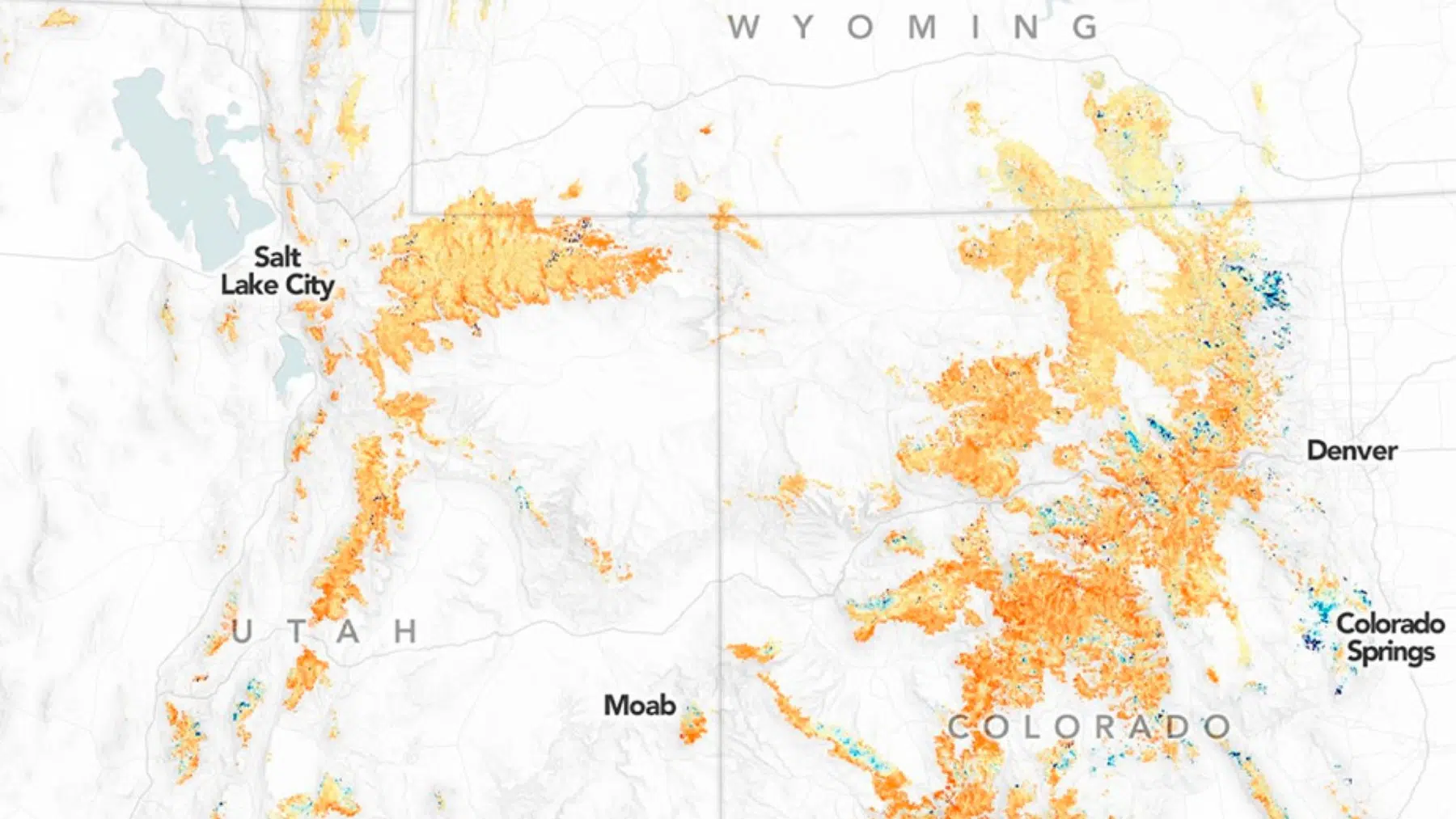
NASA satellites reveal massive, brown scars where deep snow should be.
Western reservoirs are hitting dead-pool levels, threatening power grids and food supplies.
But this year’s snow drought is not simply about storms that were missing.
A high-altitude anomaly is defying standard climate models.
Warmer weather conditions changed the snowpack at exactly the wrong times.
What extremely rare phenomenon is causing this snow drought?
How low can you go: A Colorado mystery that has now been explained
NASA researchers were tracking the Upper Colorado Basin when they noticed something alarming.
Snowpack levels crashed 30% below historical averages in weeks.
Peak runoff arrived 30 days early, effectively ‘stealing’ summer’s water.
Especially in the western part of the nation.
The snow didn’t just melt; it vanished via sublimation and record-fast runoff.
Satellite observation revealed a startling truth.
Snow cover shrank to record lows across the western United States.
Researchers discovered a ‘warm snow drought’. This is where it rains instead of snows even at high elevations.
They were melting differently. This raised a profoundly important question.
What was causing this new and unexpected reality in Colorado?
Drop it like it’s hot: Extreme warmth transformed winter storms in Colorado
NASA researchers quickly realized much of the West was experiencing a “warm snow drought”.
Which can happen when precipitation temperatures stay warm for too long.
This reduced the timeframe for lasting snow accumulation on the mountains.
In some Western states, the snowpacks were disappearing months earlier than normal.
The issue in Colorado became especially worse during March of this year.
A significant heatwave in the Colorado Basin shattered temperature records.
According to NASA experts, the basin experienced its warmest March on record.

Snow cover rapidly melted as the heat arrived.
But was this climate change? Or something else entirely?
Climate change is affecting every part of the world.
From the oceans warming at an alarming rate, to the Colorado snowpacks simply vanishing.
Fresh snow has an albedo of 0.9, reflecting 90% of solar energy. But fewer rainstorms meant that the snow was aging.
Dust-on-snow events and ‘old’ snow grains absorb solar radiation, accelerating melt by 50%.
Which accelerates melting even further. Faster melting exposed open ground far earlier than normal.
But rising temperatures alone could not explain what was happening in Colorado.
Something else was at play.
What it was has been explained by environmental experts at NASA.
A forecast that calls for chaos: a rare phenomenon that only happens every 1,000 years
NASA identified a climate dipole: a seesaw of extreme atmospheric pressure.
The agency has the technology to study the Earth far more extensively than ever before.
NASA’s technology pointed in one direction: an extremely rare atmospheric pattern called a western U.S. dipole.
This phenomenon only takes place around every 1,000 years or so. It traps intense heat over the western parts of the nation.
The East is experiencing something else completely as arctic air plunges into those parts of the country.
A rare pattern that disrupts storm tracks for months at a time
This dipole merged with ‘The Blob’—a massive Pacific marine heatwave.
sudden stratospheric warming (SSW) disrupted the polar vortex, locking the heat in place.
That combination would have a profound impact on the West of the nation.
Climatologists believe this unique and rare overlap of conditions led to the snowpack melting early.
This 1,000-year event isn’t just a fluke; it’s a preview of the ‘new normal’ for 2050.
Colorado has astonishing natural beauty that defies the norms.
But its snow system is feeling the effects of a rare combination of extreme events.
If 1,000-year events are now happening in a single decade, are we witnessing a rare anomaly?
Or a permanent rewrite of the American West?
Read the whole thing?
Get the week's signal, not the noise
Our sharpest reporting on energy, climate and nature — free, once a week.