

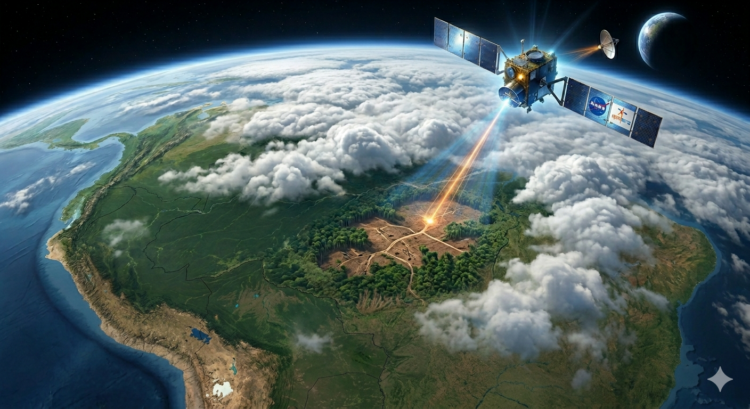
Every year, roughly 10 million hectares of tropical forest disappear — an area about the size of Kentucky. But satellites often don’t catch it in time. Thick cloud cover blankets these regions for most of the year, and in some areas months pass before a clear image can be captured. By then, cleared land may have already begun to regrow, erasing the evidence entirely.
NASA scientists have now developed a fundamentally different way to detect that destruction — one that doesn’t wait for the clouds to part.
The cloud problem that blinds conventional satellites
Optical satellites like Landsat have monitored Earth’s forests for more than 50 years and remain the backbone of modern forest tracking. Brazil built one of its first satellite-based systems on Landsat data in 1988, and that system is still running today. The imagery is detailed, intuitive, and highly accurate — when conditions cooperate.
They almost never do. Optical sensors capture reflected sunlight, which means clouds render them useless. In tropical regions, overcast skies are the norm, and some areas go months without a single usable image.
That gap carries real consequences. Cleared land can begin regrowing within months, effectively erasing signs of illegal logging before any satellite gets a clean look. Africa Flores-Anderson and her team at NASA’s Marshall Space Flight Center set out to close these blind spots — not by waiting for clearer skies, but by switching to a wavelength that ignores them entirely.
L-band radar: seeing through clouds and debris
Synthetic aperture radar operates on a fundamentally different principle than optical imaging. Rather than capturing reflected sunlight, SAR instruments emit their own radar signals and measure what bounces back. No daylight required. No clear skies needed.
Earlier radar-based monitoring efforts relied on C-band wavelengths, which were more widely available — but C-band carries a significant limitation. Its shorter wavelengths scatter off treetops and the debris left behind when trees are felled: branches, leaves, trunks not yet removed. That scattering obscures the very evidence researchers are trying to find.
L-band radar uses longer wavelengths that cut through surface clutter and reach the ground, revealing damage that C-band misses. Flores-Anderson’s system is the first to automatically fuse Landsat optical imagery with L-band SAR data. The fusion runs through a Bayesian algorithm that requires multiple consecutive observations of forest loss before issuing a confirmed alert — a design choice that proves critical for accuracy.
Three months faster, with near-zero false alarms
The practical difference showed up clearly in a Brazilian Amazon pilot study. The combined method detected deforestation patches in January. Optical-only sensors didn’t flag the same clearing until April — a three-month lag that, in the context of illegal clearing, can mean the difference between intervention and a fait accompli.
Those results aren’t an outlier. On average, the system identifies felled trees within 16 days, and in heavily clouded regions it can outpace optical-only alerts by up to 100 days.
Requiring multiple consecutive detections from both sensor types also nearly eliminates false alarms — a persistent problem with single-sensor approaches that erodes trust in monitoring systems over time. For forest managers and enforcement agencies, reliability matters as much as speed. Sylvia Wilson, chief forest and climate scientist at Wilpa Capacity Development and a veteran of nearly two decades of global forest monitoring with the U.S. Geological Survey, is direct about it: “L-band SAR gives us the opportunity to see what optical doesn’t. But it’s not one sensor versus the other; the future is SAR plus optical.”
NISAR and the path to global coverage
There’s a straightforward reason this approach hasn’t already been deployed everywhere: L-band SAR data has historically been scarce. Coverage has been limited to select areas, with the Brazilian Amazon among the few places where researchers could consistently access it — a constraint that has prevented the method from scaling.
That’s about to change. NISAR — a joint satellite mission between NASA and the Indian Space Research Organisation — launched in July 2025. Once operational, it will deliver free, global L-band SAR imagery on a 12-day repeat cycle, converting a data-scarce resource into a globally available one.
Flores-Anderson’s system was built with this moment in mind. The algorithm is already designed to automatically ingest data from any sensor, optical or radar, as it becomes available. “It doesn’t matter which sensor we get data from — it automatically adds to our model,” she explained. “As more NISAR data become available, we will have more accurate, faster detection of change.” Tropical forests across Central Africa, Southeast Asia, and Central America — regions where cloud cover is equally persistent but monitoring infrastructure has lagged — could soon fall within the system’s reach.
What comes next
The launch of NISAR marks a turning point, but the real test comes as data accumulates and the algorithm begins operating at global scale. Researchers will be watching whether detection speeds and accuracy hold up across the varied forest types, clearing patterns, and cloud regimes found outside the Amazon.
If they do, the combination of L-band radar and optical imagery could become the standard for tropical forest monitoring worldwide — giving conservationists, governments, and enforcement agencies something they’ve never reliably had: a near-real-time view of what’s happening beneath the clouds.