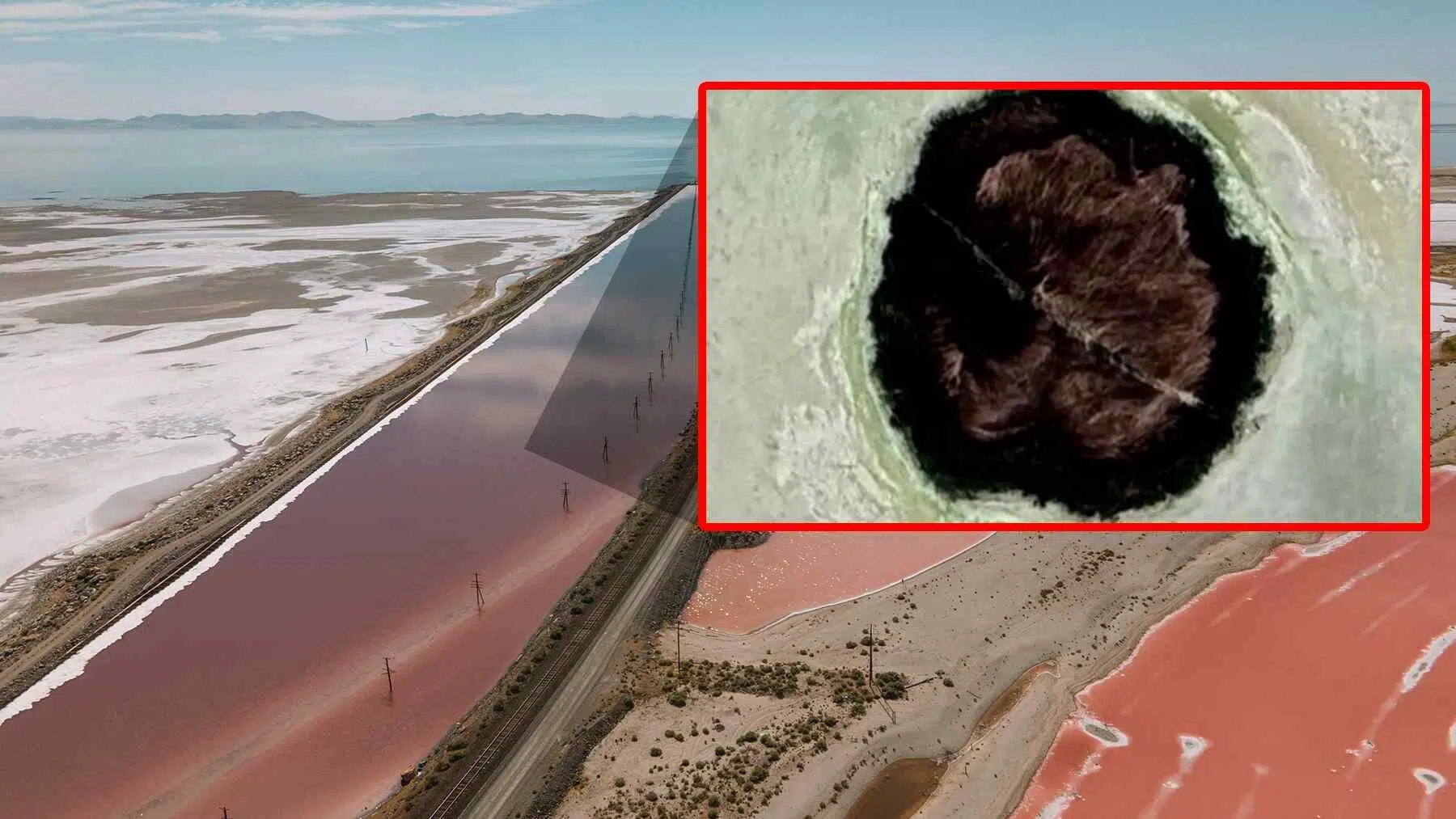
Pilots who were flying above Utah’s Great Salt Lake started noticing something strange spreading across the water.
Brilliant neon patches began bleeding across the water’s surface.
From above, the colorful formations looked like drifting islands scattered across the lake.
Satellites captured these stains expanding as water levels hit historic lows.
These were not landmasses, but ‘living’ structures visible from space.
Scientists discovered the lake was quietly revealing one of its oldest biological secrets.
What exactly had created these odd and unexpected colors?
How the alien landscapes of Utah’s Great Salt Lake have evolved
The Great Salt Lake has always behaved far differently from most lakes in America.
Its waters contain massive salt concentrations left behind from ancient Lake Bonneville.
It is a terminal lake, meaning water only leaves through evaporation, leaving behind 4.5 billion tons of salt.
That extreme salinity creates unusual conditions for life. Researchers found colorful formations spreading across different parts of the lake.
Some areas turned bright pink almost overnight.
Others shifted toward green, blue, or rusty red instead.
The changes appeared strongest near isolated sections of shallow water.
Water movement inside the lake plays a major role.
The Lucin Cutoff railroad causeway acts as a 20-mile dam, trapping salt in the north.
That separation restricts water flow between regions.
The North Arm is 10 times saltier than the ocean.
The South Arm stays green, dominated by Dunaliella viridis algae that thrive in 10–15% salinity.
This salinity gradient creates two distinct biological worlds separated by a rock wall.
Why these strange colors kept spreading through the Great Salt Lake
Scientists discovered the colors came from enormous microbial communities living inside the lake.
Different organisms thrive under different salt conditions. And these did not match any biological maps we know of.
That creates shifting patches of color across the water surface. Pink and red regions usually appear in extremely salty bodies of water.
In the hypersaline North Arm, salinity exceeds 25%, turning the water a ‘slaughterhouse’ red.
The color stems from Dunaliella salina algae and Haloarchaea, which use red pigments to photosynthesize.
The algae produce reddish pigments that protect them from intense sunlight and salt stress.
Certain halophilic archaea also contribute strong pink and red tones.
Green regions form under lower salinity conditions.
Those areas contain different algae communities, including Dunaliella viridis and cyanobacteria.

Blue sections often emerge where water becomes clearer, and salt concentrations shift once again.
Mineral content and sunlight reflection also influence those colors.
Researchers found the colorful formations constantly move around and evolve.
During drought periods, salinity rises.
That allows red and pink microorganisms to spread rapidly across large areas.
As the lake recedes, salt concentrates, pushing the green South Arm toward a permanent red shift.
University of Utah biologists warn in a report that this shift threatens the entire Great Salt Lake ecosystem.
The truth behind the “mystery islands” in the Great Salt Lake
The red, blue, green, and pink “islands” are not true islands at all.
And they certainly were not new landmasses emerging out of the water.
They are massive microbial blooms and mineral-rich microbial structures forming across the lake.
Some exist as floating algae communities.
The ‘islands’ are microbialites—living rock mounds built by billions of cyanobacteria.
These living systems contain a wide range of life and mineral deposits
These 3,000-year-old mounds cover 20% of the lakebed, forming the base of the food chain.
Their colors depend largely on salinity, sunlight, oxygen levels, and microbial competition.
Pink and red colors appear in hypersaline zones.
Green colors emerge where algae populations flourish under lower salt concentrations.
Blue regions reflect changing water chemistry, depth, and mineral composition.
These structures are modern versions of 3.5-billion-year-old fossils, the earliest evidence of life on Earth.
Scientists believe similar microbial communities existed billions of years ago on ancient Earth.
That means the Great Salt Lake may be offering a rare window into the planet’s biological past.
And every new color spreading across the surface could signal another shift inside that hidden microscopic world.
Read the whole thing?
Get the week's signal, not the noise
Our sharpest reporting on energy, climate and nature — free, once a week.