

Something has been moving through America’s rivers that most people would not recognize, and would probably not take seriously if they did.
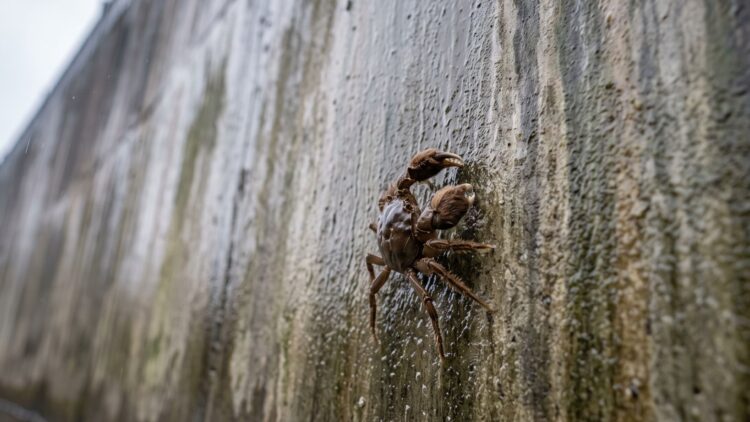
It looks, at first glance, like an ordinary crab.
But it has hairy, mitten-like claws, an almost supernatural ability to survive in nearly any water, and a habit of dismantling riverbanks from the inside out.
The story of how it got here, and what it is doing to the waterways Americans fish, swim in, and depend on for flood protection, is one of the strangest ecological dramas unfolding right now in plain sight.
A creature that wears its own disguise
Most invasive species arrive with fanfare: a python spotted in the Everglades, a swarm of Asian hornets on the news.
This one arrived in the holds of cargo ships, invisible as water itself.
The species is native to Chinese and Korean rivers, but humans spread it first to Europe, where it was officially documented in Germany in 1912, then to the West Coast of the United States, where it was first reported in San Francisco Bay in 1992, and later to the Northeast.
Mitten crabs probably traveled in the ballast water of ocean-going ships and may have been deliberately released from live markets in the Northeast.
Once in, they set up shop and started exploring upstream.
The Chinese mitten crab is catadromous: adults live in freshwater rivers for most of their lives, but migrate to brackish or salty water to breed, after which juveniles return upstream to grow and mature.
That two-world life cycle is part of what makes them so difficult to intercept at any single point.
It can climb walls, survive droughts, and steal your bait
Part of what makes this animal so hard to stop is how effortlessly it adapts.
While some freshwater crustaceans cannot tolerate even brackish salinities, the Chinese mitten crab functions equally well in freshwater or marine conditions.
The species thrives in rivers with winter temperatures as low as 5°C.
Crabs can survive up to 35 days in wet meadows and at least 10 days in burrows during a drought.
Even in captivity, it has escaped confinement by scaling walls up to 13 feet high, according to the U.S. Bureau of Reclamation.
They compete with native species for food and steal bait off anglers’ hooks, damaging traps in the process.
A single crab spotted picking apart a wire fish trap in the Hudson estuary sums up the problem neatly: it is opportunistic, strong, and not easily deterred.
They are, in short, almost impossible to discourage.
Where Americans are already finding them
The map of confirmed sightings has grown steadily and is now alarming ecologists who track waterway health.
Documented sighting locations include San Francisco Bay, the Hudson River, the Chesapeake Bay, and London’s River Thames, along with other major northern European waterways.
It is worth noting that Smithsonian researchers tracking the species report that no live crabs have been recorded in California since 2010, and the last confirmed East Coast record was from Chesapeake Bay in 2014, meaning established populations may be lower, or harder to detect, than once feared.
Then, in late 2025, something shifted the threat to a new level entirely.
Wildlife officials in Oregon captured a live invasive crab in the Willamette River, more than 150 miles from where the species had previously been recorded in the state.
Found roughly 150 miles from a sighting on the lower Columbia River near Astoria earlier that year, the first confirmed presence in the Pacific Northwest, the discovery was described as “concerning” by wildlife officials.
For ecologists, that word carries real weight.
A species crossing that kind of distance suggests an established corridor, not a stray individual carried by a single ship.
The mitten crab’s most destructive secret
Most people imagine a crab as a creature that scuttles along the bottom and eats scraps.
The Chinese mitten crab is something more unsettling: an engineer of collapse.
To escape predators and survive low tides, mitten crabs dig horizontal burrows into riverbanks.
In high-density areas, researchers have recorded up to 39 burrows per square meter.
These tunnels, up to half a meter long, weaken banks and make them prone to sudden collapse.
The burrowing also damages flood-control levees and smothers the gravel beds that salmon and trout depend on for spawning.
Think of an ordinary garden bed slowly leaching poison into soil: the damage is invisible until the structure gives way.
What happens next, and why it is not entirely hopeless
The most pressing question is whether the crabs have crossed from scattered sightings into true, self-sustaining populations across the country.
The ecological impacts of a large mitten crab population remain the least understood of all their impacts, which means the full cost is still unknown.
That uncertainty cuts both ways: the crabs may be entrenched in parts of Europe’s major rivers, but in newer territories like Oregon, early reporting can still make a real difference.
Scientists tracking other strange creatures in unexpected places have shown that environmental DNA sampling from river water can find a species before it becomes impossible to remove.
The mitten crab is not a monster.
It is simply a resilient animal doing exactly what evolution shaped it to do, in a world whose rivers it was never meant to reach.
Removal, once a population establishes, remains genuinely difficult, but awareness is the first step.
Right now, most Americans walking the Hudson or the Willamette have no idea what may be tunneling beneath their feet.