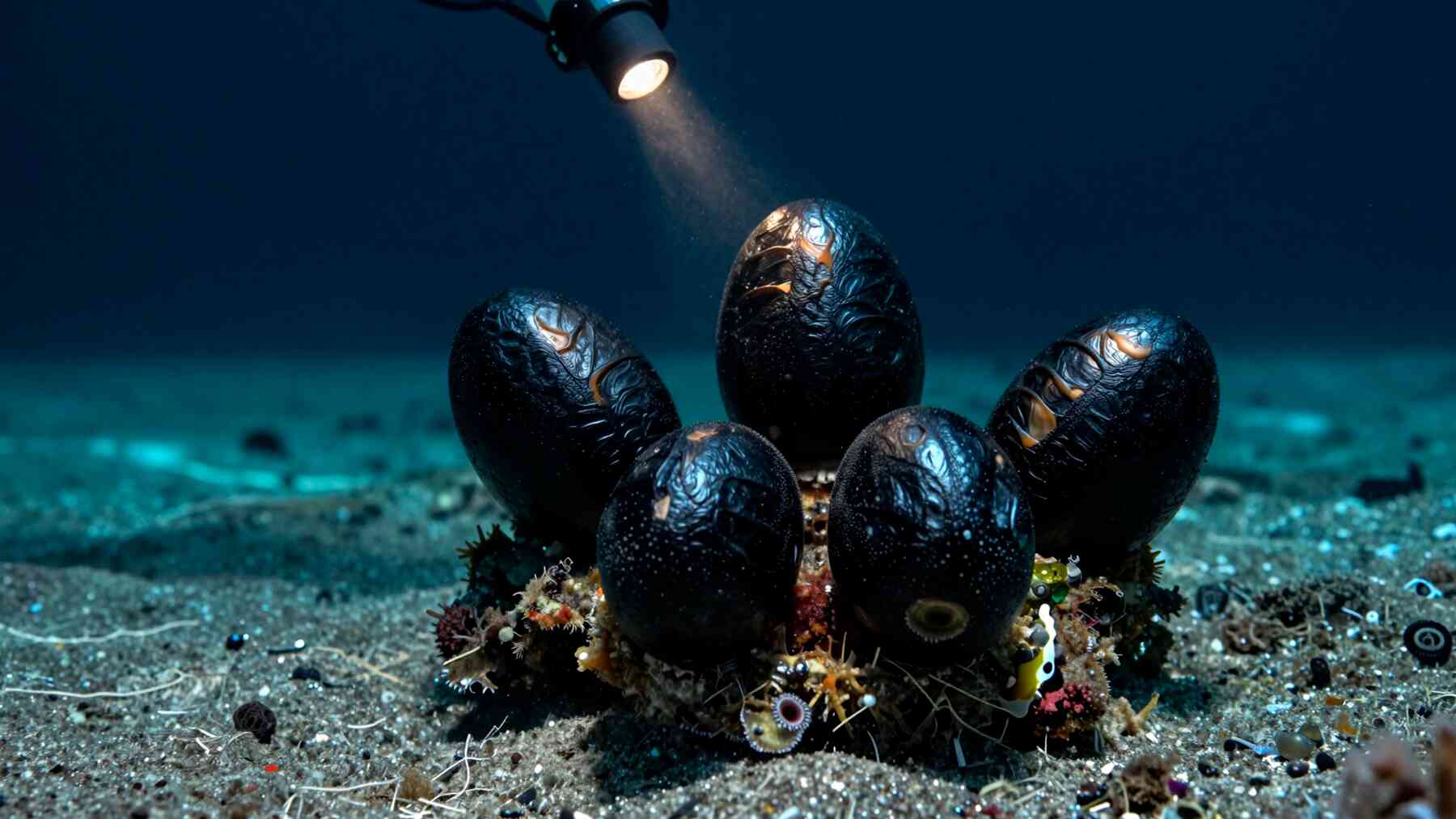
At roughly 6,200 meters below the surface of the Pacific Ocean, a researcher at the controls of a remotely operated vehicle was navigating through near-total darkness at the very edge of the abyssopelagic zone — one of the least explored environments on Earth. Then something unusual appeared on the seafloor: four jet-black objects, attached to a rock, unlike anything the team had retrieved from that depth before.
What those objects contained would surprise everyone.
A robot dive into one of Earth’s most hostile zones
The abyssopelagic zone stretches from about 4,000 to 6,000 meters below the surface — though its outer boundary can push deeper. Pressure at these depths is crushing, temperatures hover just above freezing, and sunlight is nonexistent. Biological discoveries here are rare, and when they do happen, they tend to rewrite what scientists thought they knew about where life can exist.
The expedition was run by researchers from Tokyo University and Hokkaido University, piloting a remotely operated vehicle through the Pacific when marine researcher Yasunori Kano spotted something strange attached to a rock at roughly 6,200 meters down. The objects were small, jet-black, and unlike anything previously retrieved from that depth. Kano decided to collect samples.
It’s worth pausing on just how remote this environment is. Scientists and oceanographers have long noted that humans know more about the surface of Mars than the ocean floor — and that’s not hyperbole. It reflects how genuinely difficult deep-sea exploration remains, even with modern robotics.
Four intact cocoons and a surprising reveal
Retrieving the objects was only the beginning. Once the samples reached the surface, the team found that most of the egg-like structures had been torn and emptied during collection. Four, however, remained intact.
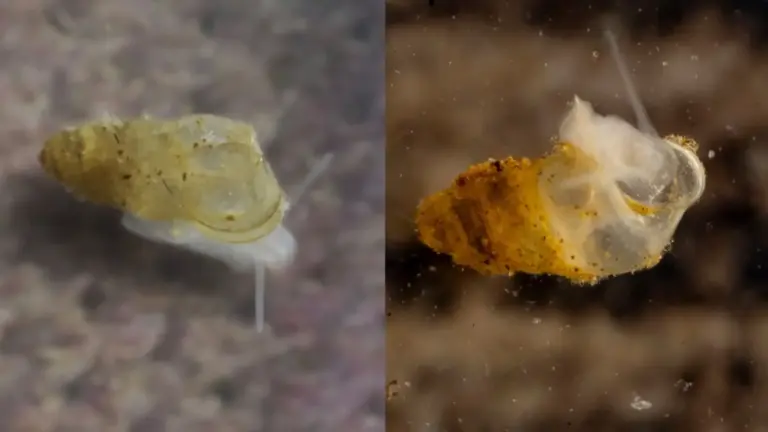
Kano sent those four specimens to invertebrate biologists at Hokkaido University for a closer look, and what happened next caught even the specialists off guard. Researcher Keiichi Kakui placed one of the objects under a stereomicroscope and carefully cut it open. A milky liquid leaked out. After clearing it away with a pipette, Kakui found fragile white bodies inside the shell.
“I first realized that it was the cocoon of platyhelminths,” Kakui told IFLScience. He hadn’t recognized them at first — he’d never seen flatworm cocoons before and initially thought they might be protists. The realization was entirely unexpected. Nobody had documented flatworms at anything close to this depth.

Breaking the depth record for flatworms
Flatworms belong to the phylum Platyhelminthes, a group far more commonly associated with shallow coastal waters, freshwater environments, and terrestrial habitats. Finding them in the abyss wasn’t on anyone’s radar.
The previous deepest flatworm on record had been found at around 5,200 meters — and even that specimen came with an asterisk. It was attached to a piece of wood, leaving scientists uncertain whether the worms actually lived at that depth or had simply drifted down with the debris. Before that, the deepest confirmed flatworm observation sat at roughly 2 miles, far shallower than what Kano’s team had now retrieved.
DNA analysis confirmed that the specimens from 6,200 meters represent a previously undescribed species. This wasn’t just a depth record. It was a new species, unknown to science until that ROV camera caught a glimpse of four dark shapes on a rock.
Deep but surprisingly familiar
Here’s where the story takes an unexpected turn. Despite living at record-breaking depth under extreme pressure and cold, the new species appears superficially similar to its shallow-water relatives. The research team observed no drastic developmental differences between these abyssal flatworms and the flatworms found in far more hospitable environments.
That raises real questions about adaptation. How did this species establish itself in the abyss? What biological mechanisms allow it to survive conditions that would destroy most animals? The paper, published in the journal Biology Letters in 2024, doesn’t yet answer those questions, but it frames them clearly. The findings suggest that life’s adaptability in extreme environments may be broader than current models account for.
What the abyss still hides
This discovery is a reminder of how much remains unknown about the abyssopelagic zone. Life cycles, biodiversity, feeding behavior — for most species down there, scientists are working almost entirely in the dark.
What this flatworm find suggests is that even animal groups considered well-studied may have representatives living at depths no one thought to look. If flatworms can establish themselves at 6,200 meters, other so-called shallow-water groups may have deep relatives waiting to be found.
Continued ROV exploration is the clearest path forward. Each dive into the abyss has the potential to challenge existing assumptions — not just about ocean biology, but about the limits of life itself. And if life can adapt to conditions this extreme on Earth, that has implications worth considering for the search for life beyond it.
You can check the full study here: Keiichi KakuiAoi Tsuyuki; Flatworm cocoons in the abyss: same plan under pressure. Biol Lett 1 January 2024; 20 (1): 20230506. https://doi.org/10.1098/rsbl.2023.0506
Read the whole thing?
Get the week's signal, not the noise
Our sharpest reporting on energy, climate and nature — free, once a week.