
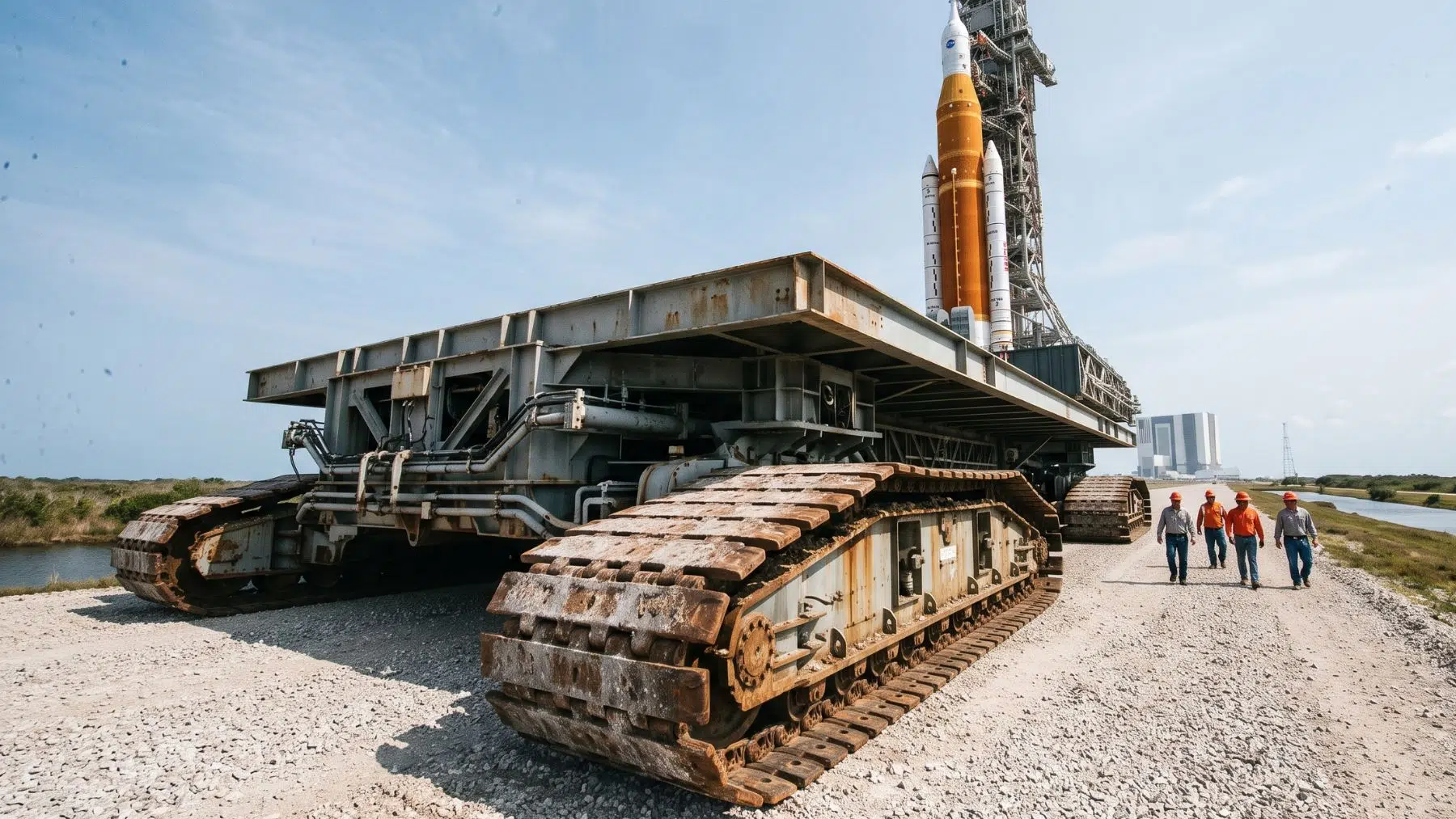
On the flat coast of Florida, a finished rocket is on the move, and it is slower than you walk.
Beneath it sits a slab of steel the size of a baseball infield, grinding forward on giant tracks.
The scene looks almost frozen, yet the whole thing is truly inching ahead.
The whole machine weighs 6.6 million pounds before it lifts a thing.
Load a rocket and its tower on top, and it hauls close to three times that.
The people who work here call this gentle steel monster Hans.
Two giants named Hans and Franz
There are two of these crawlers, and the crews nicknamed them Hans and Franz.
Both were built in 1965 by an Ohio company that made mining shovels.
This million pound machine first rolled out to move the Saturn V moon rocket.
Its flat deck stretches about 130 feet on each side, wide enough to park houses on.
At each corner sits a tank like track unit taller than a person.
Each one runs on eight track units, two at every corner of the deck.
Every steel shoe on those tracks weighs close to a ton on its own.
Together they rank among the largest machines that move on land anywhere.
From the start, the two machines have shared one impossible sounding assignment.
The job nothing on wheels could do
A rocket is not just heavy, it is tall, fragile, and fully assembled before it leaves the building.
Engineers stack the rocket and its launch tower upright inside a huge hangar.
Then the whole stack has to travel about four miles to the launch pad.
It must stay upright the entire way, or the structure can be damaged.
No truck or rail car could carry that much mass and keep it that steady.
A single mistake on that short trip could ruin months of careful work.
So the load rides on the crawler, which slips underneath and lifts the platform.
From there it begins one of the slowest journeys in engineering.
The trip can take most of a day for a distance you could drive in minutes.
How you move a rocket at walking pace
The crawler rolls on a special road of smooth river rock built just for it.
Loaded, its top speed is about 1 mile an hour, roughly a slow stroll.
Big diesel engines drive generators, which feed electric motors at each track.
All that power exists to move the load smoothly, not fast.
The thirst is enormous, burning well over a hundred gallons of fuel for every mile.
A team of drivers and technicians rides along and inside the machine as it moves.
Spotters walk beside it, watching every foot of the road.
Even at full effort it needs a wide, gentle path with no sharp turns.
According to official figures, the crawler has logged thousands of miles this way.
Sensors watch the load constantly, feeding a system that keeps it level.
That leveling trick is where the real magic hides.
The balancing act on the ramp
The launch pad does not sit at ground level, it rises on a gentle hill.
To reach it, the crawler must climb a ramp with a five percent grade.
Tilt a rocket that tall even slightly, and the top would swing far out of line.
So as the front tracks climb, the machine raises them and lowers the back.
A leveling system adjusts constantly, holding the rocket almost perfectly straight up.
The towering stack barely leans while the ground beneath it changes angle.
Climbing that slope with millions of pounds on top is the trickiest moment of all.
In 2021 an upgraded crawler set a world record as the heaviest self powered vehicle.
Holding that much steel this steady is the part that still amazes engineers.
Sixty years and still crawling
Both machines are now about sixty years old and still on the job.
Very little of the original steel has ever needed replacing.
They carried every crewed moon mission and every space shuttle to the pad.
Upgraded and strengthened, they now move the rockets of the Artemis program.
Few machines built in the 1960s are still doing frontline work today.
They have outlasted whole rocket eras that came and went around them.
The rockets they carry go on to chase discoveries far from Earth, from a NASA find on distant moons to signs of an alien ocean.
Other machines are pushed to similar extremes, but few must be this gentle with their cargo.
The crawler proves that slow can be sophisticated, not primitive.
On the Florida flats, Hans keeps rolling, one careful mile at a time, still carrying the future.
Read the whole thing?
Get the week's signal, not the noise
Our sharpest reporting on energy, climate and nature — free, once a week.


