
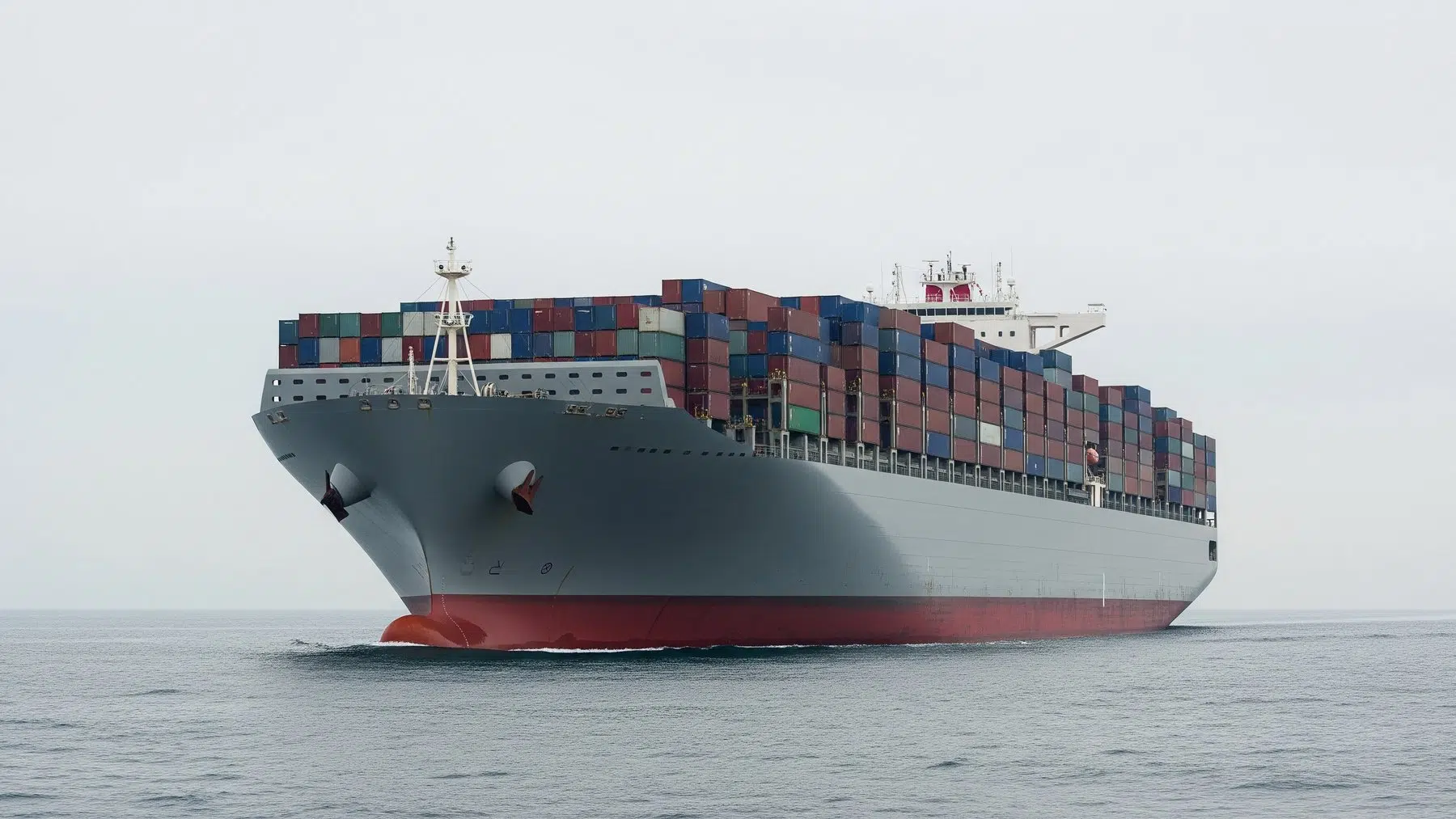
Every day, thousands of them cross the world’s oceans.
They carry the televisions, sneakers, grain and fuel that stock American shelves and fill American tanks.
And almost everyone who has ever watched one slide past a harbor mouth has felt the same small shock: how does something that enormous not simply fall straight to the bottom?
The answer turns out to be one of the most counterintuitive engineering truths in the physical world, and the real protagonist of the story is not steel at all.
A wall of steel the size of a city block
Stand at any major US port and watch a fully loaded cargo ship come in.
A large cargo ship can measure up to about 1,300 feet long and can weigh an almighty 220,000 tonnes.
The hull alone is a continuous wall of welded steel plate, each section thick enough to survive open-ocean storms.
Steel is roughly eight times denser than water, so the logic of the sinking ship feels airtight.
Add to that the heft of cargo containers and fuel, and it genuinely seems like a wonder they do not sink to the bottom of the sea.
Picture the weight of a fully loaded freight train stretching for several miles, and then double it.
Except that logic is completely wrong.
Why your intuition fails at this scale
Most people picture a ship the way they picture a stone: a solid, heavy object dropped into water.
But ships are not solid pieces of steel.
They are hollowed-out shells, and that distinction changes everything.
The average density of the total volume of the ship and everything inside it, including the air, must be less than the same volume of water.
The trapped air inside the hull pulls the ship’s overall density far below the density of the surrounding ocean.
Think of it less as a steel vessel and more as an enormous steel balloon, one whose walls happen to be several inches thick.
The balloon analogy is not a simplification; it is the operating principle every naval architect builds from.
The invisible upward hand
The force doing the actual lifting has a name that goes back to a Greek mathematician in a bathtub roughly 2,300 years ago.
Archimedes’ Principle states that the upward force on an object equals the weight of fluid it displaces.
When a ship settles into water, it shoves aside a volume of ocean equal to its own weight, and the ocean shoves back with exactly the same force, directed straight upward.
Ship designers calculate how much water the hull must push aside to support the vessel, cargo, fuel and passengers.
The shape of the hull spreads that weight over a large area, allowing it to push aside more water without sinking too deeply.
A wider, shallower hull displaces more water per foot of depth than a narrow one, which is why modern cargo ships look almost flat-bottomed when viewed from the waterline.
The result is a perfect mechanical standoff between gravity pulling down and water pushing up.
The number that makes it real
To feel the true scale of this principle, consider the car carrier class of vessel, or the single largest vessel currently operating on any ocean.
The Pioneering Spirit, a heavy-lift crane vessel built for the single-lift installation and removal of offshore platforms, displaces approximately 1,000,000 metric tons of water, the equivalent of roughly 200,000 elephants, making it the heaviest ship ever put into service.
Every one of those displaced tons is pushing upward on the hull at this very moment, somewhere out on the ocean.
What engineers are really doing is packaging air inside a watertight steel shape, then making that shape wide enough to shove aside enough ocean to carry the load.
It is, at its heart, the same reason an empty tin can floats and a full one sinks, just performed at a scale that staggers the imagination.
The engineering that keeps the balance
When a ship tips due to wind or waves, several engineered elements bring it upright again.
Heavy equipment sits below deck to create a low center of gravity, and ballast tanks in the lower hull can be flooded or pumped empty within minutes to shift the ship’s weight distribution.
Ships in fresh water float deeper than in salt water, because fresh water is less dense.
Cold northern seas are denser than warm tropical ones, so the same vessel rides at a visibly different waterline depending on where it sails.
The Plimsoll lines painted on every hull, those horizontal marks that look like a ruler on the side of the ship, are the visible record of all those calculations.
Naval architects design for all of it, calculating decades of random waves, thermal gradients and loading variations before the first steel plate is ever welded.
What the physics guarantees is the wonder: a 220,000-ton vessel is, at its core, a carefully shaped pocket of air, crossing an ocean one displaced wave at a time.
Read the whole thing?
Get the week's signal, not the noise
Our sharpest reporting on energy, climate and nature — free, once a week.


