
Every time a large plane comes in to land, something strange happens in the final few feet above the runway.
The aircraft seems to float a little longer than it should.
The engines feel less strained.
Pilots know it well, and physics explains it exactly, but almost no passenger ever realizes the invisible force holding the plane up in those last seconds is one of the most useful phenomena in all of transport.
And now, for the first time, that same hidden force has been handed to ordinary people as a vehicle they can actually buy.
The moment every pilot feels but never explains to you
Bring any winged aircraft close to a flat surface and the air underneath its wings starts to behave differently.
When an aircraft descends within roughly one wingspan of the ground, the airflow beneath its wings becomes compressed.
That compressed air has nowhere to escape.
This compression disrupts the typical downwash and wingtip vortices that define normal flight, generating what pilots often describe as a cushioning or floating sensation.
It is not turbulence and it is not a gust.
It is the aircraft briefly riding its own pressure, a natural air cushion the wing builds entirely for itself.
Every commercial pilot is trained to expect it, yet most passengers sit back, look out the window and assume it is simply a smooth landing.
Why it matters far more than anyone tells you
The cushion does two things at once that engineers have dreamed about for generations.
It boosts lift while simultaneously cutting induced drag.
Less drag means the same engine produces far more useful thrust.
Eliminating the vortices through ground effect means an aircraft using it can, in theory, travel more efficiently than any machine flying above that zone.
Think of it as a free energy bonus, built into the laws of physics, that every commercial jet briefly collects on every single landing.
The efficiency gain is not marginal either, engineers estimate that drag can fall by as much as 40 percent inside the zone, which is why the idea has haunted aerospace designers for over a century.
The question they kept returning to was whether you could build a vehicle that lives permanently inside that bonus zone, rather than just passing through it on the way to the tarmac.
The Cold War’s strangest flying machine
Soviet engineers in the 1960s decided the answer was yes, and they built something enormous to prove it.
Wing in ground effect vehicles emerged when Soviet designers began exploiting the compressed air gap between a wing and a surface to generate lift and shed drag at the same time.
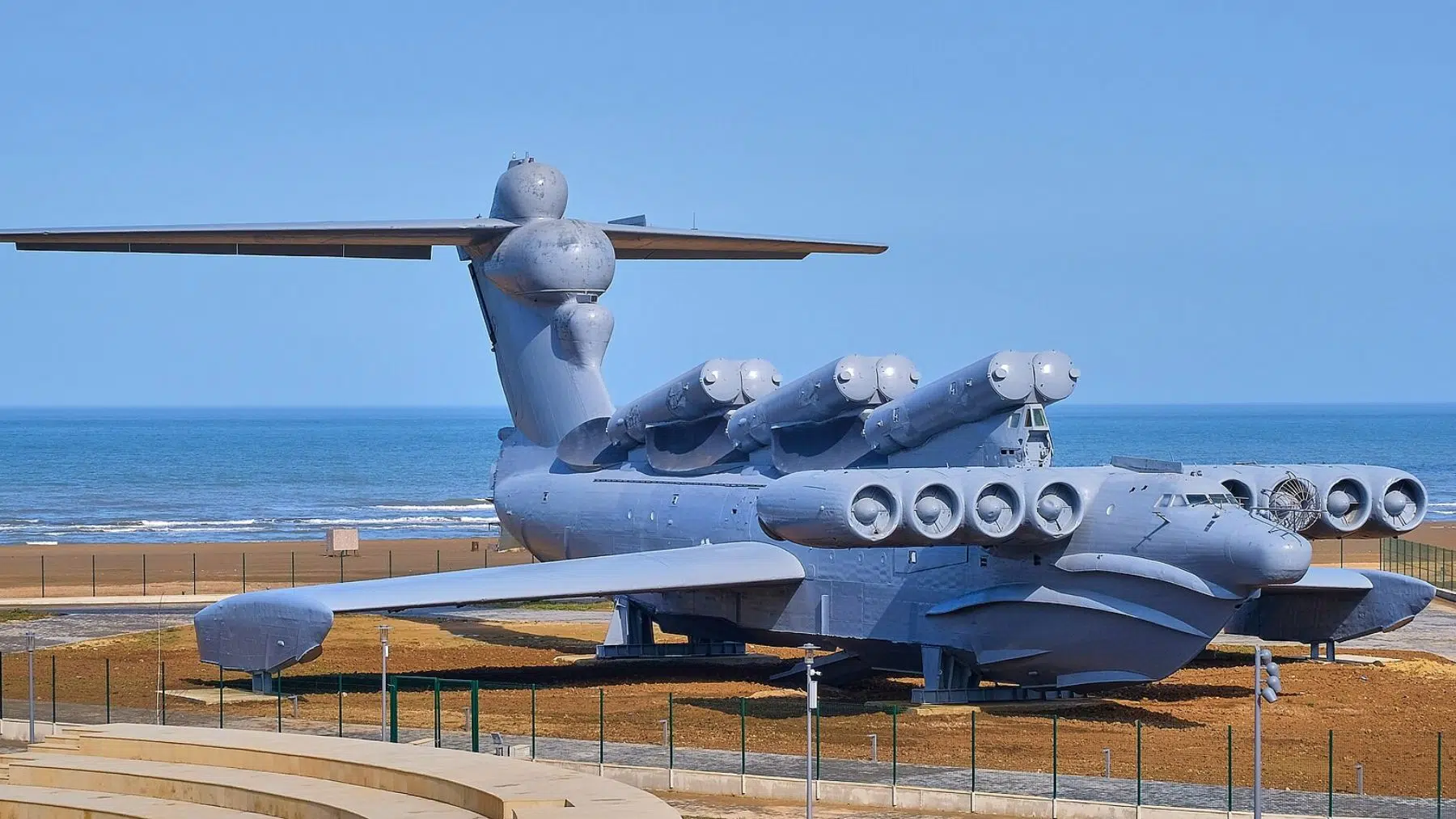
The first was the KM, the craft the West nicknamed the Caspian Sea Monster, the largest aircraft in the world when it flew in 1966.
From it grew the Lun, a 73 metre warship that rode the very same cushion of air, the only one ever completed, with six anti ship missiles mounted in pairs along its spine.
It entered service in 1987, then sat rusting for decades before being hauled onto a Caspian beach as a museum piece.
Western intelligence agencies spent years trying to work out what these machines were, because they flew too low for high altitude surveillance to capture clearly.
For decades the whole idea sat on the shelf, too large, too costly, too specialized for anyone outside a defense ministry to consider.
That era is now ending.
The craft that just made it personal
Decades after that missile armed giant was hauled onto a Caspian beach to rust, the same trick has arrived as something you could park at a marina.
The Suzhou based company NAVEE has completed the maiden flight of its WaveFly 5X at Dong Taihu, calling it the world’s first wing in ground effect vehicle built for everyday use.
It rides on a cushion of compressed air trapped between its wings and the water below, traveling at high speed while flying only 30 to 50 centimetres above the surface.
Built with a dual tandem wing structure and an aerospace grade carbon fiber body, it reaches speeds of up to 85 km/h with a range of up to 80 km.
It needs no airport, and NAVEE positions it as operable more like a recreational watercraft than a conventional aircraft, though regulatory requirements for any licensing will ultimately depend on national authorities, making it about as far from a car carrier or a jumbo jet as a vehicle can get while still using the same core aerodynamic secret.
The vehicle does not require a runway, making low altitude flight accessible to consumers for the first time.
What comes next on the water and in the air
In the United States, DARPA spent three years on a WIG transport concept called the Liberty Lifter, designed to move large payloads at low altitude across open ocean, before cancelling the program in June 2025 after determining it was not cost effective to build a demonstrator, while sharing its design findings with industry and Pentagon partners for potential future development.
That decision says a great deal about where the technology is heading.
International distributors have signed letters of intent, and a consumer brand is now selling the dream of skimming above a lake on trapped air alone.
Critics note that ground effect vehicles remain sensitive to sea state and weather, and no regulatory approval pathway for consumer use has yet been announced.
But the physics has always been patient.
The same principle that steadied a Cold War monster the length of a city block now steadies a two seat craft light enough to trail behind a car.
A supertanker moves a million barrels through the sea at walking pace, this craft moves two passengers above the sea on a whisper of air at highway speed.
That force was hiding in the last few feet of every landing you have ever made.
Read the whole thing?
Get the week's signal, not the noise
Our sharpest reporting on energy, climate and nature — free, once a week.


