Sixty-six million years ago, an asteroid hit Earth and ended the reign of the non-avian dinosaurs. The planet went dark, temperatures dropped, and ecosystems collapsed on a global scale. Yet crocodiles — a lineage already ancient by then, stretching back to the Triassic — came through largely intact.
How they pulled that off has remained one of paleontology’s more stubborn puzzles. A sweeping analysis of more than 7,000 fossils and records from over 400 living and extinct species may finally offer a compelling answer.
A planet-wide catastrophe with unequal survivors
When the Chicxulub asteroid struck 66 million years ago, it triggered a cascade of destruction. Dust and debris blocked sunlight, temperatures plummeted, and food chains fell apart. Non-avian dinosaurs were wiped out almost entirely. Crocodiles weren’t small or obscure — they were well-established animals sharing the planet with the very creatures that didn’t make it.
The UCL-led study, published in Science Advances, set out to understand why. Researchers traced 245 million years of evolutionary history, pairing that fossil record with detailed reconstructions of ancient climates and geography.
Following the heat: 245 million years of climate loyalty
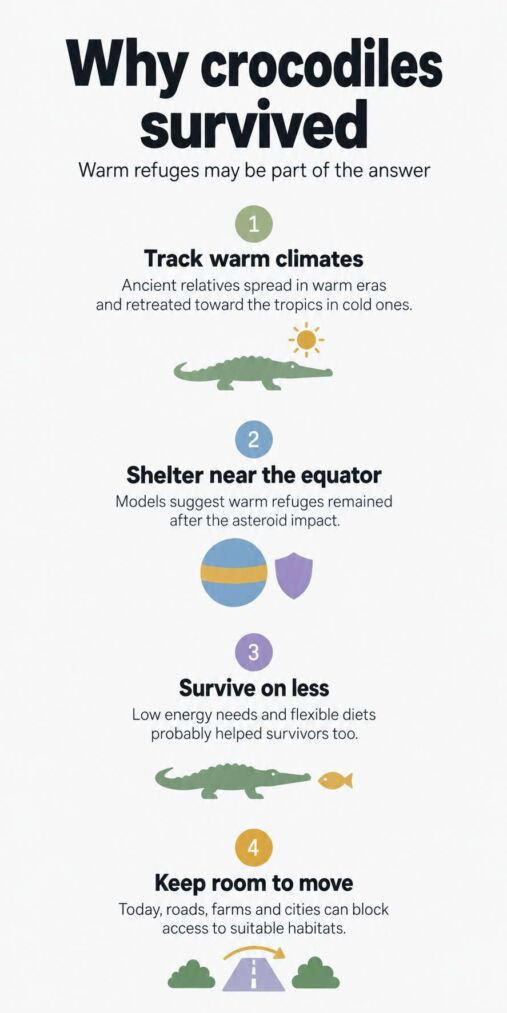
The study’s central finding is striking in its consistency. Across nearly their entire evolutionary history, crocodile relatives didn’t adapt to a wide range of temperatures — they followed warm ones. Ranges expanded when the planet heated up. When it cooled, populations pulled back toward the tropics.
During the early Eocene, roughly 50 million years ago, global temperatures ran about 10°C higher than today. Crocodile relatives spread across high latitudes in North America, Europe, and even Antarctica. As global cooling set in over millions of years, their range contracted toward warmer regions. Dr. Alfio Alessandro Chiarenza, the study’s lead author, noted that despite enormous variation in body shape and lifestyle, “what stayed surprisingly consistent was their relationship with climate.”
Ancient crocodiles were nothing like their modern descendants
The word “crocodile” tends to conjure a specific image — a long-snouted, semi-aquatic ambush predator. The broader pseudosuchian lineage was far stranger. This group once included heavily armored plant-eaters, bipedal land predators, and giants weighing more than a metric ton. Sarcosuchus — nicknamed “super croc” — could reach 12 meters in length.
Dr. Chiarenza put it vividly: ancestors ranged from “giants the size of a bus that could have devoured a T. rex, to small, cute animals with the face of a pug.” Morphology changed dramatically across 245 million years. Thermal loyalty didn’t.
Two exceptions that prove the rule
The researchers identified two moments where parts of the lineage broke from that pattern. During the Cretaceous Thermal Maximum, around 94 million years ago, temperatures climbed as much as 14°C above modern levels — and one branch evolved tolerance for heat beyond what the broader lineage typically handled, driven by extreme pressure.
Around 34 million years ago in Australia, an extinct group adapted to increasingly arid, desert-like conditions as prolonged cooling dried out the continent. These cases show that evolutionary flexibility existed — it just wasn’t the default.
What the simulations show about the asteroid’s aftermath
To understand what happened after the Chicxulub impact, the researchers modeled several post-impact scenarios — testing 5%, 10%, and 15% reductions in sunlight, along with elevated CO₂ from volcanic activity.
At 5–10% sunlight reduction, equatorial regions stayed warm enough to serve as refuges for crocodile relatives. At 15%, those refuges disappeared, though the researchers note that this more extreme scenario is now considered unlikely by scientists. Previous modeling found that suitable habitats for non-avian dinosaurs contracted far more severely, which helps explain the divergent outcomes. As Dr. Chiarenza put it: “The asteroid did not make the whole planet equally hostile to every group.”
A survival strategy that may now be a vulnerability
Climate refuges weren’t the whole story. Other traits likely helped — relatively small body sizes, semi-aquatic lifestyles, flexible diets, and the low energy demands of ectothermic animals that don’t need to eat as frequently as warm-blooded ones. That last point matters enormously when ecosystems collapse.
The climate piece raises an uncomfortable modern parallel, though. For 245 million years, moving toward suitable habitats appears to have been a core survival response. Today, that option is increasingly blocked. Professor Philip Mannion framed it directly: “Today’s species will need room to move as the planet warms, and the loss of suitable areas to roads, farms and cities is making that harder.” A strategy that carried a lineage through mass extinctions may prove far less effective in a world carved up by human infrastructure.
Read the whole thing?
Get the week's signal, not the noise
Our sharpest reporting on energy, climate and nature — free, once a week.