Dark matter fills the universe. It outweighs all the stars, planets, and gas clouds combined, yet it passes through everything — planets, stars, your own body — without leaving a single trace in any detector ever built. Decades of searching have confirmed it exists, but never revealed what it actually is.
Now, buried inside a gravitational wave that traveled halfway across the universe from a black hole collision, scientists may have found the clue they’ve been waiting for.
The substance that fills the universe but can’t be touched
Dark matter accounts for roughly 85 percent of all matter in the universe, yet it has no known interaction with light, magnetism, or any other force along the electromagnetic spectrum. It doesn’t emit, absorb, or reflect anything. Physicists are confident it exists only because of the gravitational influence it exerts — most famously, the anomalous rotation rates of spiral galaxies, which spin far too fast at their outer edges for ordinary matter alone to explain.
That gravitational fingerprint is compelling, but indirect. Decades of purpose-built detectors, buried underground and shielded from every conceivable interference, have searched for dark matter particles interacting with ordinary matter and come up completely empty. Not one confirmed signal. Finding a new observational window has remained one of modern physics’ most stubborn open problems.
Superradiance: how a spinning black hole can amplify dark matter
The new approach centers on a phenomenon called superradiance. The leading hypothesis involves ultralight dark matter particles — many orders of magnitude lighter than an electron — that behave not as isolated particles but as coordinated waves when they encounter the intense gravitational environment near a rapidly spinning black hole.

What happens next is striking. Rotational energy from the black hole transfers into those waves, amplifying dark matter to densities far beyond the diffuse background filling the rest of space. Aurrekoetxea’s team describes the process as something like churning cream into butter — a spread-out, barely detectable ingredient concentrated into something far denser and more structured. The result is a thick dark matter cloud locked in orbit around the black hole.
On its own, that cloud would be invisible. The scenario changes when a second black hole enters the picture.
A fingerprint written in gravitational waves
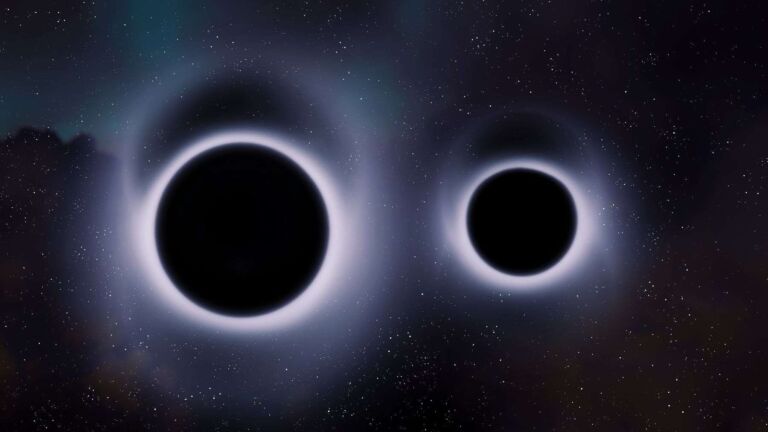
When a second black hole spirals inward and merges with the first, it passes directly through that dense dark matter cloud — and the interaction doesn’t go unrecorded. It leaves a distinctive imprint on the gravitational wave signal the merger produces, a subtle but specific pattern that deviates from what a standard merger in empty space would generate.
Aurrekoetxea’s team at MIT built a physical model predicting exactly what that imprint should look like, then applied it to publicly available data from the LIGO, Virgo, and KAGRA gravitational wave observatories. They screened 28 of the clearest signals from the first three observing runs — a catalog covering years of detections. Twenty-seven matched expectations for mergers in ordinary vacuum. The twenty-eighth did not. The signal catalogued as GW190728 showed a pattern consistent with what the model predicts for a merger involving a dark matter cloud.
A hint, not a confirmation — but a historic first
The team is careful about what this means. GW190728 is a candidate signal, not proof, and the researchers stop well short of claiming a detection. The language throughout their work reflects that caution.
The significance still holds. This is the first time a gravitational wave has been formally flagged as a potential dark matter imprint using a rigorous, physics-based model rather than a statistical anomaly or an unexplained residual. The prediction came before the screening. The methodology is principled, and the technique demonstrably works.
As Aurrekoetxea put it: “We know that dark matter is around us. It just has to be dense enough for us to see its effects. Black holes provide a mechanism to enhance this density, which we can now search for by analysing the gravitational waves emitted when they merge.”
What comes next: a flood of new signals to screen
LIGO’s fourth and fifth observing runs are producing gravitational wave detections at a rate that would have seemed extraordinary just a few years ago. Each new merger is another opportunity to run the same screening — another test of whether GW190728 was an isolated oddity or the first of many.
If the model holds up across a growing catalog, the implications reach further. Dark matter may have been encoded in gravitational wave data for years, waiting for a model capable of reading it. The work doesn’t just offer a candidate signal; it opens a fundamentally different observational strategy, one that treats the universe’s most violent collisions not merely as astrophysical events but as potential dark matter detectors. Whether GW190728 is eventually confirmed or ruled out, that strategy is now on the table.
Read the whole thing?
Get the week's signal, not the noise
Our sharpest reporting on energy, climate and nature — free, once a week.