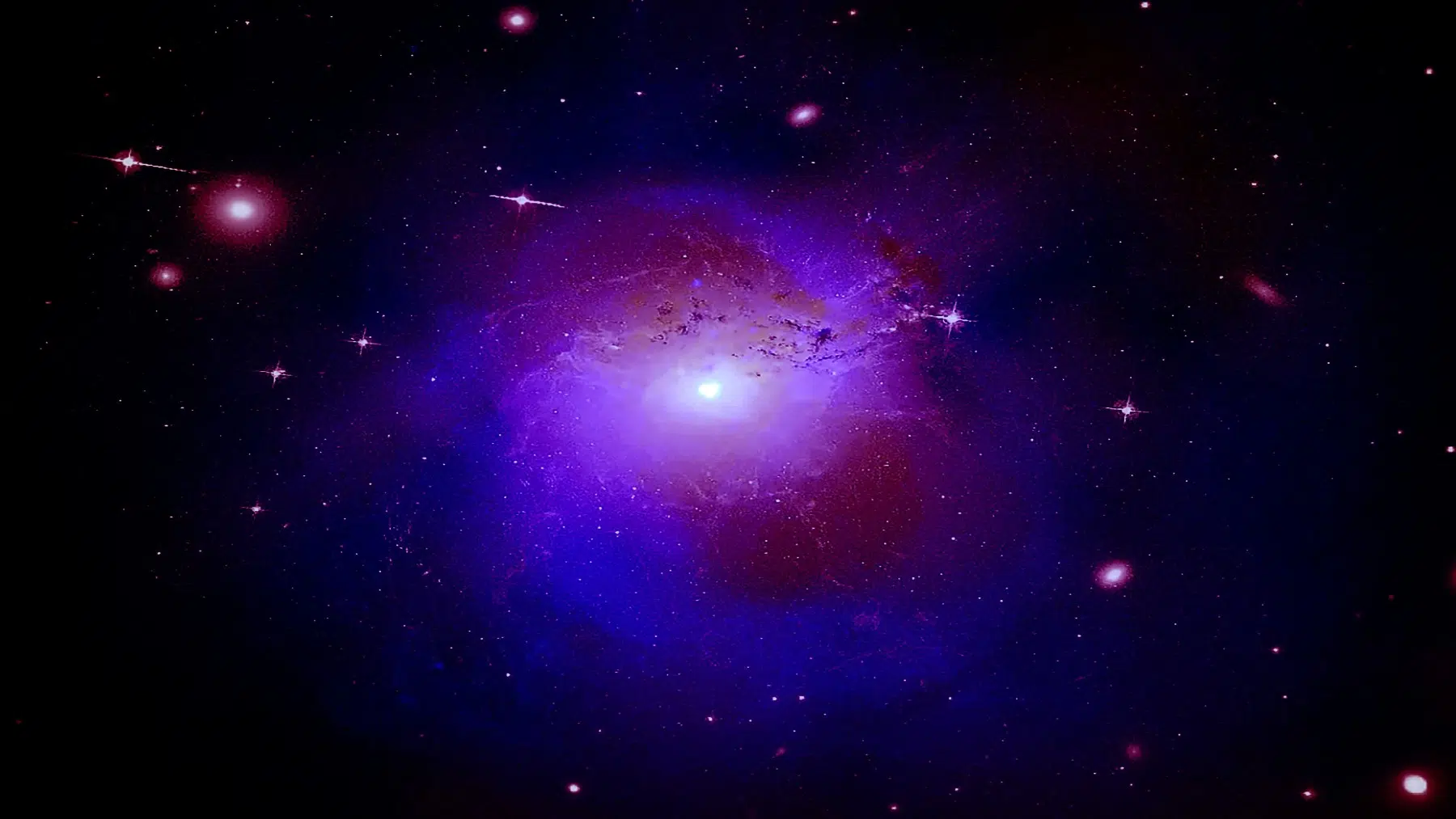
Scientists are often revisiting past theories that were used to define forces we don’t understand, like dark matter and dark energy. Both of these concepts were created decades ago and act as a foundation for searching and explaining the visible universe and its expansion. On the other hand, they can’t be proved because they are considered ‘invisible forces’ — but scientists are getting close to finding an actual proof of their existence with a new experiment that goes against some traditional testing in physics.
Dark matter is a theory looking to be confirmed by researchers
Dark matter was first introduced in 1933 by the astrophysicist Fritz Zwicky to answer the reason why some galaxies in the Coma Cluster interact with each other, and to account for the missing mass needed to explain the observed velocities of galaxies within it. After Zwicky came up with the theory of a ‘cosmic glue’ that holds everything together, it was time to explain why the universe is still expanding, as Edwin Hubble discovered in 1929 when looking at the light arriving on Earth from distant galaxies.
Something holds everything in place, but what’s the power expanding the universe? In 1998, Saul Perlmutter, Brian Schmidt, and Adam Riess came up with the concept after observing supernovas. Both theories were never proved, but remain the most acceptable hypotheses to answer some of the biggest questions of the universe.
Scientists use non-conventional experiments to prove the existence of a particle
Dark matter is believed to make up roughly 27% of the universe’s total energy content, while dark matter and dark energy together account for about 95%. Researchers from the University of Oxford believe that a hypothetical particle named axion could be the key component of dark matter. So, along with the UK Science and Technology Facilities Council (STFC) and other labs, the researchers will look for this unknown particle with the help of the European X-ray Free Electron Laser (XFEL).
The experiment they will conduct to see if axions are real is called “light shining through walls.” The X-rays will pass through germanium crystals with a strong electromagnetic field, which allows the photons to possibly transform into axions. If the axions pass through a titanium sheet and reconvert back into photons, then an axion is real. A chance to conduct this experiment is what scientists were looking for to try to prove its existence.
Scientists may settle for the theoretical world
In a press release, the lead author of the study, Dr. Jack Halliday, stated that the experiment shows the versatility of the XFEL technology used to conduct the investigation and address some challenging questions in physics, pushing the boundaries of what scientists understand about the universe’s formation. The discovery of a hypothetical particle present in dark matter is just the beginning. After this, researchers will still have to prove its existence in the matter that’s holding the universe together, according to the theory from 1933.
The official correlation between axion and mirror matter might never be proved because NASA or other space agencies, as well as researchers from universities, are limited to Earth, and since dark matter is an invisible force, they will have to search for it in strong magnetic fields and interactions between two cosmic objects. The interaction often results in sudden light bursts and takes a couple of million years to travel at the speed of light to Earth.
In just one experiment, the scientists are looking to prove the existence of a ‘cosmic glue’ that holds galaxies together, while also using another theoretical particle to help them have a better understanding of how a portion of the universe works, and the principal investigator Professor Gianluca Gregori acknowledges the challenge to use a measurement that does not follow the conventional methods to find something that might not exist.
Read the whole thing?
Get the week's signal, not the noise
Our sharpest reporting on energy, climate and nature — free, once a week.