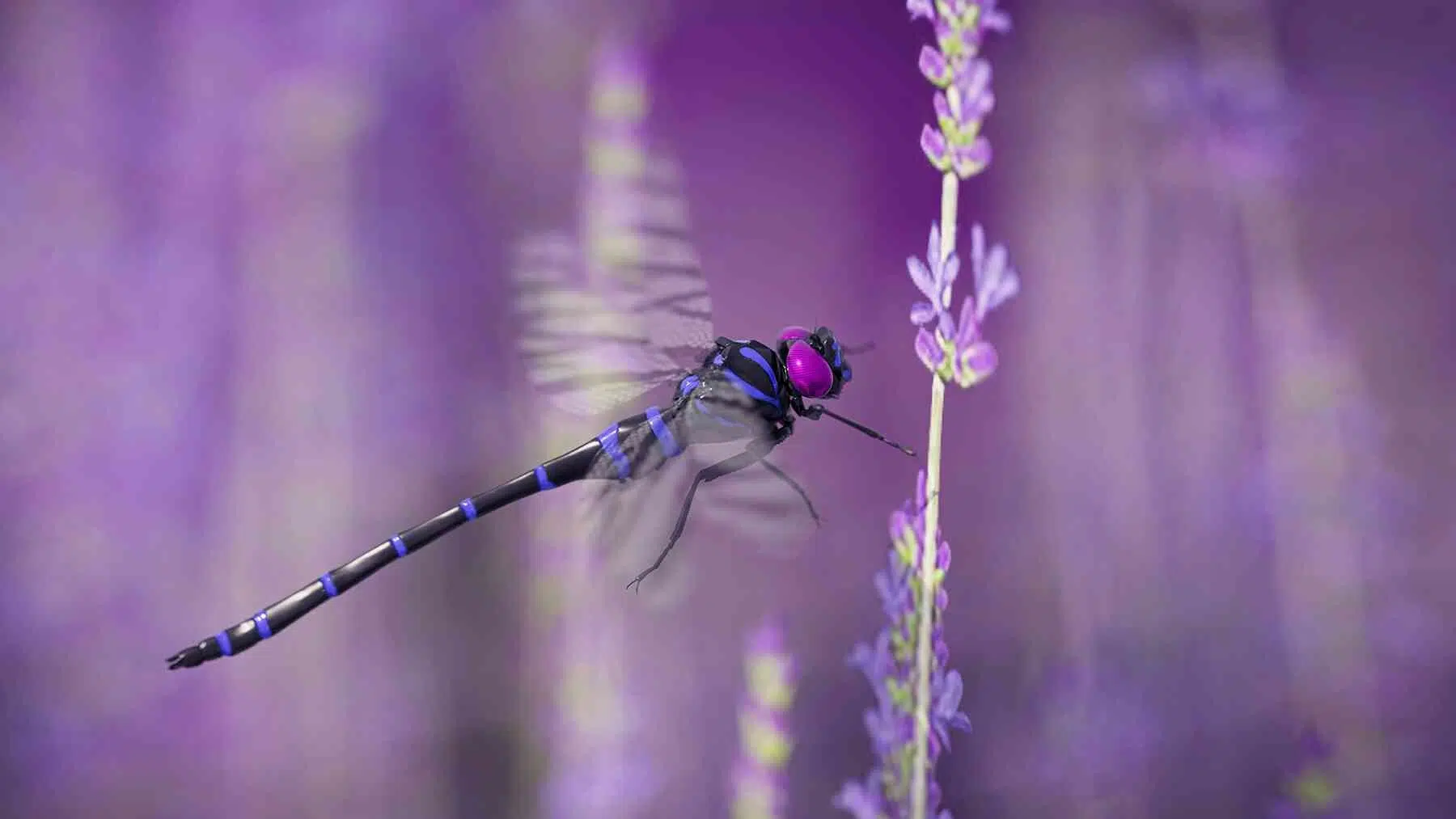
Imagine sitting outside on a warm, sunny day, watching a dragonfly zip through your garden.
At first glance, you notice the vibrant colors of its wings and metallic body.
But what you’re seeing isn’t the full picture. Dragonflies use a completely different spectrum of light when perceiving their world.
A hidden color lies beyond human vision—but how does it affect human health?
Dragonflies dominating the skies
Dragonflies excel in their job, flying around ponds and fields.
They fly fast, calculate every move, find their prey in flight, and eat, all it while flying.
This ability comes from their two compound eyes. These structures can collect vast amounts of data in extremely short periods of time compared to how fast our brains process information.
They see the world differently than humans.

While we see through a narrow band of light (visual), they interpret movement and signals in a different way.
It is almost as though they are tuned into a radio station that humans are biologically unable to receive.
For many years, scientists have been fascinated by this phenomenon. It has also intrigued those who study the intricacies of insect visual systems.
As the limits of perception begin to fade
Researchers studying dragonfly vision have noticed that they appear to anticipate movement before it happens.
In fact, it has been observed that they will fly toward something that appears to be no more than empty space to us.
This behavior is almost as though they are processing large amounts of data from a source we cannot identify.
Because of this, scientists are now exploring how similar technology could help solve medical problems. They believe that studying how dragonflies sense their environment may lead to improved imaging technology for hospitals.
It is also believed that this work may lead to the development of better sensors for internal surgical tools.
If successful, this technology may allow surgeons to operate with greater delicacy.
That is to say, they hope surgeons may be able to develop treatment plans based on precise images of delicate tissues.
How can we possibly begin to understand how to view things that are invisible to us?
You can explore the core of this research in the study “Dragonflies can see a color humans can’t and it could change medicine” published by the Osaka Metropolitan University in Science Daily.
Deep red and near-infrared light reveal hidden signals
Most people would agree that viewing something is a passive experience, but that is not the case.
Our experience of seeing objects is much more dynamic.
Traditional optical imaging devices take advantage of what we can capture.
However, the most important biological processes occur too deep for conventional cameras to reach.
These systems require more than just high-resolution lenses. Deep tissue imaging requires the ability to penetrate multiple layers of biological noise.
Beyond familiar visual limits
Engineers are developing probes that detect light frequencies similar to those used by dragonfly photoreceptors. By doing this, they can create images of previously unobservable parts of the human body in real time.
Instead of invasive procedures, they propose using these systems to create detailed images of cells inside the body.
Physicians will have the ability to obtain diagnosis sooner with the aid of this technology and will be able to see conditions that were once invisible.
This represents an alternative way for it to “see” through the adaptation of a survival trait used by dragonflies.
Is it possible that medicine’s future is less about developing larger machinery and more about acquiring a finer set of eyes?
Read the whole thing?
Get the week's signal, not the noise
Our sharpest reporting on energy, climate and nature — free, once a week.