
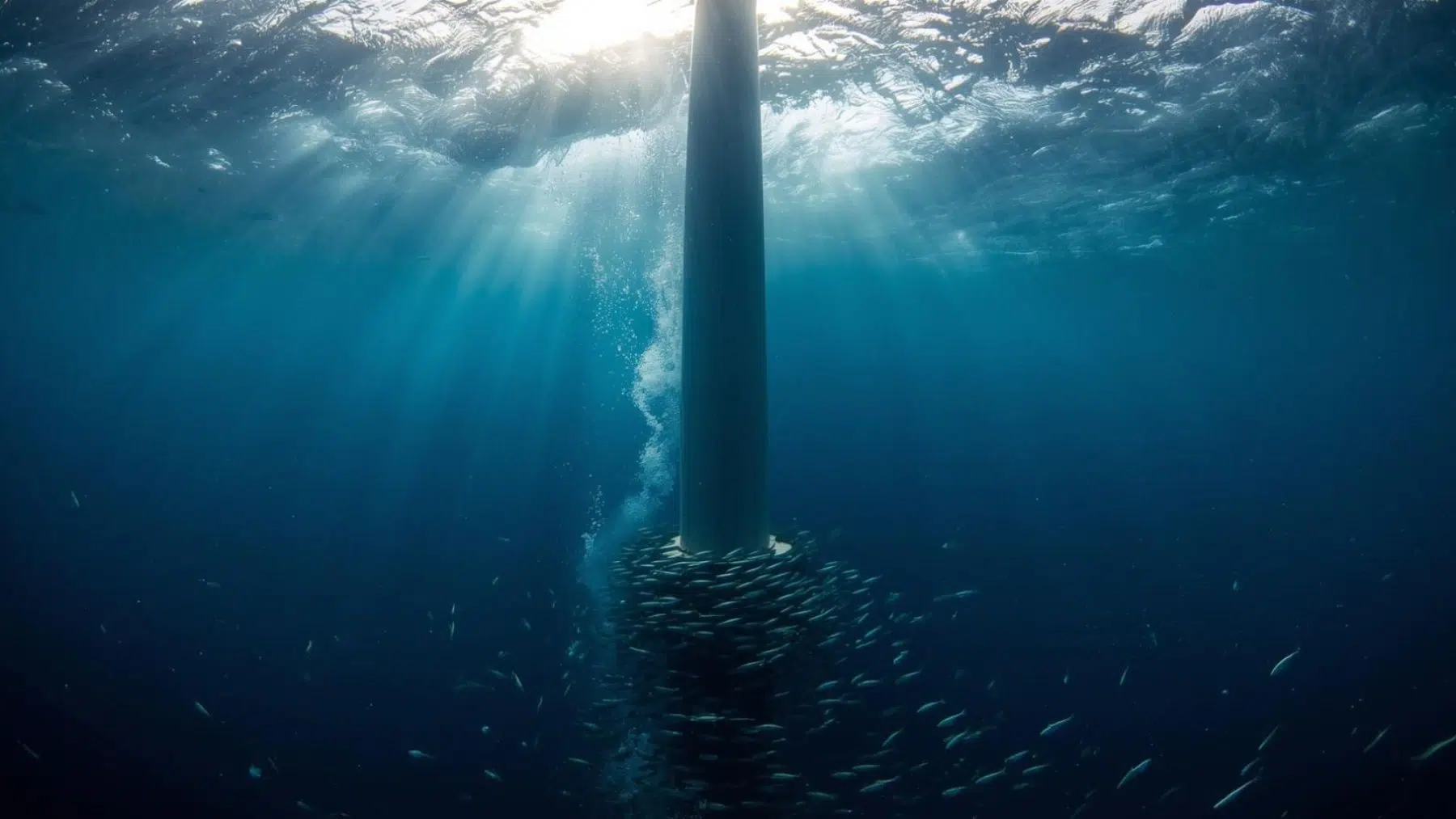
Far out in the North Sea, more than fifty kilometres from the nearest beach, there is a stretch of water that the people who work there sum up in a single blunt word.
Empty.
It is deep, exposed and useful, and for years that was all anyone needed it to be.
That reputation is about to change, and the reason has almost nothing to do with the wind turning above the surface and everything to do with the floor far below it.
A patch of seabed that was built to stay bare
For decades this part of the sea was treated as a foundation, never a habitat.
What mattered was depth, distance from shore and stability, the qualities that let heavy steel stand in one spot for thirty years.
The living world down there was simply not part of the brief.
So the seabed stayed flat and sandy, raked smooth by the current, with no ledges, no cracks and no rough ground for anything to grab.
Crews even armoured the base of each structure with loose rock to stop the current scouring it out.
It held the steel in place, but it did nothing for life.
And where there is nothing to grip, almost nothing settles.
Why almost nothing wanted to stay
Open ocean needs more than clean water to come alive.
It needs structure.
A hard surface gives seaweed something to coat, gives mussels and oysters something to cling to, and gives small fish a shadow to slip into.
A bare floor offers none of that.
Food drifts through in the current and keeps moving, because there is nothing to make it pause.
Tiny larvae looking for a home are carried straight over the sand and away.
Even a single boulder on an empty plain can turn into a crowded oasis, simply because it breaks the monotony.
The result is strange but ordinary.
You get a sea that looks busy near the top and stays sparse and idle along the bottom.
Then someone changed the shape of the bottom
Recently, heavy grey blocks started arriving at sites like this one.
They are blunt and cuboid, each weighing close to 6,000 kilograms, and at first glance they look almost boring.
Each one is cast on land, barged out to the site and lowered into position by crane.
Look closer and the design gives itself away.
Their outer faces are deliberately rough, and their cores are hollow.
Those cavities and ridges slow the water, carve out calm pockets and hand the seabed the one thing it never had.
A flat floor offers a passing animal nowhere to stop.
A textured, cave-like surface offers shelter, shade and a foothold all at once.
Instead of letting life wash straight past, the blocks finally give it a place to land.
What is really being lowered into the water
These blocks are Reef Cubes, built by a firm called ARC Marine from low carbon recycled material, with crushed shell folded into the mix to tempt native oysters to settle.
Sixty-six of them are bound for OranjeWind, a 795 megawatt wind farm that RWE and TotalEnergies are building 53 kilometres off the Dutch coast.
The cubes will ring eleven turbine foundations and add more than 1,400 square metres of habitat to a floor that had almost none.
Cod and native oysters have been picked as the species to watch, because both pull a wider web of marine life along behind them.
One thing matters for honesty.
OranjeWind is not built yet.
Foundation work begins in 2026, and the cubes go down only once the turbines are standing, so the reef out there is still a plan, not yet a place.
Why the empty sea may not stay empty
The confidence behind that plan comes from waters where the same blocks are already on the bottom.
RWE has set tens of thousands of reef cubes around its Rampion wind farm off the English coast, and ARC Marine’s earlier North Sea trials pulled a surprising range of life onto the bare concrete.
Other wind farms tell the same story, from lobsters tucked between foundations to cod gathering where there used to be open sand.
None of this is promised at OranjeWind, and the developers are careful to call the work research as much as restoration.
The cubes will stay in place for the entire life of the wind farm, giving scientists years to measure what actually shows up.
For the company behind the blocks, OranjeWind marks the jump from small pilot trials to building reefs at full commercial scale.
Even so, the pattern repeats often enough that they expect oysters and fish to find these cubes as well.
If they are right, the wind farm will do two jobs at once, pushing clean power toward a million homes above the surface while rebuilding a small world beneath it.
Read the whole thing?
Get the week's signal, not the noise
Our sharpest reporting on energy, climate and nature — free, once a week.


