The promise was electric. A wind generator with no blades, no gears, no spinning parts at all — just a thin ribbon trembling in the breeze, supposedly many times more efficient than the small turbines it was built to replace.
Its inventor said it could light homes that had never known electricity.
Two decades on, the ribbon is still trembling. But the story around it has grown more complicated, and far more interesting, than the headline number ever suggested.
The bridge that became a power source
Shawn Frayne was working in Haiti in 2004, in communities lit by smoky kerosene lamps, when he set out to build a tiny, cheap wind generator.
He hit a wall almost at once. Turbines do not shrink well. At very small sizes, friction in the bearings and gears swallows most of the energy the wind delivers.
So Frayne looked somewhere strange for inspiration: the 1940 collapse of the Tacoma Narrows Bridge, which twisted itself apart in a moderate wind through a phenomenon called aeroelastic flutter.
He had seen the footage of the bridge tearing itself apart as a schoolboy, and the thought had stuck with him for years: all that violent motion was, at heart, raw energy waiting to be caught.
Where engineers saw one of history’s most famous structural disasters, he saw a source of untapped energy.
How a trembling ribbon makes electricity
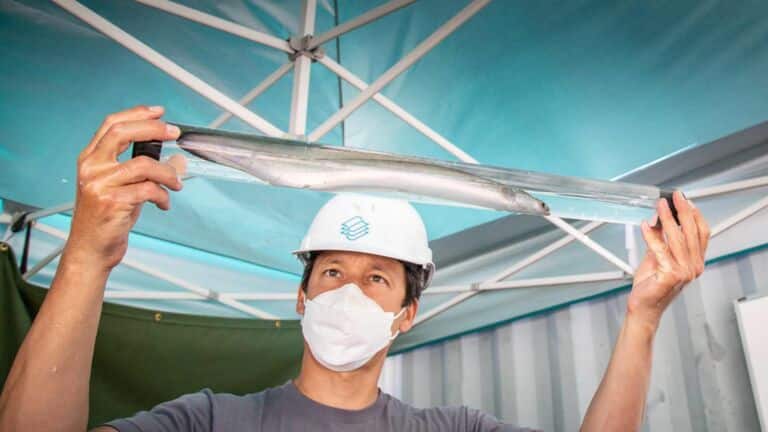
The Windbelt, as he named it, is disarmingly simple. A taut membrane is stretched between two supports, and when wind flows across it, swirling vortices set it vibrating rapidly back and forth.
Small magnets ride on the ribbon, sweeping past stationary coils. That movement induces an electric current, the same basic principle behind every generator ever built.
Because it feeds on vibration rather than rotation, it can stir to life in breezes far too weak to budge a bladed rotor.
No blades. No gearbox. Almost nothing to wear out or break.
Early prototypes lit a couple of LEDs and ran a small radio on nothing but the wind from a household fan, using materials that cost under ten dollars.
The number that made the headlines
Here is where the story needs care.
Frayne claimed his prototype was 10 to 30 times more efficient than the best micro-turbines of the day, and that figure raced around the internet for years.
But it was his claim, not an independent result. When researchers later put flutter devices on the test bench, the measurements came back far lower than the marketing suggested.
Tested versions produced efficiencies of well under one percent, while conventional turbines typically convert one to ten percent of the wind’s energy. Most flutter harvesters built since have landed below turbines, not above them.
In one assessment a small Windbelt managed only a fraction of a milliwatt in a gentle breeze, climbing to a few milliwatts as the wind picked up — real, but a long way from the language of revolution.
The honest version is narrower, and more useful. At the very smallest scales, where tiny rotors barely turn at all, the Windbelt can still be the better tool — not because it beats turbines everywhere, but because turbines are simply bad at being tiny.
Where it actually shines
Stripped of the hype, the Windbelt still does something real.
In low, gusty, unpredictable wind — the kind that makes a small rotor stall — a vibrating ribbon keeps working. It can trickle-charge a battery, feed a sensor, or power an LED in places a turbine would simply sit motionless.
Picture a humidity sensor buried in a building’s air duct, quietly powered for years by the draft moving past it, with no battery anyone ever has to climb up and replace.
That makes it genuinely useful for small, distributed, human-scale power: wireless sensors tucked inside buildings, off-grid lighting, and the everyday airflow we usually ignore, right down to the breeze through an open window.
It was never going to replace a wind farm, and Frayne said exactly that himself.
The quieter legacy
The Windbelt never became the revolution its biggest headlines promised.
Humdinger, the company built around it, faded. Frayne moved on to other inventions, among them a small machine for printing low-cost solar panels. Wide commercial deployment of the Windbelt never truly arrived.
Yet the maker community kept the idea alive, rebuilding Windbelts from scrap parts and proving the concept still works on a kitchen table.
And the deeper lesson survives intact. Sometimes the smartest move is not to spin faster but to move differently, expanding what wind power is even allowed to look like.
The trembling ribbon was never a miracle. It was something rarer in clean energy — an honest, useful idea that knew its own size.
Read the whole thing?
Get the week's signal, not the noise
Our sharpest reporting on energy, climate and nature — free, once a week.