
Picture a flat, sun blasted basin in the California desert, the kind of place most people would call empty.
For thousands of years it belonged to a creature that moves at its own unhurried pace and asks for almost nothing in return.
Then the machines arrived, the animals were carried away, and conservationists braced for the worst.
What happened next, out among the rows, is not the story anyone wrote in advance.
An animal built for a place that punishes everything else
The Mojave is one of the harshest landscapes in North America.
Summer ground heat can be brutal, and the rain can skip an entire year.
The resident at the center of this story has endured there for millions of years by doing very little, very slowly.
It can live to around eighty, and go more than a year without a sip of water.
To beat the heat, it digs.
A burrow a few feet down stays cool while the surface bakes, and the animal waits out the worst months below ground.
In spring it surfaces to feed on wildflowers, then retreats again.
It is perfectly tuned to a place that kills most things, which is exactly why it has so little room to spare when that place shifts.
Why the open desert turned into a trap
For all its toughness, this animal carries one real weakness.
Its young hatch tiny, with soft shells, and stay nearly defenceless for years.
A hatchling the size of a cookie has to hide from ravens, coyotes and badgers long enough to grow armor.
Cover is everything.
That cover comes from low desert shrubs, the scrappy plants that throw a little shade and break a predator’s line of sight.
Where the shrubs thin out, the babies are exposed.
And across the Mojave, the shrubs have been thinning.
Drought, grazing, off road vehicles and new roads have all chipped away at the ground cover these animals lean on.
So the open desert, the supposedly pristine wild, had already become a harder place to be young and small.
The danger was there long before any panel was bolted down.
What everyone expected when the machines moved in
When developers came for this desert, the conflict looked obvious.
Big energy projects need flat, sunny, open ground, which is precisely the animal’s home.
At one enormous site, surveys expected fewer than twenty of them.
Crews ended up finding more than a hundred and fifty, then had to gather them up and move them to holding pens before release nearby.
Relocation is punishing for a creature that maps its entire life onto a few hundred metres of ground.
At another project, biologists shifted well over a hundred animals across a road, and within weeks dozens were dead, likely taken by badgers during a drought.
So the early headlines wrote themselves.
Clean energy, it seemed, came at the cost of one of the desert’s most fragile natives. That looked like the end of the story.
The discovery that flipped the whole picture
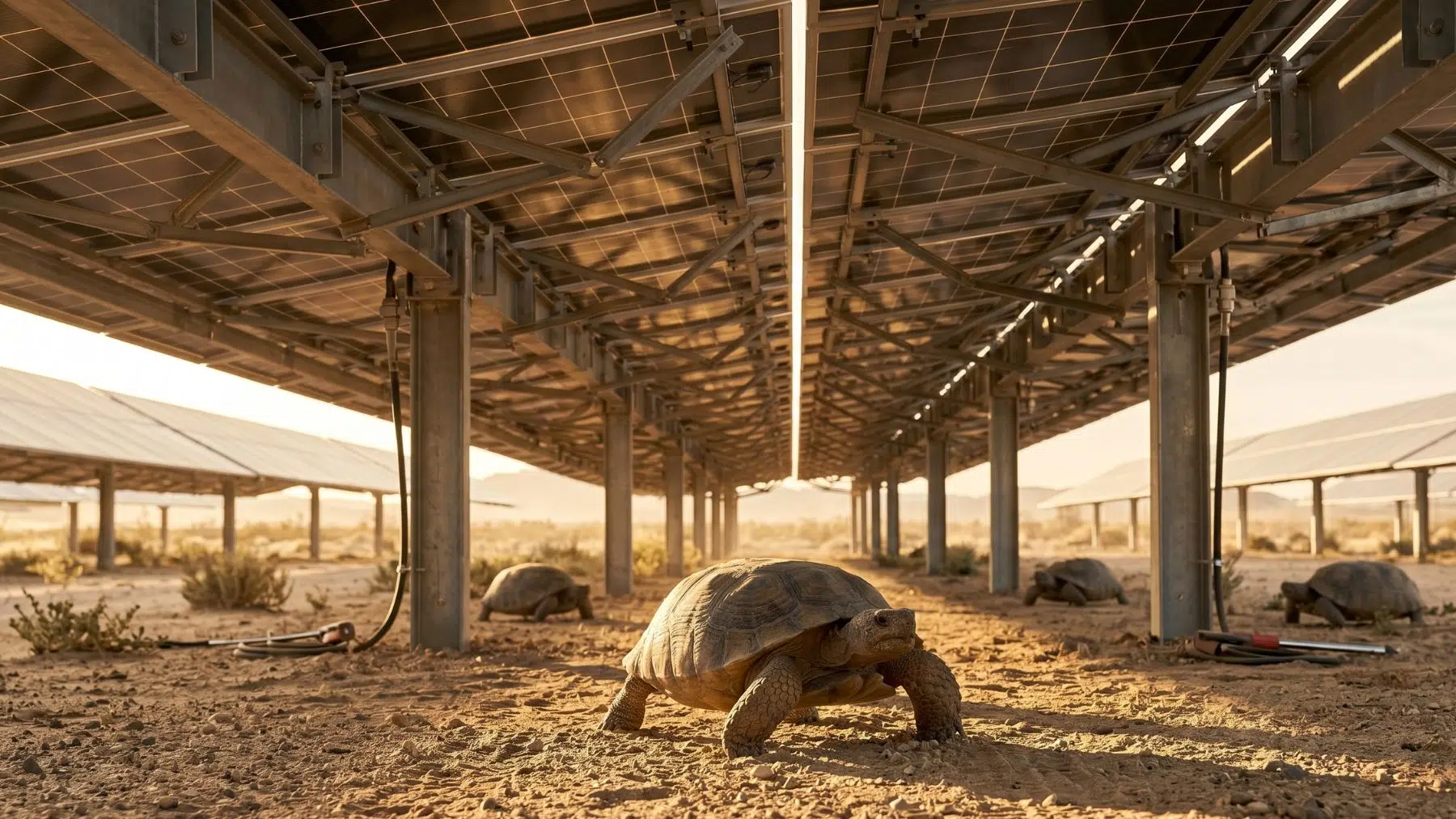
Then researchers looked closely at the desert tortoise living in and around a working solar farm in Nevada, and the picture flipped.
At one community solar site, crews had cut tortoise sized gaps in the fence so the animals could wander in and out.
Inside that fence, the low plants the young tortoises shelter under were growing better than in the open desert beyond it.
The panels themselves were the reason.
Their shade and the way rain ran off them had reshaped the local microclimate and the soil moisture, and the desert shrubs responded by thriving.
It was the same twist that has turned other clean energy sites into accidental habitat, the way a North Sea wind project became a reef.
A federal wildlife biologist watching the project found the plants most vital to tortoise survival were doing better inside the array than outside, as first detailed in solar industry coverage.
When the slowest animal in the desert gets a second chance
None of this makes a solar farm a simple gift to the desert.
The relocations are still risky, and the deaths at that other Nevada project, reported in the local press, are a real warning about moving animals through a drought.
The lesson is narrower and more useful. Design decides the outcome.
Fence gaps, a lighter footprint and shade in the right places can tip a site from a wall into a refuge.
Biologists are leaning into it.
Teams from two universities now raise young tortoises in protected pens until their shells harden, a head start that sharply lifts their odds before release.
There is something fitting in an animal that survives by waiting finding shelter under the very machines built to harvest the sun.
Above the panels, the desert keeps making power, the way other odd pairings of wildlife and hardware, like lobsters claiming a wind farm, keep catching us off guard.
Below them, in those thin strips of shade, the slowest resident of the Mojave may have found an unlikely place to begin again.
Read the whole thing?
Get the week's signal, not the noise
Our sharpest reporting on energy, climate and nature — free, once a week.


