
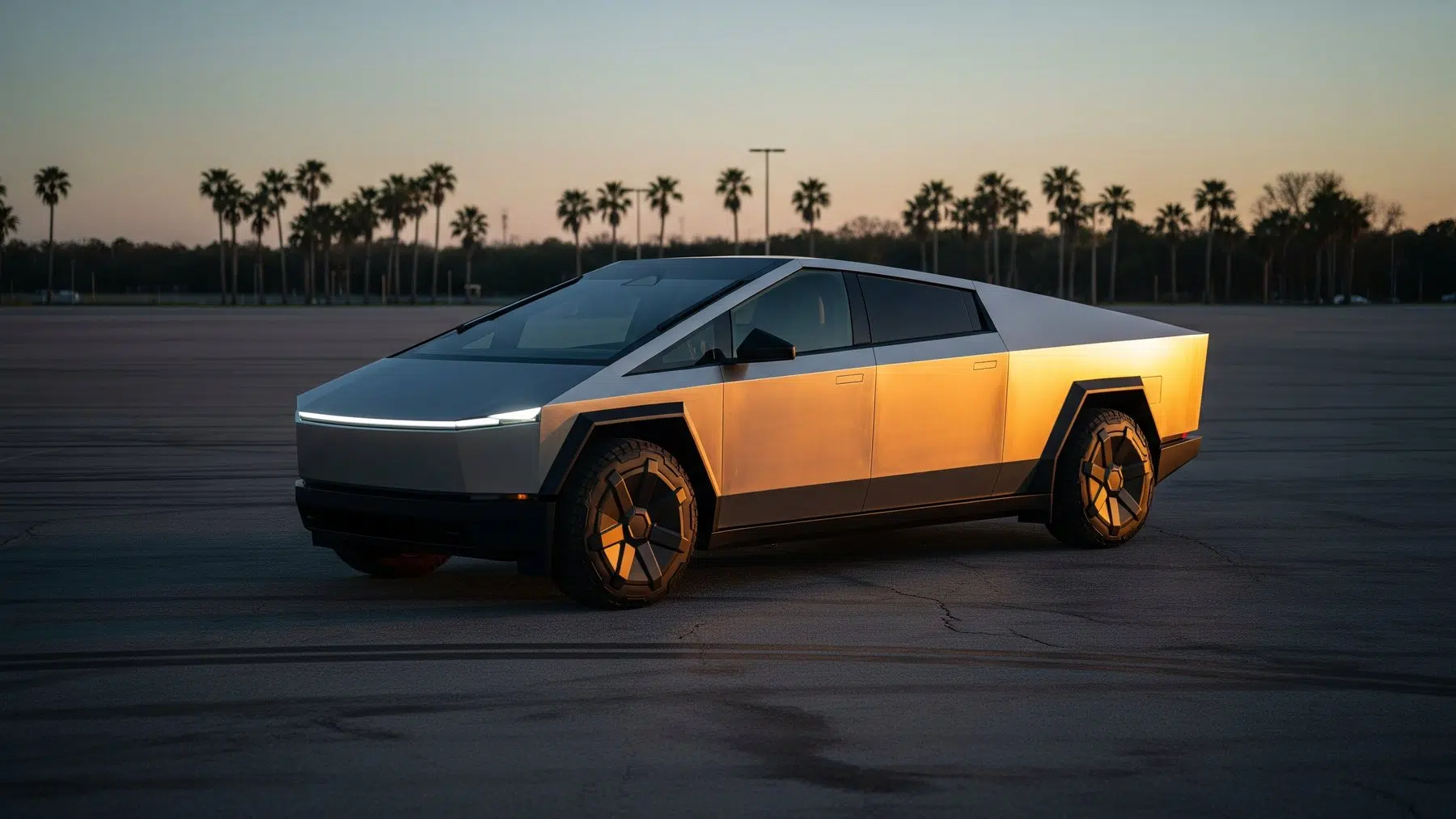
It started as an ordinary Wednesday afternoon at a Tesla dealership in Tampa, Florida.
A man walked in, met with a salesperson, and signed an agreement to take a brand new Cybertruck Cyberbeast out for 30 minutes.
The 30 minutes came and went.
Then an hour. Then a day. Then five days.
What happened next revealed something hiding inside that truck that most drivers never know is there, and it raises a genuinely strange question about where this machine was always headed.
The agreement he signed and the truck that disappeared
On March 26, 2025, Dexter Smithen went to a Tesla dealership, met with a salesperson, and chose to test drive a Cybertruck Cyberbeast.
He handed over his driver’s license and signed an agreement to return the vehicle within 30 minutes.
He did not return.
The salesperson called the phone number Smithen had listed on the agreement, but it was disconnected.
Then the salesperson emailed Smithen directly, demanding the return of the Cybertruck.
No response. No truck. No Dexter.
To most people watching from the outside, it looked like a clean getaway in one of the most recognizable vehicles on American roads.
The detail that should have been obvious, but wasn’t
Here is the thing about stealing a Cybertruck, it is arguably the worst choice of getaway vehicle in automotive history.
The truck is built from cold rolled stainless steel, angular enough to be spotted from three blocks away, and carries no camouflage whatsoever.
But the more important problem is invisible.
Every Tesla ships with a live geolocation system woven into its onboard computer, constantly pinging its position to Tesla’s servers.
A salesperson used that tracking to locate the vehicle on March 31, discovering Smithen had driven it to a Home Depot and walked inside.
That salesperson retrieved the truck from the parking lot.
At that point, most people would have assumed the chapter was closed.
The part of the story that nobody predicted
Smithen came back.
On April 1, 2025, he returned to the Tesla dealership, telling a deputy he had gone back to retrieve belongings left inside the Cybertruck.
Deputies were waiting for him.
While searching Smithen, a deputy found five credit and bank cards in the names of five different people.
He was charged with grand theft of more than $100,000 and unlawful possession of personal identification.
The Cybertruck had effectively become a rolling trap.
But the deeper story here is not really about the theft at all.
It is about what a modern electric vehicle actually is under the surface, and what that machine has in common with something designed to move through water.
The hidden system every Cybertruck buyer should know about
The tracking system that recovered the stolen vehicle is part of a broader architecture of real time connectivity built into every Tesla on the road.
The truck knows where it is, who is driving it, and how fast.
But the Cybertruck’s relationship with the physical world goes further than software, and this is where the story gets genuinely strange.
The Cybertruck’s Off Road Mode includes a feature called Wade Mode, which raises the air suspension and pressurizes the battery pack to protect it from water intrusion, enough to ford rivers and shallow crossings up to about 31 inches deep, but not deep water.
Lars Moravy, Tesla’s vice president of vehicle engineering, demonstrated the feature on Jay Leno’s Garage and noted that Elon Musk had wanted to make it a boat, adding that the vehicle almost floats and that a creative owner could attach an electric outboard motor to the truck’s power outlet and go boating.
Elon Musk responded on X in December 2023, saying Tesla planned to offer a mod package to let the Cybertruck cross at least 100 metres of water as a boat, a claim that drew wide attention but has not yet arrived as a shipping product.
A Cybertruck, in other words, was engineered with water in mind, even if the deepest ambitions for it remain, for now, on dry land.
You can read about the engineering of the world’s largest car carrier ship and the floating structures that move vehicles across oceans, but a pickup truck engineered to pressurize its own battery pack and push through a river crossing is something else entirely.
Then someone actually tried to make it a boat
In May 2026, more than a year after the Tampa theft, a driver in Texas decided to test the boat idea for real.
He drove his Cybertruck down a ramp and straight into Grapevine Lake near Dallas, telling police he wanted to try Wade Mode.
The truck slid through the shallows, then died the moment it turned deep.
It took on water and began to sink, and the driver and his two passengers, reportedly visitors from Germany, climbed out through the windows.
A fire department water rescue team hauled the swamped truck back to shore.
He was arrested on the spot, charged with entering a closed part of the park and, fittingly, having no valid boat registration.
Wade Mode was only ever built for slow, shallow crossings, not open lakes, and the boat package Musk promised in 2023 still has not arrived.
What the Tampa theft actually leaves behind
The Cybertruck’s stainless steel exoskeleton was always the detail people fixated on, the angular body, the cold industrial look, the truck that belongs in a science fiction film.
But the more consequential engineering lives in layers nobody sees, the sealed battery architecture, the live data connection, and the legal obligations tied to every vehicle on American roads.
The tracking system that caught Smithen is the same system that logs every trip and monitors battery health in real time.
Modern electric vehicles are not just machines.
They are networked objects, always connected, always reporting, and almost impossible to truly hide.
Geolocation data raises genuine privacy questions too, and reasonable people disagree about how much access manufacturers should hold over a vehicle an owner has paid for outright.
Still, on a Wednesday in Tampa, that invisible thread brought a stolen Cybertruck home and walked its alleged thief directly into handcuffs.
The machine knew exactly where it was the entire time.
Read the whole thing?
Get the week's signal, not the noise
Our sharpest reporting on energy, climate and nature — free, once a week.


