
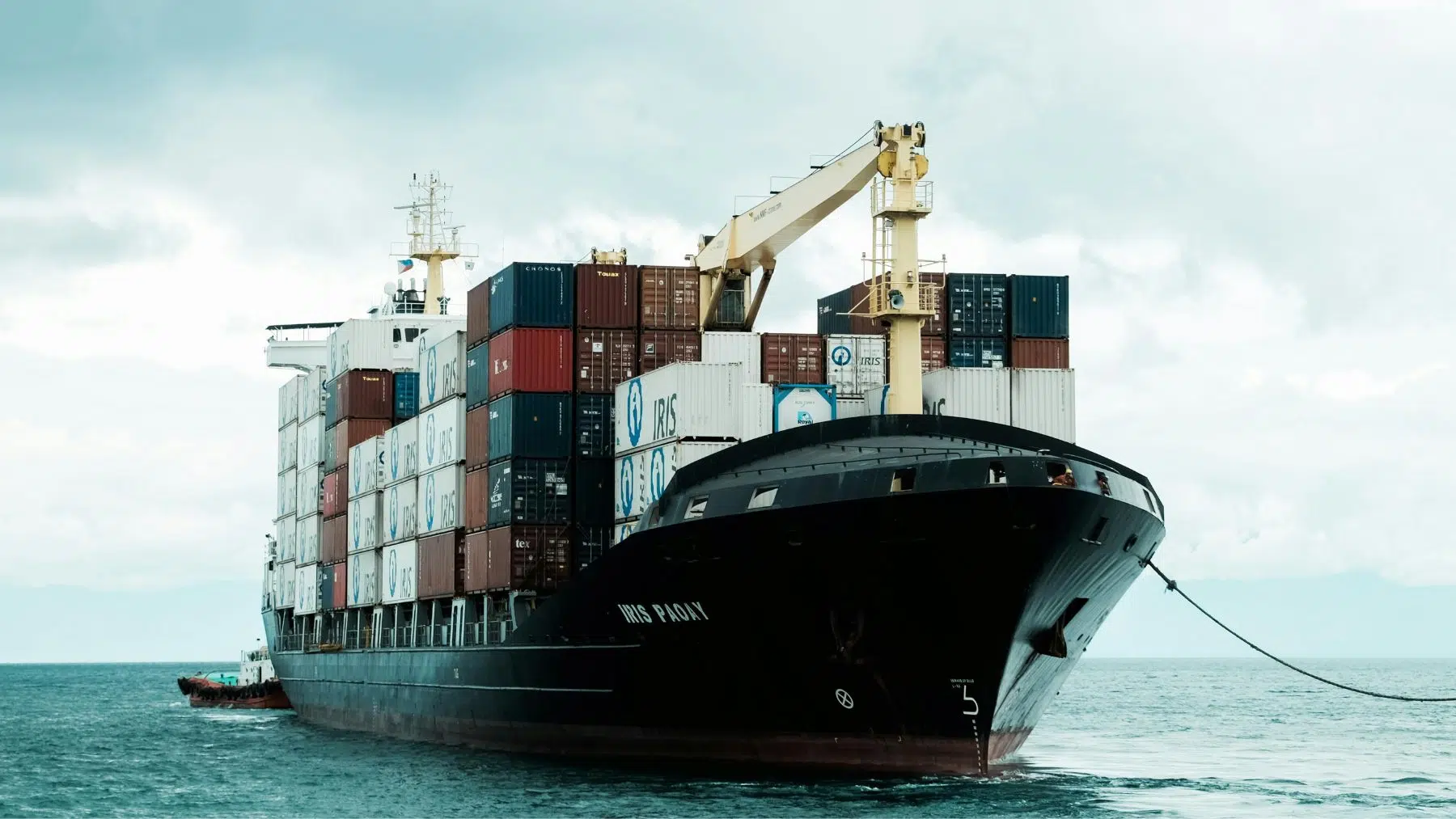
Picture a cargo ship the size of a city block, loaded with 100,000 tons of steel, grain, or fuel, drifting into a bay and coming to a stop. Someone on the bridge gives an order. A chain clatters, a splash follows, and the vessel holds perfectly still for days. Most people watching from shore assume the anchor is doing the work. They are almost entirely wrong.
The object everyone pictures is not what they think it is
The anchor that breaks the surface on old paintings and tattoos is an icon, but as a piece of engineering it is almost secondary. Its real job is surprisingly modest. It is a hook that buries itself in the seafloor, but on its own it cannot hold a ship the size of an apartment complex against tide, wind, and swell.
The anchor alone, simply dropped and left, would drag almost immediately.
So sailors do something that looks counterintuitive. They keep paying out chain, far more than the depth of the water requires, until a long belly of iron links settles flat across the seabed.
Why the chain matters more than the anchor itself
The anchor is heavy for a reason, but that reason is not to hold the ship in place. It is to help hold the anchor chain in place. The chain is the real star of the show.
When a ship drops anchor, sailors release a long length of chain. The chain does not stay straight. Most of it sinks and rests on the seabed, creating a gentle curve that engineers call a catenary.
The goal is not a straight line to the anchor. The goal is a long heavy belly of chain lying flat on the seabed for a significant distance before the anchor itself even begins.
Ships release far more chain than the water depth demands. Sailors follow a rule called the scope ratio: for an all-chain rode, a scope of around 4:1 is generally workable, while rope-and-chain rodes typically require considerably more, often 7:1 or greater.
The invisible physics pulling against the ocean floor
An anchor’s holding power depends entirely on maintaining a horizontal shank angle. When the shank is horizontal, the pulling force acts parallel to the seabed, driving the flukes forward through the substrate rather than upward out of it.
As soon as the shank angle rises, the force gains an upward component, and holding power falls away sharply. The chain’s weight bends the pull back down toward the seafloor, ensuring that when the ship tries to drift, the pull on the shank stays horizontal rather than angled upward and extracting.
The chain also absorbs the shock of every wave that hits the hull, stretching and relaxing like a vast metal spring. It is a system built entirely on geometry, not brute force.
The catenary curve shows up in the most unexpected places
The same mathematical curve, the catenary, appears wherever engineers need to distribute a heavy, moving load without a rigid structure. The most familiar example above water is a suspension bridge cable hanging between its towers: gravity and tension find equilibrium in exactly the same shape that keeps the anchor chain pressed against the seabed.
The geometry is sturdy enough to move extraordinary weights. NASA’s crawler-transporters at Kennedy Space Center, which carry assembled rockets to the launch pad along a roadway surfaced with Alabama river rock chosen for its hardness and roundness, travel at a maximum speed of just 1 mile per hour when loaded. For the Artemis I mission that combined load reached approximately 21.5 million pounds in motion, a reminder of how seriously engineers take the forces that geometry must absorb.
Those are the same physics keeping a supertanker still in a harbour right now. You can also see the chain’s forces at work on a 1,000-foot ship nudging under a century-old bridge, where every force on the hull transmits through chain and water in ways that shift the clearance by inches.
And that chain lying dark on the seafloor is far from lifeless. Anchor chains accumulate barnacles, mussels, and tube worms within weeks, and a dragging chain can plow a furrow through a seabed teeming with organisms, flipping coral heads and scattering reef fish sheltering beneath them.
A system older than history, still full of surprises
Sailors have used versions of this chain-and-hook system for thousands of years, long before anyone could write down the mathematics of a catenary curve.
Anchors do not hold ships in place simply because they are heavy. They grip the seabed, and the weight of the chain does the invisible heavy lifting in the water column above them.
Modern anchor design keeps refining the geometry. New-generation anchors are engineered to orient themselves correctly the moment they hit the bottom, turning physics and geometry into active advantages.
Marine scientists continue to study how to reduce anchor drag on fragile reef systems, and that work is slowly changing where and how ships moor. But the engineering at the heart of it remains one of the most elegant solutions in all of transport: a curve of iron, lying in the dark, holding a small floating city perfectly still.
Read the whole thing?
Get the week's signal, not the noise
Our sharpest reporting on energy, climate and nature — free, once a week.


