Fish moving towards a hydroelectric dam will likely encounter significant difficulties.
Hydroelectric dams generate electricity. However, these structures create barriers to migration routes used by fish for years and, in some cases, centuries.
Engineers typically solve this issue with ladders, elevators, or fish passage systems that help fish migrate upstream.
A project in Connecticut is testing a different approach to helping fish move past dams.
Where the river becomes a barrier
Rivers are not simply conduits of water. They represent critical migration pathways for numerous species throughout their life cycles.
A barrier, such as a dam, can significantly disrupt those pathways.
This may make it harder for fish to reach vital areas, including spawning sites and other critical habitats. For many years, engineers have developed fish passage systems to reduce the impacts of dams on fish migration.
Traditional solutions include fish ladders, elevators, and bypasses.
Bypasses divert fish around an obstacle instead of requiring them to pass directly through it.
Many migratory species repeatedly return to the same watercourse annually. Even relatively small barriers can disrupt these migrations.
A different way past the dam
FirstLight and Fishheart Ltd. collaborated to investigate an innovative alternative at the Tunnel Generating Station in Preston, Connecticut.
This is the first large-scale implementation of Fishheart’s Hydraulic Fishway Technology in North America.
First Light Energy says the Connecticut project is also evaluating whether the system can provide a practical solution for helping fish move past dams.
The hydraulic fishway system consists of a flotation unit below the dam connected to a tube spanning the structure. Attraction flow guides fish into the passage system, where they are moved safely upstream past the dam.
Unlike most traditional fishways, the Fishheart design is intended to be both mobile and adaptable.
It can be modified as river conditions change and to improve attraction for migrating fish.
Species targeted in the Connecticut project include American Shad and River Herring. Both are significant restoration targets because their populations declined after barriers prevented them from reaching upstream habitat.
Wildlife managers have considered restoring those migration routes a high priority ever since.
The project will determine whether the system can successfully guide fish past the dam. It will also demonstrate whether it can provide a more cost-effective alternative to traditional fish passage methods.
The project will run for 3 years. Researchers and operators are assessing how effectively fish locate and successfully use the passage system.
If successful, the technology could become a more flexible option for other similar facilities throughout North America.
Advances in underwater technology, including work carried out by UCC Dive, continue to support research and monitoring projects in aquatic environments.
Where every fish leaves a record
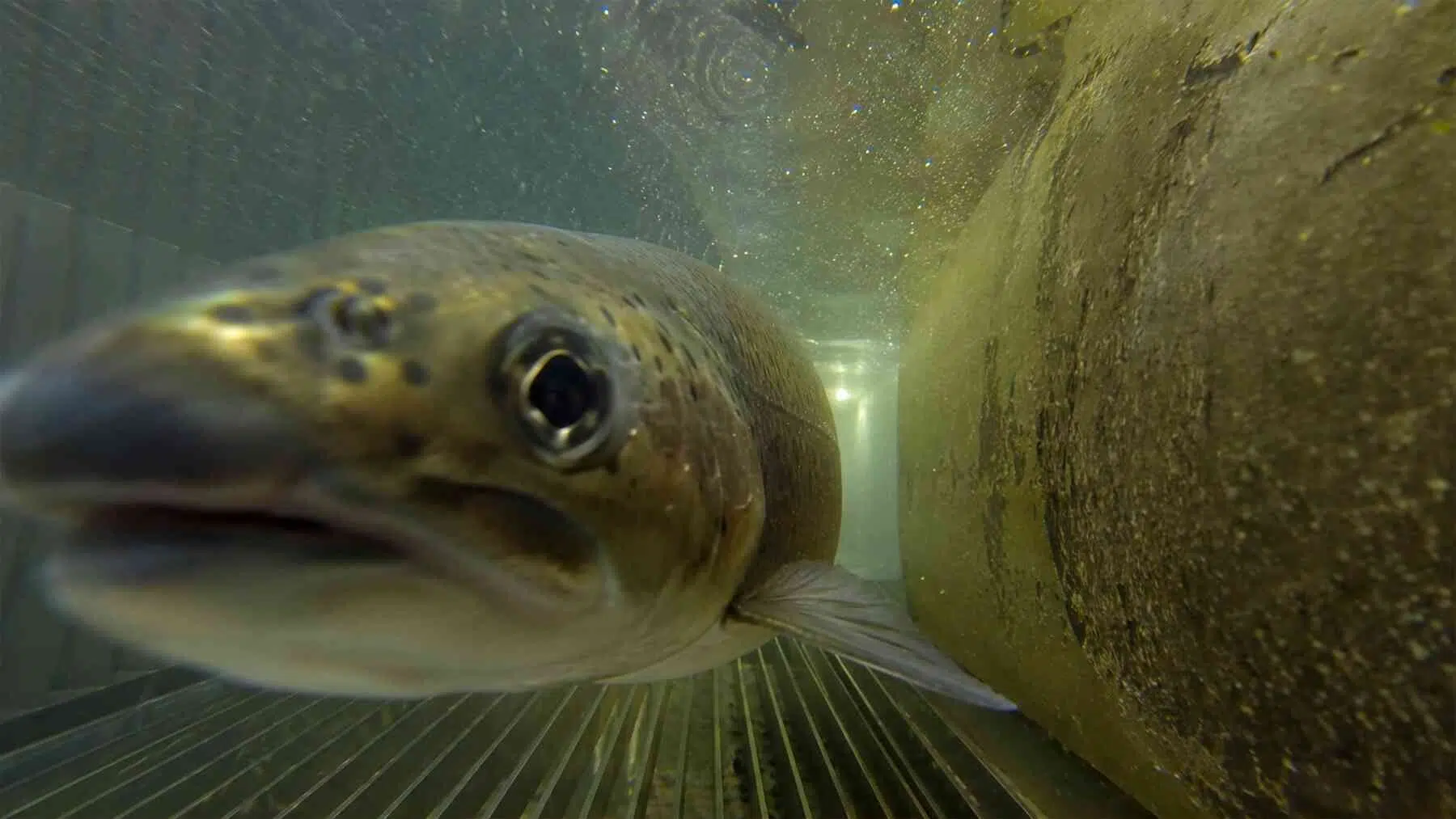
Fish are detected by Artificial Intelligence (AI) systems within the tube when they enter.
Once detected, AI collects photographs and migratory data in real time.
The AI identifies each species and records measurements while cameras capture images as fish travel through the passage system.
Each passage produces one image and one data record for every fish moving through the hydraulic passage system. Because of this, researchers and observers often refer to the process as a “fish selfie.”
One fish at a time
Researchers can analyze the data without physically handling or disturbing each individual fish during migration.
The information helps researchers better understand local migration patterns, seasonal movements, and fish behavior at the dam.
It also allows them to evaluate the effectiveness of the passage system, including species utilization. Each fish’s objective is simple—they continue their journey upstream.
For scientists, each passage provides another image and another piece of information about how fish navigate rivers affected by man-made alteration.
Read the whole thing?
Get the week's signal, not the noise
Our sharpest reporting on energy, climate and nature — free, once a week.