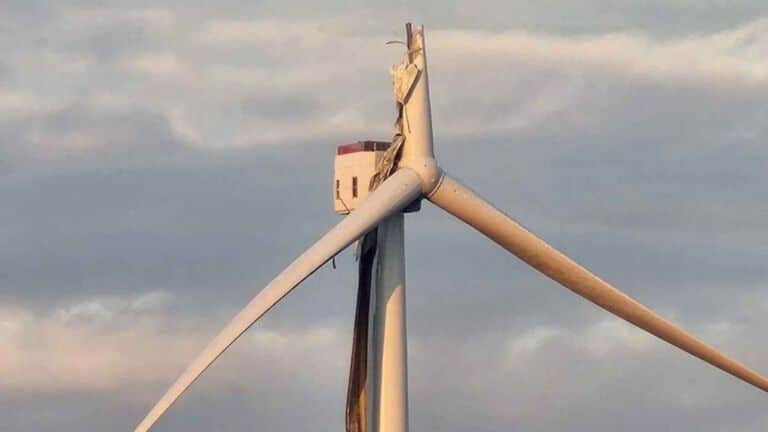
A wind turbine blade spends about two decades facing straight into the weather, and one narrow strip along its front edge takes the worst of it.
Rain hits that edge far faster than anything on a highway.
Grit follows.
Over time the surface pits, roughens, and the blade quietly loses power.
For years the industry’s answer was to patch the damage, recoat it, or in bad cases replace the entire blade.
A team in Germany asked whether only that one strip needed to come off at all.
Why a blade’s leading edge fails before anything else does
The leading edge is the first surface wind and rain meet as the blade sweeps around, so it absorbs a battering the rest of the blade never feels the same way. Rotor blade tips reach speeds of more than 185 mph in full load operation, and at that speed raindrops act on the surface like sandpaper, pitting it grain by grain over years of spinning.
That roughness matters more than it sounds. Once the smooth profile breaks down, air no longer flows cleanly over the blade. A heavily eroded blade can cut a utility scale turbine’s annual energy production by up to 5 percent.
Engineers at a German applied research institute, working inside an EU project, zeroed in on this single failure point. Their reasoning was blunt: the leading edge is typically the first part to wear, and if it cannot be replaced as a module, the entire rotor blade becomes unusable.
What the usual blade looks like, and why nothing comes apart
Picture a conventional blade: two half shells of glass fiber laminate, molded separately and then bonded together into one closed structure, with cores and internal webs sealed inside. Blades built this way run well over 260 feet, and the bonds are meant to hold for the life of the machine.
A blade that is sound everywhere except that battered edge still comes off the turbine in one piece.
The adhesive holding the laminate together does not distinguish between the edge and the spar, so the waste piles up for a reason that has little to do with the rest of the structure.
The small, swappable piece at the front of the blade
Instead of one inseparable shell, the research blade uses a modular design, with a continuous load bearing spar down the middle and every other component bonded around it. The project’s lead engineer and his partners made the leading edge from thermoplastics reinforced with natural fibers, replaceable thanks to a detachable adhesive joint. “The goal is that the blade regains the efficiency of a new one simply by replacing the leading edge,” the lead engineer said of the design.
Rather than a permanent cure that locks every layer together, the bond can be released on purpose when the edge wears out, and a fresh strip goes on in its place.
Natural fiber reinforced thermoplastics also fit reuse and recycling better than glass fiber systems, since natural fibers lose their reinforcing effect gradually instead of abruptly.
How the team actually built and showed the piece
The demonstrator is not a drawing on a slide. The institute presented the wind turbine demonstrator at a Munich trade fair in spring, showing a blade segment so visitors could see the spar, the surrounding components and the replaceable edge. Its ribs were cut from a decommissioned rotor blade, as an example of reusing end of life material.
Behind it sits a manufacturing shortcut too. The approach uses pultrusion, where continuous fibers are drawn through a resin bath and cured in a heated die, so the spar becomes a continuous profile simply cut to length.
Roughly 20 partners from research and industry across Europe worked on the project, coordinated by a technical university in Italy.
What still has to be proven before this reaches a working turbine
None of this means every turbine on the horizon will carry a peel off edge next year. The piece shown in Munich is a demonstrator segment built to prove the joint and the materials work together, not a blade that has logged years spinning in open weather. Real turbines face salt spray, hail, ice and decades of fatigue cycling a trade fair floor cannot replicate.
Even so, the problem it targets is enormous, since Europe has been accumulating tens of thousands of tons of composite wind turbine waste each year, with landfilling barred under EU rules.
Smaller swap outs already make sense elsewhere in engineering, the way crews track fish through a dam’s spiral turbine in Connecticut, or the way an idle geothermal well in Northern California got a second use instead of being capped for good.
If the detachable edge holds up through real seasons of wind and rain, the payoff is simple: a crew pulls off just the damaged strip, fits a fresh one, and sends the turbine spinning on.
Read the whole thing?
Get the week's signal, not the noise
Our sharpest reporting on energy, climate and nature — free, once a week.