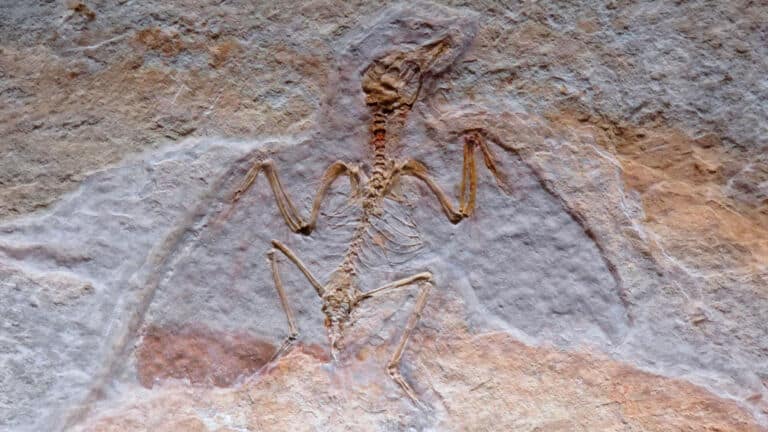
A scientist working in South America uncovered several massive fossil bones during the 1980s.
Researchers quickly realized the remains belonged to a predator.
The animal had heavy limbs and a powerful skull built for hunting and feeding.
But there was an issue for the researcher.
The fossil was incomplete.
Some bones had eroded away.
Others were still trapped underground. Researchers could not fully picture the creature that once carried them.
Years passed.
Then computer imaging changed the story.
What had the scientist found and how was it “brought back from the dead?
Why the fossil left paleontologists confounded for decades
The first remains came from layers of rock dating back millions of years.
Researchers knew they were dealing with a giant theropod.
A relative of an ancient predator that roamed the Earth.
The evidence was persistently confusing.
A few bones can reveal size.
They cannot always reveal identity.
That uncertainty kept the fossil in scientific limbo for years.
Some believed the animal belonged to a known species already described elsewhere.
Others argued it represented something distinct.
The debate had no end in sight as key sections of the skeleton were missing.
Without a skull or complete spine, researchers struggled to estimate posture and movement.
A normal procedure could not reveal the animal’s identity.
The turning point arrived after newer fossils from related predators were discovered.
Those finds gave the experts comparison material they had never had before.
At the same time, digital reconstruction software opened a new door.
Researchers scanned the original fossils and started rebuilding missing sections virtually.
Which allowed them to test how the animal’s body likely fit together.
For the first time, the predator began looking complete.
How researchers rebuilt the ancient hunter from ancient history
The team relied heavily on digital modeling.
Each fossil fragment was scanned in significantly high detail.
The resulting images created a three-dimensional skeleton researchers could manipulate on computers.
Technology has reshaped the archaeological sector.
Missing sections were reconstructed using proportions from closely related carnivorous dinosaurs.
The process helped estimate body length, muscle attachment points, and balance.
The predator measured roughly 31 feet long.
Its skull appeared deep and heavily built.
Researchers suspect it hunted large plant-eating dinosaurs that shared the same environment.
The reconstruction also revealed details impossible to study decades earlier.
Scientists examined how the jaws likely moved during feeding.
They tested limb motion and body posture through biomechanical simulations.
That work transformed scattered fossil pieces into a functioning prehistoric animal model.
Researchers described it as bringing the dinosaur “back from the dead.”
Not literally.
But scientifically.
The animal could finally be studied as more than disconnected fossil fragments.
Its body shape, movement, and hunting behavior now existed in remarkable detail.
After decades of uncertainty, the predator had effectively returned, thanks to the efforts of Columbus State University.
What species researchers finally identified
Scientists concluded the fossil belonged to a giant predatory theropod that once dominated parts of prehistoric South America.
The animal likely sat at the top of the food chain within its ecosystem.
Its size and anatomy suggest it preyed on other large dinosaurs living nearby millions of years ago.
What researchers meant by “bringing it back to life”
The reconstruction happened digitally.
Scientists combined fossil scans, biomechanical analysis, and computer modeling to rebuild the predator piece by piece.
And each piece made the picture that much clearer.
The approach allowed researchers to study how the dinosaur may have moved, hunted, and fed.
For decades, the creature existed only as incomplete bones inside rock.
Now it exists as a full scientific reconstruction created through imaging technology and anatomy research.
Read the whole thing?
Get the week's signal, not the noise
Our sharpest reporting on energy, climate and nature — free, once a week.