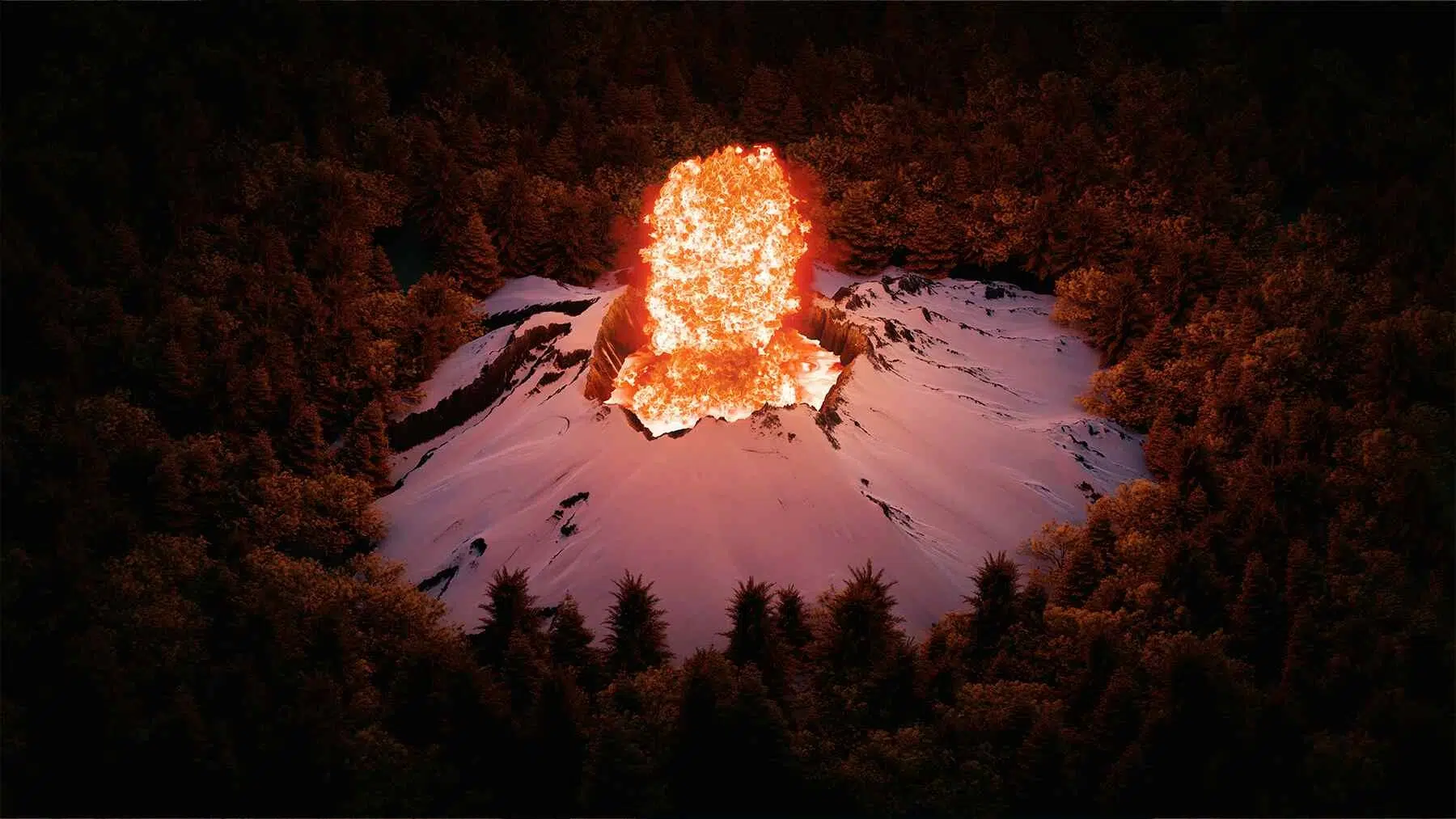
Seventy-four thousand years ago, Earth’s most devastating eruption shook the planet. Many researchers believed this cataclysm brought humanity to the brink of extinction.
The massive explosion completely reshaped the ecological record of prehistoric life.
Yet archaeologists digging in India kept unearthing highly unusual evidence.
Stone tools consistently appeared deep inside the thick, ash-covered ground layers. That bizarre detail quickly pushed researchers toward a completely different question.
A new breakthrough reveals something completely unexpected buried in the ash.
How did humans survive the Toba eruption all those thousands of years ago?
How shifting dirt revealed the truth about humanity’s closest brush with extinction
The Toba supereruption took place roughly 74,000 years ago on the Indonesian island of Sumatra.
It’s ash eventually spread across enormous parts of Asia.
Some deposits reached several meters deep.
Many experts suspected the eruption caused a near-extinction event among early humans.
Temperatures likely plummeted afterward, and rainfall patterns also shifted.
That theory shaped discussions about ancient migration for years.
Then, excavations in southern India complicated the picture. Researchers uncovered stone tools both below and above the ash layers.
The designs remained strikingly similar.
That mattered.
It suggested local human groups continued living there despite the eruption.
The discovery forced archaeologists to rethink previously established collapse theories.
Instead of a sudden disappearance, the evidence pointed toward human adaptation.
Our ancestors didn’t just survive the fallout—they rewrote the rules of survival.
How a missed clue in volcanic ash rewrote humanity’s darkest hour
Teams later examined the site using newer microscopic imaging methods.
That changed everything about the investigation.
Volcanic ash often preserves tiny fragments invisible during earlier excavations.
Researchers began isolating microscopic shards of volcanic glass trapped inside sediment.
Those fragments came directly from the Toba eruption.
The glass worked almost like a timestamp.
It helped archaeologists track exactly which human activity happened before and after the disaster.
That sequence became important very quickly.

The ash layer remained intact.
But the surrounding occupation layers showed continued tool-making activity.
People had returned repeatedly to the same landscape.
Researchers also noticed something else.
The stone tools themselves did not suddenly become simpler after the eruption.
The technology stayed stable.
That hinted that the communities retained knowledge despite environmental disruption.
Some scientists now think ancient groups survived because they already understood how to move across changing environments.
Small mobile populations may have adapted faster than expected.
Food-gathering strategies probably shifted as ecosystems changed.
The eruption still caused enormous damage.
But survival no longer looked impossible.
That gradual realization changed how archaeologists viewed one of humanity’s darkest environmental events, as noted by a report published in The Conversation.
This revealed how the ash hid something nobody expected.
The buried discovery that changed the survival timeline
The unexpected discovery hidden inside the ancient ash was microscopic volcanic glass. These tiny fragments are linked directly to the catastrophic Toba eruption.
The distinct chemical signature allowed researchers to precisely map human activity layers.
That breakthrough completely shattered previous archaeological assumptions.
Earlier theories argued that humans completely vanished from large regions after the fallout. The newly uncovered evidence suggested the exact opposite.
These incredible findings completely reshaped our ideas about early human resilience.
Instead of fragile populations easily wiped out by disasters, they thrived.
This realization changes how we interpret ancient climate catastrophes
The supervolcano released thousands of cubic miles of debris. Blinding ash spread across much of the vast Indian Ocean region.
Yet buried beneath those exact layers, archaeologists found undeniable proof that humans endured.
After seventy-four thousand years, the shifting dirt finally revealed the truth.
Those fragments allowed researchers to match human occupation layers with the exact timing of the catastrophe.
Proving there is so much more we are yet to unearth.
Read the whole thing?
Get the week's signal, not the noise
Our sharpest reporting on energy, climate and nature — free, once a week.