
Bare dirt will not stay put on a graded roadside slope.
So whoever builds there has to decide what covers it, and for fifty years the answer was mown grass.
Grass under a row of modules means a machine working between them all summer, ducking under glass, burning fuel.
There is another option, and nobody had tried it inside a fence like this one.
At an interchange in the west of the state, someone finally did, on one plot and not the next.
So what actually changes underneath?
Why the ground cover is an engineering choice
Grass is shallow. It holds the top few inches of soil and nothing below that.
Deep rooted native plants bind a slope the way turf cannot, which matters on an interchange built out of fill.
They also stop needing a mower.
A native stand is cut once a year or less, against something closer to monthly for turf through a southern summer.
Then there is the microclimate the panels themselves create.
Rows of modules throw moving shade across the ground all day, which lowers soil temperature and slows evaporation.
In a climate where midsummer normally shuts flowering down, that shade can hold blooms open weeks longer than the same species in open field.
And the fence line does the rest. Nothing inside it gets sprayed, mowed on a schedule or driven over, which is a rare condition on public roadside land.
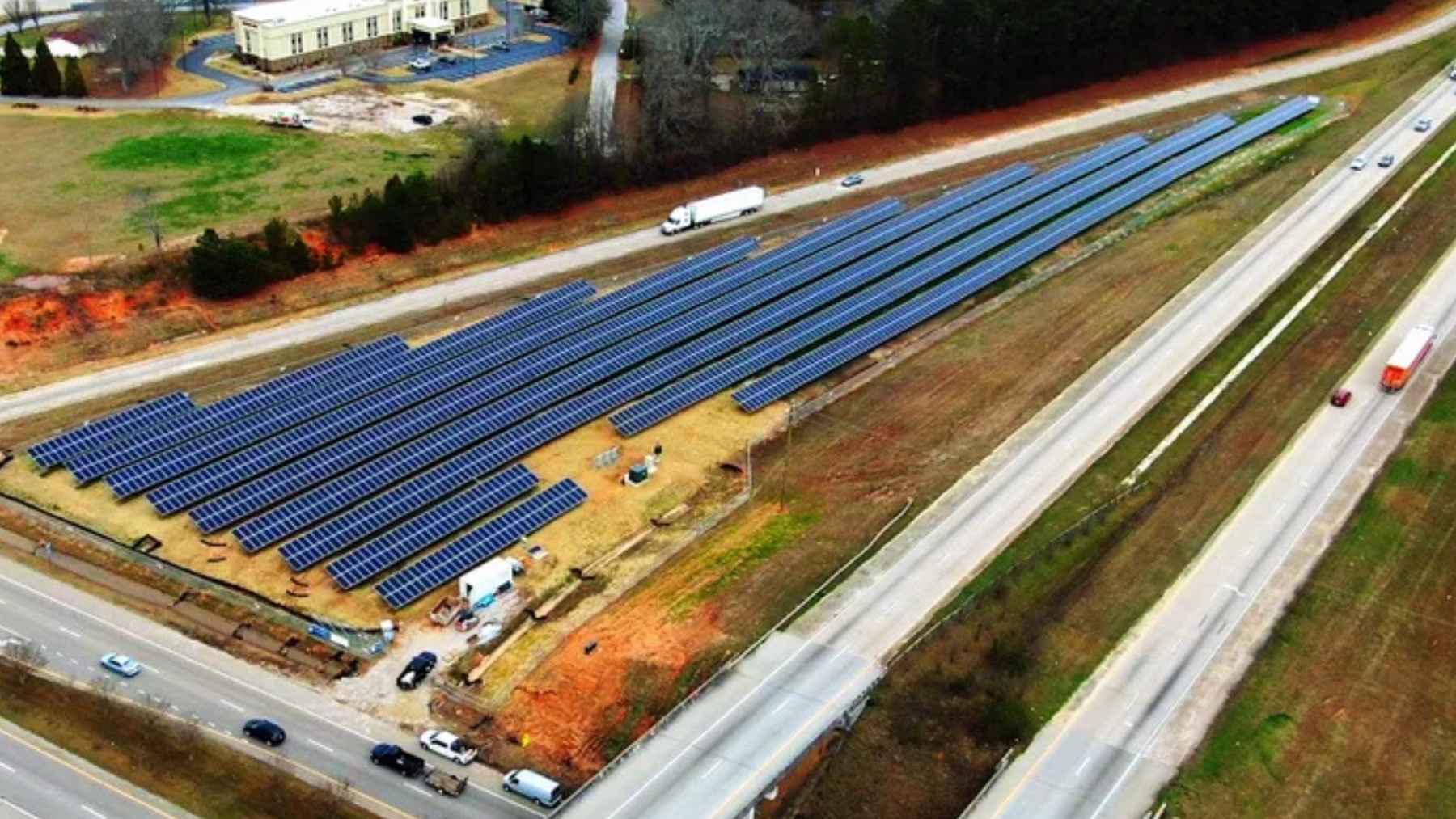
Four acres in a loop of the interchange
The site fills one quadrant of a diamond interchange in Troup County, on the stretch of interstate between LaGrange and West Point.
It is about four acres of land the transportation department already owned and could not use for anything else.
The array carries 2,600 panels, rated at 946 kilowatts direct current and 800 alternating, which is where the round megawatt figure in most accounts comes from.
The utility built it, owns it and operates it under a long term license on state land, and feeds the output to the grid.
The same project put 44 LED lights on all four ramps of the exit.
None of that is unusual. Utilities build arrays this size constantly.
The unusual part is that half the ground inside the fence was treated as an experiment.
What grew and what showed up
Construction ran through the fall of 2018 and the array started delivering power in the spring of 2019.
One half of the plot was seeded with partridge pea, milkweed, butterfly weed, verbena, black eyed Susan and Indian blanket. The other half stayed in conventional turf as a control.
By 2021, 84 percent of the seeded species were detectable on the ground and 72 percent were flowering.
Native bee numbers in the seeded half ran significantly above the turf half.
That comparison is the entire point, and it is what separates this from a landscaping decision.
The state was the first in the country to try pollinator ground cover inside a right of way array, though it was the third to put solar in interstate right of way at all.
Oregon and Massachusetts got there first with plain arrays.
What four acres cannot tell you
Higher bee counts inside a fence do not prove more bees exist.
Insects concentrate on flowers. A patch of bloom in a mown landscape pulls foragers in from the surrounding area, and nobody has shown whether the population grew or simply relocated for the afternoon.
It is also one plot, in one climate, at one highway solar array, watched for a handful of growing seasons.
The seed mix decides everything, and a mix weighted toward grasses produces almost nothing, which is how several roadside plantings elsewhere have underperformed.
Geometry limits it further.
Planting has to stay outside the roadway clear zone, and crews need mowed access lanes to reach inverters and fencing, so the flowering area is never the whole parcel.
The same caveat applies to other species reported on solar sites and to the ground nesting birds found inside fenced infrastructure.
How much roadside is actually in play
The land argument is stronger than the bee argument and gets quoted less carefully.
Work by an energy group at the University of Texas at Austin put the generation potential of interchange parcels along the interstate system at roughly 36 terawatt hours a year, close to 1 percent of national electricity use, on ground already cleared and owned.
The same analysis found most states hold somewhere between 440 and 6,600 acres of usable interchange area, which is a real number and a modest one.
Figures in the tens of thousands of acres circulate for single states, and those describe total right of way rather than land a utility could build on, as state broadcasting coverage of the corridor makes clearer.
Several transportation departments have since written pollinator requirements into their own solicitations, and the original announcement named that as the goal.
The result is not a habitat program. It is a maintenance decision that happens to feed insects.
Which is probably why it keeps spreading.
Read the whole thing?
Get the week's signal, not the noise
Our sharpest reporting on energy, climate and nature — free, once a week.


