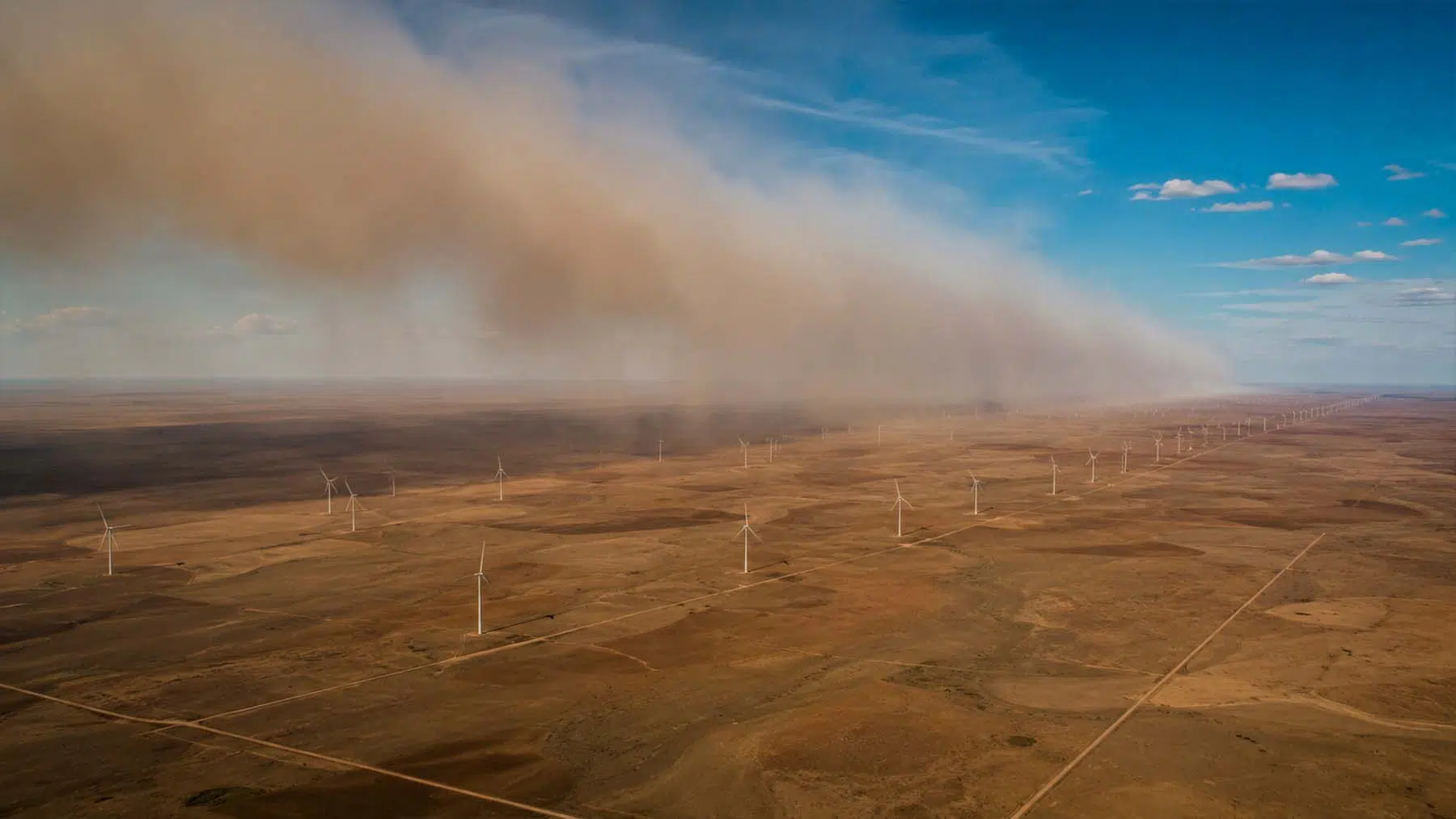
There is a change happening in the atmosphere above the Oklahoma plains that no one thought of before wind farms were installed there. The turbines are causing a change in the lower levels of air above the farmland. The currents do not move the same way that they used to.
The blades are slowing down the airflow, but there is more to it. One extensive installation is channeling air from the surface upward, creating an updraft.
What physical dynamics are at play that create this “river of wind” stretching high into the atmosphere?
How a wind farm’s footprint was picked up in the sky
The Kings Plain Wind Project occupies 60 square miles of countryside in the rural Great Plains area of Garber County, Oklahoma. The utility-scale installation incorporates 88 turbines, each with a generation capacity of 2.82 megawatts.
It is a significant producer of clean power to add to the local grid. However, when field researchers deployed advanced Doppler lidar systems into the atmosphere upwind and downwind of the site, they detected a surprising environmental footprint. One may think that the wake created by the spinning motion dissipates within a fairly short distance of the blades. This is not the case, and the kinetic effect of the turbine cluster can extend for miles.
Researchers say that rotor and atmospheric interactions are complex. The momentum of air is being altered in a way we could not have predicted before the boom in clean energy projects.
When atmospheric conditions are stable, particularly at night, the air around the wind farm does not behave like surface winds usually do. Velocity deficits were recorded downwind.
The airflow disruption needs to be explained so that effects can be tracked.
An air deficit in the boundary layer
The interaction of wind turbines with weather patterns needs to be understood as wind farming grows across the world.
Normally, the low-lying boundary of air at the surface absorbs the displacement created by the rotor motion through gradual horizontal mixing. But scientists looking at the King Plans installation picked up a far more extensive disruption on a structural level. Under nighttime conditions, when layers of air are stable, the Great Plains see regular low-level jets. These are fast-moving streams of air moving between 800 and 1,600 feet above the ground.
When the air movement gets closer to the surface, the wind farm does not block the air moving horizontally. Instead, the resistance of all the turbines forces incoming momentum vertically.
The structure of a wind farm means it becomes a soft barrier that displaces air and changes the height of the jet downwind. A high-altitude disturbance is created beyond the facility.
The mechanism behind the “river of wind”
Vertical momentum flux is the mechanism behind the changes in the atmosphere. The combination of 88 turbines pulling kinetic energy from the lower atmosphere produces turbulence above the rotors. The phenomenon functions in a similar way to a pump, moving momentum from the surface upward into the boundary layer of air. At the same time, high-velocity air is pulled to the surface.
When low-level jets pass over the atmosphere above the farm, this vertical mixing interacts with gravity waves in the stable night air. The combined forces lift air currents thousands of feet, and the result is a long-range corridor of moving air for miles downstream.
Turbine effects must be understood to avoid disruption to nearby sites
Learning about how surface energy projects change upper-air dynamics provides insight into optimizing clean energy layouts without disrupting neighboring sites. As utility-scale wind installations are installed across the Midwest, understanding these interactions ensures that energy generation remains efficient and reliable.
This study offers more information: Krishnamurthy, R., Newsom, R. K., Kaul, C. M., Letizia, S., Pekour, M., Hamilton, N., Chand, D., Flynn, D., Bodini, N., and Moriarty, P.: Observations of wind farm wake recovery at an operating wind farm, Wind Energ. Sci., 10, 361–380, https://doi.org/10.5194/wes-10-361-2025, 2025
Read the whole thing?
Get the week's signal, not the noise
Our sharpest reporting on energy, climate and nature — free, once a week.