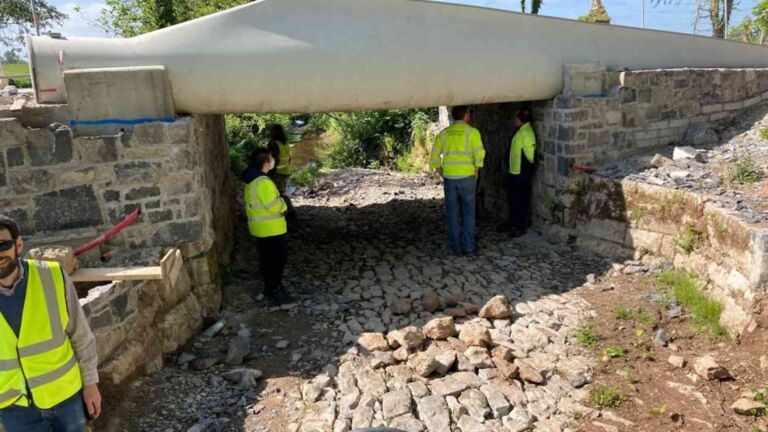
A wind farm runs right through a strong day and comes in far under what the wind should have given it.
Every mechanical check passes. The gearboxes are fine, the pitch system is fine, nothing is broken.
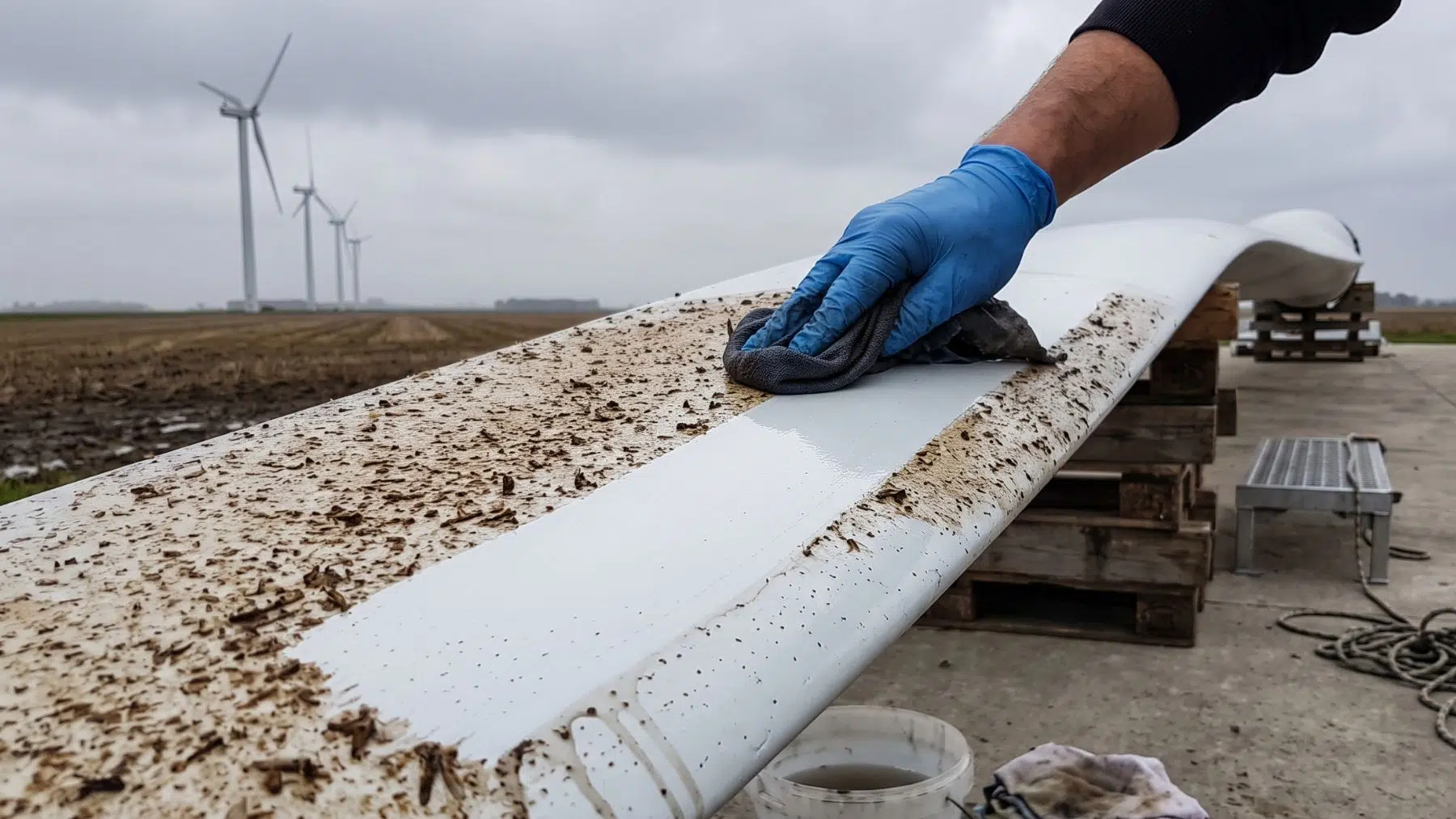
The problem is a brown crust a fraction of an inch thick, running along the nose of each blade.
It went on there during the calm week before, when nobody was losing anything at all.
That delay between the cause and the bill is what makes this so hard to catch.
The loss shows up on the wrong day
Insects fly in light air. On a still warm evening the sky over an open field carries an enormous amount of small moving biomass.
The turbine blades are turning slowly then, and every insect that strikes leaves a smear of residue welded onto the leading edge.
At those wind speeds the roughness costs almost nothing at all, so the machine keeps producing normally and nobody notices a thing.
Then the wind gets up, and the blade suddenly needs the airflow to stay attached across a much longer stretch of its surface.
That is precisely what a crusted nose prevents. The flow separates early, lift drops away and the power curve falls off a cliff.
The counterintuitive part is that a hard blow does not scour the blades clean. It collects the invoice for a quiet week.
How much output actually goes
Two different numbers get quoted for this, and they are emphatically not the same thing.
At high wind speeds the power a fouled machine makes can roughly halve, which is the figure that gave the original paper its title.
Measured across a season, the production loss comes out at up to 25 percent, because the high wind hours are only part of the year.
The work behind both was done by an engineer at a Dutch energy research centre and one at a Danish turbine manufacturer.
They used a flow visualization method to watch exactly where the air was breaking away from the surface, then traced it back to the leading edge.
It was published in the summer of 2001, which makes this a quarter century old and still the reference everyone cites.
Why the nose is so unforgiving
A blade is a wing, and a wing does its work through shape rather than through strength.
The leading edge meets the air first and sets up the flow for everything behind it, so a rough nose ruins the whole span.
Speed makes all of it worse. A modern rotor runs its blade tips at somewhere around 180 to 200 miles an hour.
Designers hold it below that ceiling deliberately, partly to avoid shock waves forming on the surface and partly because noise rises steeply with tip speed near housing.
So an insect meets the blade at highway speed, and the impact presses the remains into the surface rather than glancing them off it.
Which is also why rain does not solve it, and why the only reliable fix is somebody with a cloth.
The other side of the ledger
All those strikes add up to a second number that has nothing to do with electricity.
One assessment put the insect biomass lost at German turbines at roughly 1,300 tons across a single growing season, as the paper on the power effect never set out to measure.
Converted at an average body weight, that works out at somewhere near 1.2 trillion individual insects over a year.
Per machine it comes to about 40 million insects annually in temperate country, as the estimate lays out.
Those figures rest on stated assumptions and the author says so plainly, but the order of magnitude involved is not seriously disputed.
It is the same double accounting that follows an offshore array or a fenced solar site, where the energy ledger and the living one rarely get read together.
What anybody can actually do
The fix itself is embarrassingly simple, and awkward to get onto a schedule.
Wash the blades. The original paper says exactly that in its final line, and the power comes straight back afterwards.
The awkward part is that the nose in question sits 300 feet up or higher, which means a lift, a rope crew or a specialist rig.
None of that appears in the maintenance plan a turbine was sold with, because the plan was built around bearings and bolts.
Coatings that shed residue are being trialled on real machines, and early results look useful without yet surviving a full heavy insect season.
Until one does, a turbine can pass every inspection it has while a quarter of its output sits on the front of the blade.
Read the whole thing?
Get the week's signal, not the noise
Our sharpest reporting on energy, climate and nature — free, once a week.