
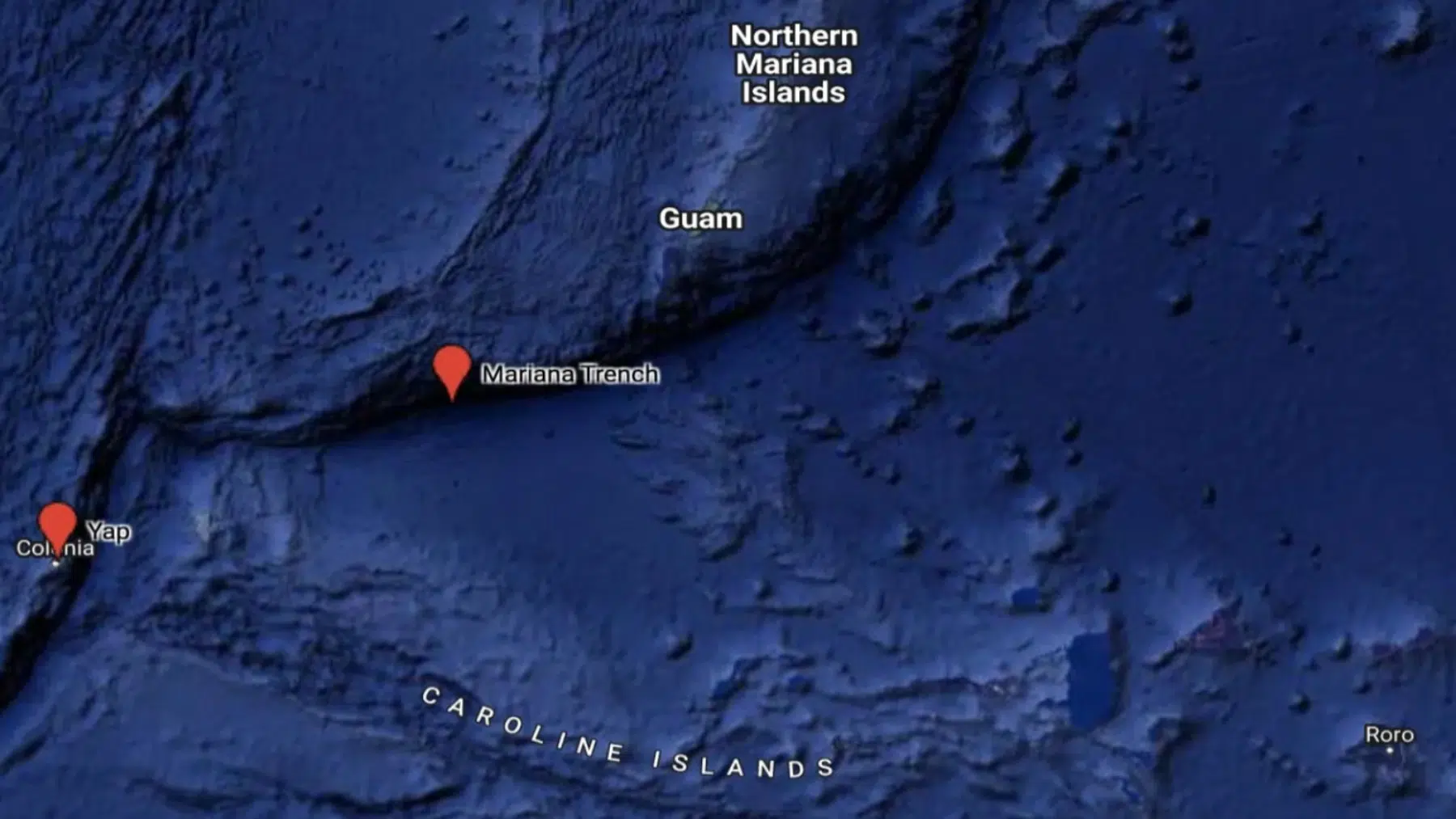
The deepest part of the planet’s ocean has been found and some say it looks like an alien world. This is because it is deep to the extent that one would conclude that the place cannot hold life but aliens. This deep ocean is called the Mariana Trench, plunging over 36,000 feet beneath the Pacific Ocean’s surface. It is the Earth’s mysterious abyss.
According to Geographical, the ocean is so deep, that you could fit the entire Mount Everest and leave a centimetre or two of space. The entire humanity will not be able to survive this place. There is no light because the sun cannot penetrate and so much unbearable pressure. However, it is interesting that, aside from its deepness and scariness, there are species that are living and thriving in this deep ocean of the Mariana Trench.
A journey into shadows: The shocking truths of the deepest oceanic pit
The Mariana Trench is described as the deepest, freezing dark abyss, and crushing pressures exceeding 1,000 times that at sea level. Such a place gives us the impression that it could be a world where only aliens are found and not normal living creatures. As I mentioned, the Mariana Trench is brimming with unusual species that have adapted to live and flourish in spite of these extremes.
What’s at the bottom, what are the inhabitants, and what have they recently found?
Research indicates that life exists in the Mariana Trench, which is also known as the Challenger Deep’s harsh environment. According to Gerringer, shrimp-like amphipods can be “really abundant.” “You’ll see hundreds of amphipods come to it very quickly if you put down bait,“ she explains. Examples of creatures thriving in the deep, dark oceans are the dumbo octopus, Mariana snailfish, jellyfish, supergiant amphipod, giant single-celled organisms, and the sea cucumber.
These sea creatures have learnt to survive, hunt and thrive in these temperatures and dark oceans without any problems. In 2017, researchers discovered a snailfish and witnessed how it adapted to the temperatures and environment, at a depth of 8,336 meters. The snailfish can withstand conditions that would be fatal to most other living things because of these adaptations, which include flexible bones and specialised proteins that prevent cellular collapse.
Uncovering the secret of the “alien” sounds: Echoes from the abyss
This discovery has also had scientists question something. From time to time they would hear certain sounds that had them concerned and curious. According to reports by The Sun, these unsettling sounds, which lasted between 2.5 and 3.5 seconds, were first heard around 2016, raising questions about their source. They were thought to be mating sounds from whales, but there was something irregular about them that still baffles scientists today.
This acoustic mystery has been clarified by recent research conducted by the National Oceanic and Atmospheric Administration (NOAA). Bryde’s whales were determined to be the most likely source of the Biotwangs by researchers using a combination of visual and audio survey data. The vocalisations of these whales, which are normally found in mild, temperate waters, were heard in the Mariana Archipelago, and they sounded similar to the enigmatic noises heard in the trench.
The Mariana Trench as an alien world mirror
The Mariana Trench represents nature’s ability to adapt to the most unexpected regions beneath the oceans, places where other species cannot survive, but there will always be those that are made to be in such an environment. It is like an alien-like environment because of the unique inhabitants with different sounds, which keep captivating scientists and explorers alike. Additionally, with technology advancing, we can keep learning more about the deep oceans.
Read the whole thing?
Get the week's signal, not the noise
Our sharpest reporting on energy, climate and nature — free, once a week.


