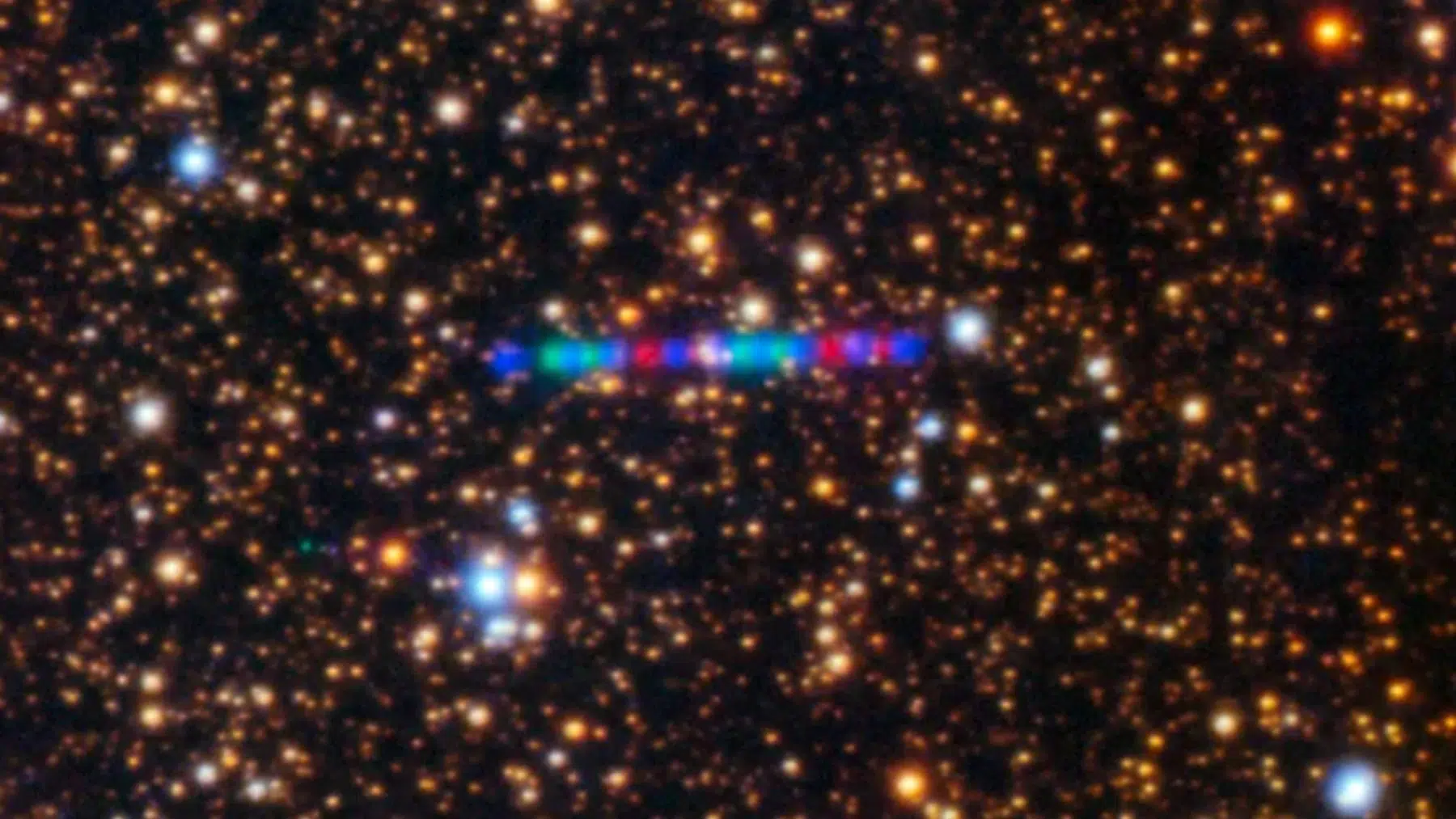
The celestial visitor, the 3I/ATLAS comet, has captured the attention of astronomers, some of whom have called it a serial killer. This comet will make its closest appearance to Earth on December 19, with Harvard astronomer Avi Loeb asking questions that paint a rather ominous picture of this comet. The most recent comment from Loeb is that 3I/ATLAS could be a “serial killer spreading poison,” and this comment has started sowing up doubt at the same time that NASA and JAXA released specific scientific observations that confirm the natural origin of this comet.
NASA states that the comet has a natural origin, but an unusual halo
This month, NASA revealed the first-ever X-ray of an interstellar object. JAXA’s XRISM observatory was able to capture a 400,000-kilometer X-ray halo that surrounds this comet. All observations that were conducted between November 26 and November 28 showed spectral excesses in carbon, nitrogen, and oxygen, which show that the emission comes from carbon-exchange interactions between solar wind and the comet’s gas plume.
With the XRISM data, a huge envelope of gas was shown as well. The 3-million-kilometer-wide field of vision depicts no thrusters or propulsion. According to NASA and JAXA scientists, the halo is evidence of a large comet interacting with its environment. NASA seems to believe that this comet is just a matter of chemistry.
Loeb is pushing forward life-or-death theories
Although the X-ray findings depict something entirely different, Loeb points to the fact that radio data from ALMA show a generous amount of methanol and hydrogen cyanide (HCN). While methanol is not dangerous, HCN in very high concentrations could be rather toxic. Now, Loeb has got everyone questioning whether 3I/ATLAS could be the “seed of life,” or a “serial killer.”
Loeb believes that the methanol-to-HCN ratio is too high and has never been seen before in a comet. This suggests an unusual chemical profile; however, the Harvard astronomer also suggests that objects, like ATLAS, may have had a life in the Milky Way or beyond.
Two sides of the coin concerning the 3I/ATLAS comet
Nothing has been observed as yet to signify that the comet has an artificial origin. There is no evidence to support Loeb’s observation.
Thus, NASA, ESA, and JAXA mission scientists tend to disagree with this observation. To these scientists, the plume complexity is a common feature of dynamically active comets. While the world is fixated on this comet, a stranger visitor is being tracked by NASA, and it is not moving naturally.
The interstellar visitor that carries two distinct narratives
The closer that this comet gets to Earth, the more distinct the two narratives are becoming. The scientific narrative is strongly rooted in XRISM’s X-ray halo and 10 years’ worth of comet research. This theory, backed by scientific evidence, states that the comet is undergoing outgassing. Loeb’s speculative tale focuses on extraterrestrial technology without enjoying any support from the evidence. The public remains rather fixated on the idea that Comet 3I/ATLAS will be showing a “heartbeat” every 16 hours, with its brightness changing chaotically.
While both perspectives could not be more different, they are both alike in terms of the fact that they depict comets as something fascinating. Since interstellar objects are extremely rare (there were only two other interstellar objects before ATLAS), this comet shows insight into the material chemistry of planetary systems. The hope is that observations from ESA’s Juice mission and the James Webb Space Telescope could provide more clarity in the next year. For now, the 3I/ATLAS will flash across the sky whilst being viewed from a speculative point of view or from the scientific viewpoint.
Read the whole thing?
Get the week's signal, not the noise
Our sharpest reporting on energy, climate and nature — free, once a week.