A solar panel pulled from a rooftop after more than a decade outdoors does not look like much.
The glass is clouded, the frame is chalky, and the plastic underneath has gone the color of weak tea.
Inside that plastic sits a web of silver lines thinner than a human hair.
Shredding the panel or cooking it at furnace heat once seemed like the only way to reach that silver, and both ruin most of what else is worth having inside.
So what actually happens when you point a laser at the seam instead?
A laser peels the plastic seal off in one piece
The mechanism is almost embarrassingly simple once you see it. The plastic that bonds a solar cell to its glass, called EVA, is built to survive decades of sun and rain without cracking.
That same toughness built for decades outdoors is exactly why old panels resist clean separation, leaving shredding and bulk thermal treatment as the dominant routes. Instead of fighting that bond, the researchers sent infrared laser light straight through the transparent plastic so it was absorbed by the silicon underneath, heating only the boundary between the two.
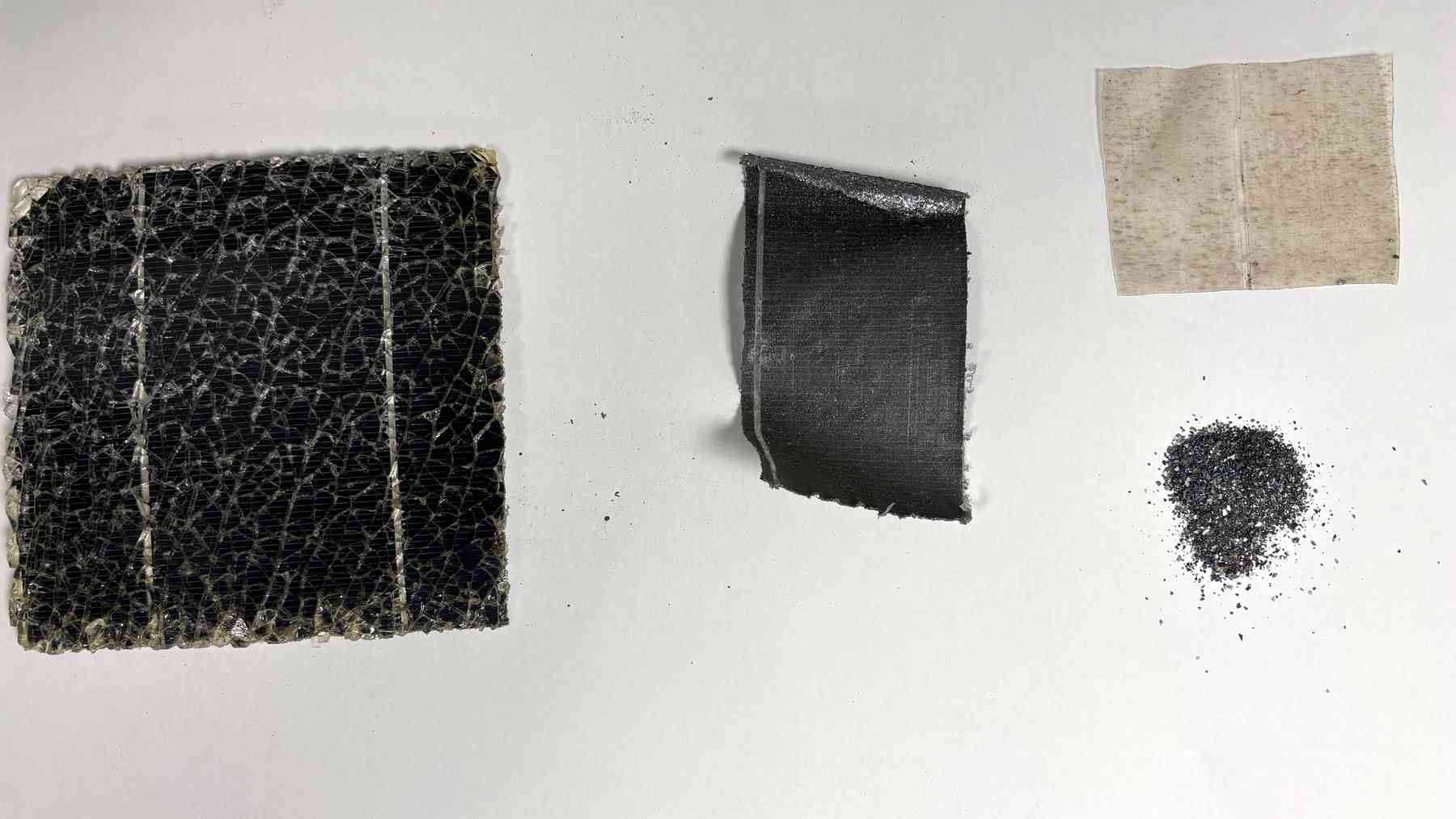
Above a certain power, the plastic let go as an intact film rather than melting into a sticky mess. A clean sheet of plastic can then be set aside instead of contaminating every step that follows.
Joseph Cameron, who led much of the work at the James Watt School of Engineering, said the approach lets the team “quickly release the encapsulant in one piece rather than burning or dissolving it.” What is left behind is a cell stripped down to its metals and silicon.
Busbars lift away in a second step and the rest becomes powder
Once the film peeled off, the metal contacts running across the cell’s surface, called busbars, could be physically separated from what remained. That remainder was a silicon rich powder carrying aluminum and silver along with it.
That powder is where the second trick happened. The team treated it first with dilute sodium hydroxide to strip the aluminum, then with an iron chloride and choline chloride brine to dissolve the silver.
Each step targeted one metal at a time rather than reducing everything to an unsortable soup. The silicon was never exposed to the nitric acid used in conventional silver leaching, staying behind as a solid while the unwanted metals went into solution.
Panels aged 10 to 13 years gave up silver at better than 99 percent selectivity
The team did not test panels fresh off an assembly line. Cell stacks from decommissioned commercial modules, supplied by a German photovoltaics research center, were roughly 10 to 13 years old, the kind of weathered hardware a recycling plant actually receives.
The glass came off before a 1,064 nanometer fiber laser scanned the plastic and silicon interface. The results were striking: silver came back with more than 99 percent selectivity in one module type and more than 95 percent in the other, which the authors describe as the most selective silver extraction yet reported for aged panels.
Selectivity here describes how cleanly the silver was separated from the other metals, not the purity of a finished ingot. X-ray diffraction confirmed the crystalline silicon survived, with the silver and aluminum peaks gone, and the researchers estimate the route cuts power use during recycling by 84 percent against conventional high heat methods, an estimate drawn from the process rather than a measurement at a working plant.
A sliver of silver still rides away with the peeled plastic film
Even a clean process leaves something behind. The intact films came away carrying trace metal residues, which means a small share of silver leaves with the plastic instead of staying in the recovered powder.
Scaling is the bigger open question, since one laser scanning one small bench sample is a long way from a yard handling thousands of panels a day. That gap is why the university is working with a Glasgow based laser company, Watt Laser, to explore making the technique commercially available, much as tuned solar panels have moved from lab trials toward working fields.
A decade’s backlog of retired panels still waits on this fix
None of this solves solar’s waste problem overnight. Commercial scaling remains unproven, and an Environmental Protection Agency assessment found that only about 10 percent of retired panels in the United States are recycled, because recycling costs still exceed what the recovered materials fetch.
But the direction matters. A recent modeling study of China’s photovoltaic fleet found that holding recovery at a flat 21 percent rate would return roughly 3,607 metric tons of silver from retired modules, rising above 15,000 metric tons if recovery instead climbs toward 90 percent early enough.
A laser that leaves silicon intact and separates silver that cleanly will not empty the landfills by itself. What it offers is a path where the next wave of retired panels might one day get taken apart as carefully as a jeweler opening a watch, rather than simply shredded, buried, or stacked and forgotten.
Read the whole thing?
Get the week's signal, not the noise
Our sharpest reporting on energy, climate and nature — free, once a week.