Wind turbines are a great source of sustainable and renewable energy that is a lot better for the environment than burning fossil fuels.
France is dedicated to this type of clean power.
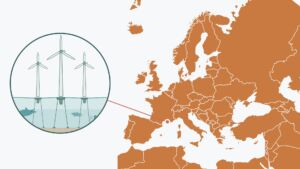
They have implemented a floating wind farm in the Mediterranean, just off the coast.
The three turbines stick out as foreign objects above the sea.
As much as they do good for the environment, they are certainly not part of it.
Researchers have been wondering what ocean species are co-habiting that space, and whether these foreign turbines have deterred them at all.
France’s first floating wind farm
The three floating turbines are around 17 kilometres from France, and together are called the Provence Grand Large.
They do not stand on the seabed.
They float.
The facilities are huge, and so is the power production.
It produces 25 megawatts that can supply the yearly electricity use of about 45,000 people.
Such a large development would logically impact the environment around, and so necessary precautions should be made.
That is what Provence Grand Large aims to do.
The farm is a pilot project for gathering feedback about the environment, both above and below the sea.
The owners are dedicated to environmental research and have invested almost four million euros into research and monitoring for a period of 20 years.
One part of that research includes these survey boats that have been spotting wildlife on every trip.
Observing the wildlife around Provence Grand Large
These boat surveys work to list all the birds and marine mammals in the area, and the team aboard focuses on observing their behaviour.
On each boat trip, researchers see 35 to 40 dolphins, and the shearwater seabird is large in numbers too.
These birds are of particular interest, as the turbines are in their direct territory.
While some wind farms move their construction away, this one had a different idea.
To deter them, the central turbine holds a radar to track their movement, and cameras equipped with alarm noises are in place to scare off any close-flying birds.
This data is useful to understand the behaviour and movements of birds in this area.
But for underwater sea life, it is a bit harder.
While the researchers can see the dolphins occasionally pop up around the wind turbines, they need to look underwater for more information.
Listening to sea life underwater
Under the surface, there are a lot more organisms to be concerned about.
Even down to the seabed itself, researchers are making sure the living creatures are studied, and the data is understood.
Through bio-sediment monitoring, developers are making sure they understand the before-and-after conditions for organisms at the lowest point in the ocean.
The bigger animals are being monitored too.
Before and during the wind farm construction, researchers needed to understand and monitor the movement of cetaceans.
They installed hydrophones (underwater noise recorders) to listen to these mammals, which emit sounds to understand their surroundings.
This gives more data on what larger sea life calls this part of the ocean home, and helps developers plan better for this type of construction.
Researchers are also still monitoring dolphins and other sea life while the turbines are in operation, for the animals’ own well-being, but also to use this data in the production of future ocean wind farms.
This is a technological turning point for France, as its first-ever floating wind farm, Provence Grand Large, becomes operational.
For now, it does not appear that the turbines have driven dolphins or other sea life away, with pods being spotted on every boat trip nearby. But this is not the same as concluding they are unaffected, and the pilot program will need to continue collecting data to know for sure. Other wind farm projects like this one are also learning how to work alongside the natural life.
Read the whole thing?
Get the week's signal, not the noise
Our sharpest reporting on energy, climate and nature — free, once a week.