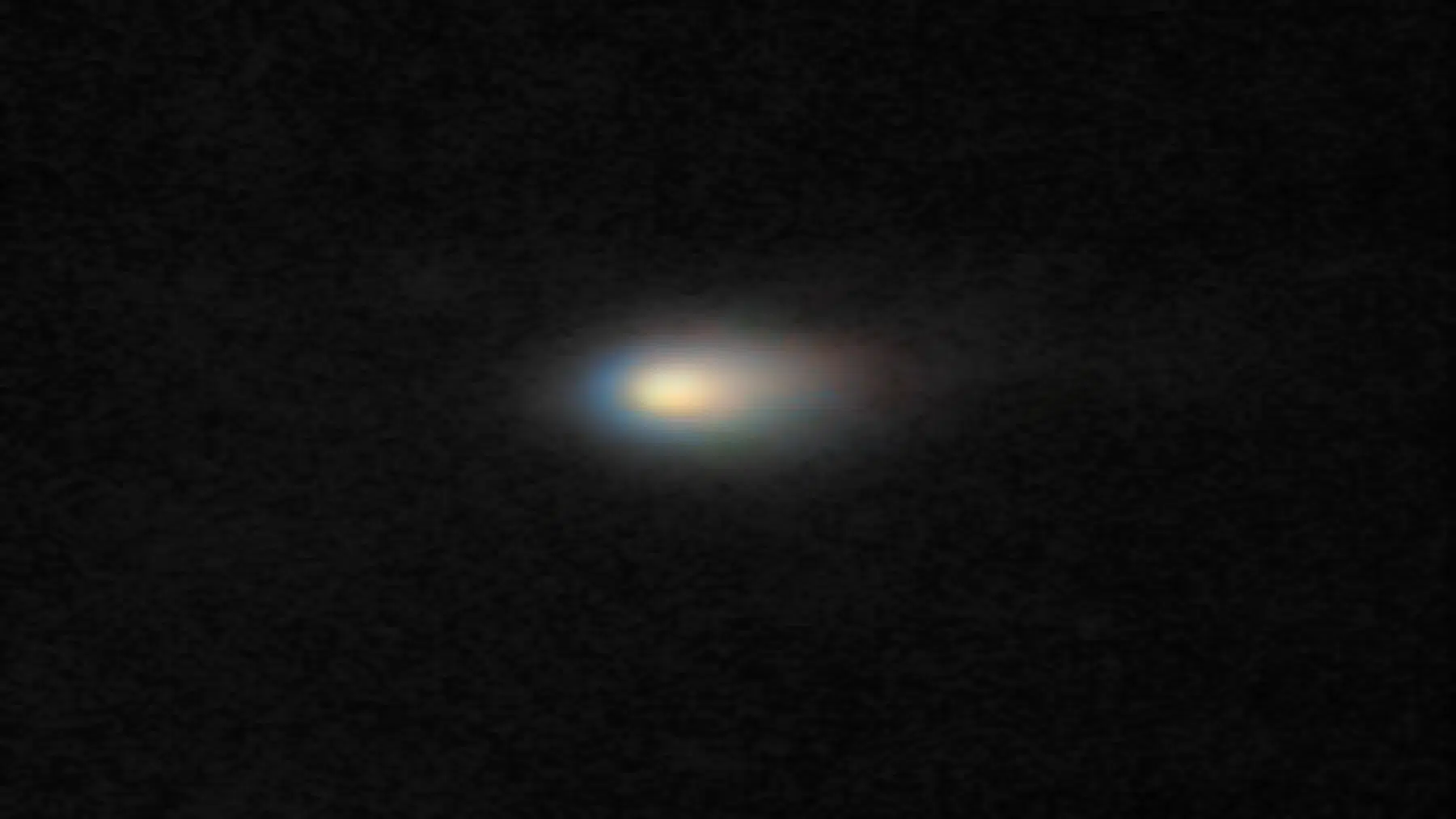
One of the biggest enigmas in the history of astronomy is currently unfolding. A Manhattan-scale intruder traveling at a high speed through the cosmos is entering our solar system. While some people argue that it could be the first real evidence of alien technology, NASA is considering the 3I/ATLAS as one of the largest comets we have ever seen. Scientists are unsure about what it means to have this gigantic cosmic object inside our solar system, and it will pass close to Mars, close enough for us to see what it actually is.
Earth is not in danger: The intruder will exit the solar system
A comet approaching Earth, Mars, and Jupiter could mean a lot of things depending on one’s perspective. If it were going to hit our planet and the planetary defense system could not stop it, it would most likely be the end for most species. Meanwhile, if this had happened billions of years ago, it would look like something was trying to send more minerals to a planet in formation.
For Mars, it would mean almost the same thing, as researchers continue to search for signs of life on the planet. While this Manhattan-scale intruder is not going to hit us, it is still one of the largest comets humans have ever seen up close. On a hyperbolic trajectory, it will eventually continue its journey and exit our solar system, but for now, it will spend time with us inside our solar system.
New insights on 3I/ATLAS: It’s carrying something big
New questions are emerging as 3I/ATLAS continues to head towards us. A recent study found something unusual: its gas plume on the intruder contains way more nickel and iron than expected. The researchers call it “extremely puzzling.” The discovery comes from an international team using the UVES spectrograph on Chile’s Very Large Telescope. Usually, comets are too cold for minerals like nickel and iron to turn into gas, so seeing them here is a real surprise.
Some traces of these metals showed up on 2I/Borisov, the second interstellar object we’ve seen, and on comets from our solar system. However, this intruder is different. Its nickel-to-iron ratio is unusually high — unlike anything astronomers have seen before. The team tracked the comet at distances ranging from 3.14 to 2.14 AU from the Sun. Nickel appeared all the time, but iron only showed up when 3I/ATLAS got closer than 2.64 AU. Overall, it’s producing nickel at a rate far beyond any comet we know, and NASA could see another big dark comet soon.
It’s getting closer by the day: This is serious speed
In early October, the object will pass close to Mars. NASA’s Mars Reconnaissance Orbiter, along with ESA’s Mars Express and ExoMars Trace Gas Orbiter, will get the closest look yet. At just 29 million kilometers away, their cameras could finally show its size, shape, and composition in detail. Previously, the best images came from Hubble in late July, when 3I/ATLAS was 570 million kilometers away.
Now, Mars-orbit cameras will get a resolution of about 30 kilometers per pixel — enough to finally pin down the nucleus’s size. New studies show the intruder is huge — roughly 7 miles (about 11 kilometers) across. That makes it about the size of Manhattan Island, and way bigger than its predecessors, 2I/Borisov and 1I/’Oumuamua.
Nothing was ever this large: The mystery is about to end
At roughly 33 billion tons, this comet is a real heavyweight. The size difference compared to earlier interstellar visitors shows just how diverse these cosmic travelers can be. Upcoming images from Mars-orbiting spacecraft might finally explain the mystery — or make it even stranger, as there are theories about this Manhattan-scale intruder being an alien spacecraft that is here to learn about our solar system.
Read the whole thing?
Get the week's signal, not the noise
Our sharpest reporting on energy, climate and nature — free, once a week.