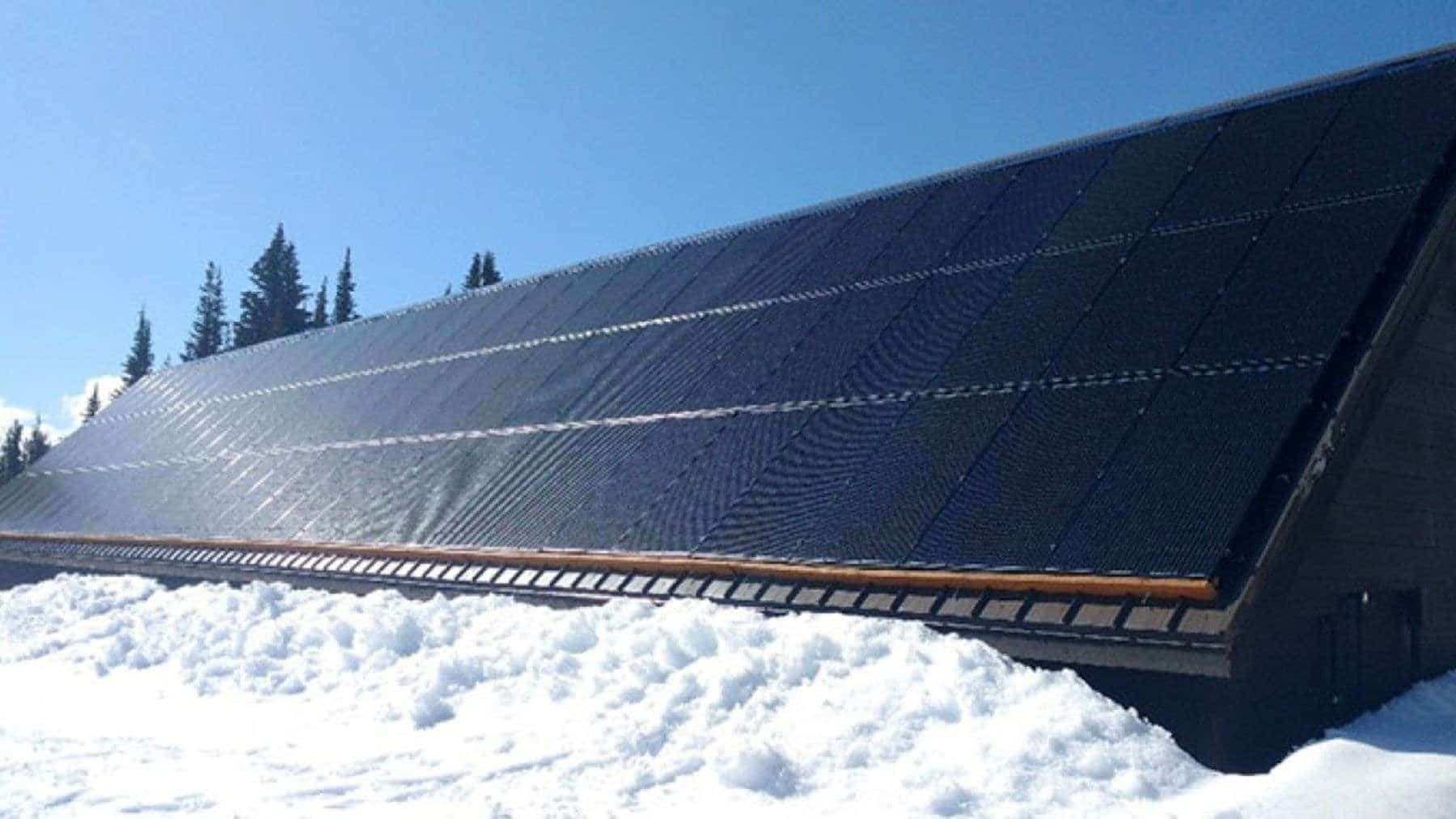
Solar PV modules at the Mount Rainier site had been in operation for some time.
A number of issues had developed due to heavy snow loading. However, energy was still being produced.
The damage was limited to specific parts of the installation rather than the entire system.
Without replacing the whole system, a solution needed to be found.
Repairs focused only on the damaged parts of the system.
Years of snowfall eventually exposed a design weakness
Although solar PV systems are well suited to cold conditions, heavy snowfall can place them under significant stress.
At Sunrise, significant snow loading in the winter caused issues with the aluminum structures supporting several modules within the PV system.
Despite this, the system was still operational. Components were strengthened to overcome the problem.
Prior recommendations had considered significant snow loading.
However, it became apparent that there was a specific design weakness rather than a flaw in the overall system.
Many essential services depend on this system
The Sunrise PV site is located within Mount Rainier National Park, so it is very remote.
It is isolated from grid connection. Utility power is not available at this remote mountain location.
During a specific time of year, visitors come to the area.
Therefore, it is important that key infrastructure is functional in these difficult conditions.
Housing for staff, provision of services for visitors, water provision, and other key functions are all supported by this site.
Having electricity running at this site is therefore very important in many areas.
As this site is the highest part of the park accessible by vehicle, large snow accumulations are to be expected.
Repairs focused on the modules hit hardest
For the 10 affected modules, eight additional fixing points were added. Reinforcement was added at highly stressed points.
More fixing points were added by installing an additional rail below the modules. This helped reduce deformation under heavy loads.
The added support helped resist these forces without replacing working parts.
The next winter provided useful comparison data.
There was significant accumulation of snow in the surrounding area, so the retrofit was tested effectively.
No further damage caused by snow loading was observed in these retrofitted panels during the next heavy snowfall.
Evidence from the field in this U.S. Department of Energy case study indicates that the solution was successful.
As intended, the retrofit performed well under the conditions experienced.
Different conditions can still change the outcome
Although this solution was successful in this instance, it may not be applicable to all situations in the future.
Snowfall can vary significantly between years, and even between separate snowfall events.
Different types of ice can affect different parts of the system. Snow and ice do not affect solar modules in the same way.
Site conditions may require different solutions. Designs therefore still face physical limitations.
Resilience measures must be assessed with respect to the conditions actually experienced.
Some weaknesses only appear after years of exposure
PV systems perform well in cold conditions. However, harsh winter conditions can create new design challenges.
Significant snow loading can cause warping and breaking of modules.
Ice may cause increased weight and strain fragile parts of the structure.
These forces often only become evident with years of exposure and occasional failures.
Certain weaknesses may not be evident in the structure until they have been exposed to repeated winter conditions over a number of seasons.
Future storms may provide the real answer
Within infrastructure, strengths and weaknesses will only be seen after extended periods of time.
The Sunrise retrofit provided an example of strengthening targeted areas rather than replacing an entire system.
Depending on conditions at other sites, similar strategies may be more or less effective.
Read the whole thing?
Get the week's signal, not the noise
Our sharpest reporting on energy, climate and nature — free, once a week.