
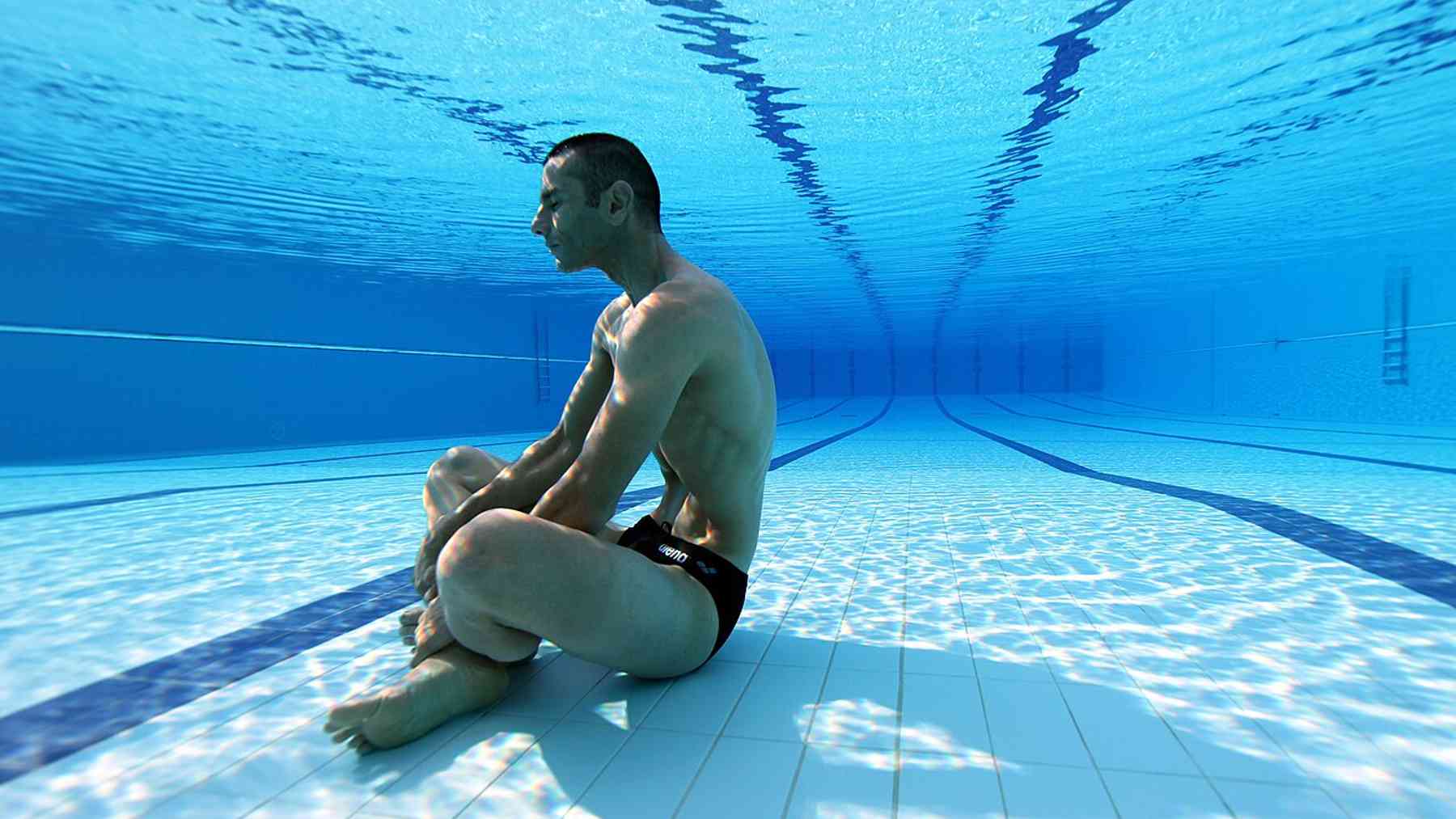
The pool at Hyères, in southern France, was an ordinary one.
A man floated face down on the surface, arms loose, body still as driftwood.
Minutes passed with no twitch and no breath.
Judges timed the hold rather than measured the water.
Eleven minutes and thirty five seconds after he started, he lifted his head and breathed.
What had his body been doing all that time, and how had it learned to ignore its own alarms for so long?
A trained tolerance for carbon dioxide, not a bigger gulp of air, made the eleven minute hold possible
The urge to breathe does not come from running low on oxygen. It comes from rising carbon dioxide in the blood, which chemical sensors near the brainstem track until the level crosses a threshold and the diaphragm starts to contract whether a person wants it to or not. That single mechanism, not a shortage of oxygen itself, is what most people feel as the first unbearable urge to gasp.
Stéphane Mifsud, the French freediver behind the mark, spent years learning to sit with that alarm rather than obey it. Freedivers train with what are called carbon dioxide tables, repeated breath holds with shrinking rest periods between them, which blunt the panic response long before oxygen itself becomes dangerously low.
So the fight underwater was never really about air. It was about overriding an ancient reflex that keeps land mammals breathing without their ever having to think about it, one contraction at a time.
The heart drops to 20 beats per minute as the hold runs on
A long breath hold switches on the mammalian dive response, the same oxygen saving machinery that stalls a seal’s heart underwater. In trained freedivers the pulse usually settles between 40 and 60 beats per minute, and rates of roughly 20 to 24 beats per minute have been reported in elite divers. A slower heart works through the body’s oxygen more gradually, stretching out every second before the breaking point arrives.
The same response shunts blood toward the brain and heart and away from limbs that can temporarily do without it. It sharpens when the face meets cool water, which is why static apnea is performed face down at the surface.
Lung size helps too. Mifsud’s capacity has been measured at about 2.8 gallons of air, against roughly 1.6 gallons for an average adult man, a bigger reserve tank before the chemistry begins working against him.
The record was set on June 8, 2009, with no oxygen breathed beforehand
Mifsud set it at Hyères, under the rules of the sport’s international federation, which bar breathing pure oxygen before an attempt. The federation still lists 11:35 as the men’s static apnea world record, and Guinness World Records recognizes the same time, place and date.
That rule is what separates his number from longer sounding breath hold claims. Those begin with several minutes of pure oxygen, a different physiological event with a different starting reserve, and the oxygen assisted record has since passed 29 minutes.
Without that boost, 11:35 has stood as the benchmark on ordinary air for more than fifteen years.
Three to five minutes separates a trained diver from a 90 second beginner
Most adults who have never trained manage somewhere between 30 and 90 seconds before discomfort wins. A freediver with a season or two of practice often reaches three to five minutes, multiplying that baseline through carbon dioxide tolerance training alone, before years of further conditioning stretch the number far past what seems physically reasonable.
Getting from there to eleven and a half minutes takes years, not months. It is less a single trick than a slow renegotiation between the conscious mind and a reflex arc that evolution tuned for emergencies rather than sport, much like the discipline shown by a swimmer who kept stroking for hours in cold water without stopping.
Climbers chasing a different kind of oxygen limit, the ones who reach the 29,032 foot summit without bottled air, lean on a related but separate adaptation, letting the body build more red blood cells over weeks rather than suppressing a single reflex in one sitting.
Judges and safety divers watch the entire eleven minute hold
Competitive static apnea runs under federation rules, with judges and safety personnel stationed at the pool throughout the attempt. A blackout can arrive with no warning signs once the body’s reserves run low, so that supervision is what allows a hold to physically happen and what later makes a time eligible for ratification at all.
“You have to respect the discipline, because the body will not always warn you before it shuts down,” Mifsud has said of the training behind his attempts, a line that captures why solo practice is strongly discouraged no matter how well a swimmer thinks he understands his own limits.
Even so, the record reads as something more measured than reckless. It is a controlled demonstration of how much slack the human body carries that ordinary life never calls on.
Most people will never need to know what their own diaphragm can tolerate, and that, in its own way, is exactly the point.
Read the whole thing?
Get the week's signal, not the noise
Our sharpest reporting on energy, climate and nature — free, once a week.


