Astronomers have always studied the universe with their eyes. But NASA’s Chandra X-ray Observatory is now asking a different question: what does it sound like?
The answer turns out to be stranger and more beautiful than expected. Violent X-ray flares from infant stars, giant plumes of hot gas from exploding suns, and towering cliffs of cosmic dust have been translated into drones, metallic plucks, glassy tones, and cascading musical pitches — a kind of accidental orchestra playing at the edges of creation.
Turning light into music
Sonification is the process of mapping data into sound. For astronomers, it opens a completely different channel for experiencing the universe — one that doesn’t rely on vision at all. It also makes space science more accessible to people who are blind or have low vision.
The technique works by translating visual properties into audio equivalents. Brightness becomes volume. Different wavelengths of light — X-ray, infrared, optical — get assigned to different frequency ranges or instrument textures. The result isn’t noise. It’s structured, layered, and genuinely musical in ways that tend to surprise first-time listeners.
This latest release adds four new entries to an ongoing sonification program at the Chandra X-ray Center, led by visualization scientist Kimberly Arcand alongside astrophysicist Matt Russo, musician Andrew Santaguida, and consultant Christine Malec. They’ve been quietly building a growing audio library of the cosmos.
A starburst galaxy heard for the first time
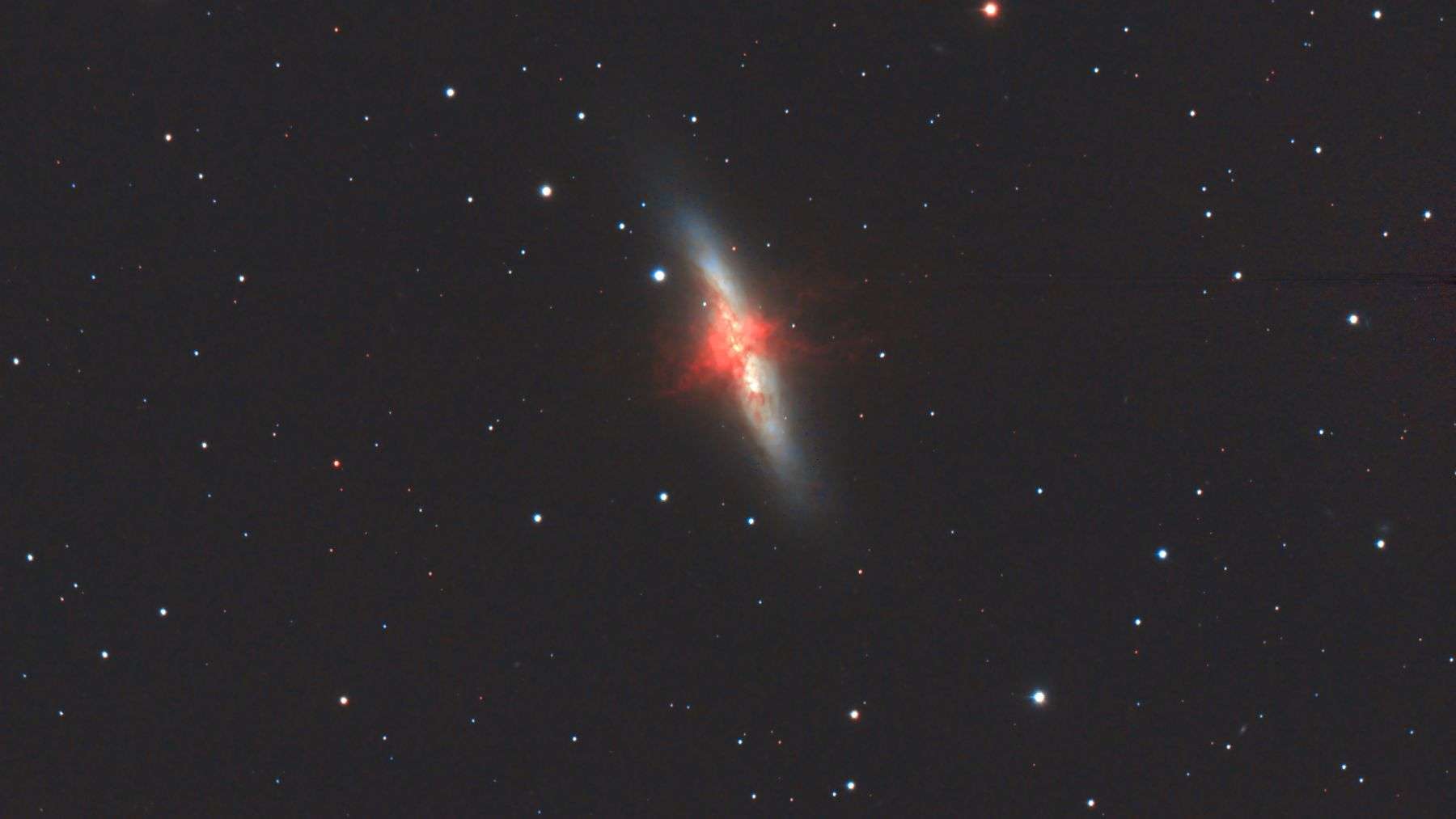
The most distant subject in the new set is M82 — also known as Messier 82. It’s a starburst galaxy forming stars tens to hundreds of times faster than our own Milky Way, a frenetic pace that may have been triggered by a collision with another galaxy in the distant past.
Today, Chandra detects the aftermath: giant plumes of hot gas, the byproduct of young, massive stars that burn fast and explode. It’s a chaotic environment. It sounds like one too.
The sonification layers data from four telescopes. Chandra contributes X-ray data mapped to the highest frequency ranges, while infrared data from Webb and the retired Spitzer telescope becomes a low drone and plucked tones. Optical data from Hubble fills the middle with shifting pitches and textures. A radar-like scan moves across the image, growing louder wherever sources are brighter.
Nurseries closer to home: Orion and Rho Ophiuchi
The Orion Nebula is one of the closest and most active star-forming regions to Earth — visible below Orion’s belt on a clear night. Chandra detects more than a thousand infant stars there, each energetic and volatile in its early life.
In the sonification, those individual stars become twinkling sounds. Diffuse X-ray emission across the region maps to pure, high tones, and Webb’s infrared view — revealing the raw dust and gas from which new stars are still forming — comes through as lower musical tones, distorted strings, and a digital harp. The layers build into something genuinely atmospheric.
Rho Ophiuchi offers a different experience entirely. This gas-and-dust cloud contains stars at various stages of formation, and Chandra catches the youngest ones mid-flare, their violent X-ray outbursts rendered as high-pitched glassy tones. Webb’s infrared clouds map to differently pitched sounds, while individual stars arrive as metallic plucks.
Then, midway through, the sound almost disappears. That silence isn’t an artistic choice — it reflects a real gap in the data caused by dark dust clouds that emit almost no light. The absence itself becomes part of the composition.
The Cosmic Cliffs and the science behind the sound
Webb’s infrared image of the Carina Nebula’s “Cosmic Cliffs” became one of the most widely shared astronomical photographs in recent memory. The towering structures of gas and dust look almost geological. Chandra, though, sees something different: individual baby stars hidden behind all that material.
Those stars become short string sounds in the sonification. A diffuse X-ray glow across the region takes on longer, sustained string notes, and Webb’s nebula data provides a continuous background sound punctuated by other instruments marking specific features — ridges, stellar clusters, bright points of interest.
All four sonifications are ultimately aimed at the same scientific question: how are stars born? By studying regions where formation is actively happening, astronomers can reconstruct the full stellar lifecycle — including the one that produced our own Sun, which went through these same violent, glowing stages billions of years ago.
That’s perhaps the most striking implication of the project. The chaotic sounds coming from M82 or Rho Ophiuchi aren’t alien in any abstract sense. They’re an echo of our own origins — the same process, the same physics, caught at a different moment in time. All four sonifications are available to listen to at chandra.si.edu/sound.
Read the whole thing?
Get the week's signal, not the noise
Our sharpest reporting on energy, climate and nature — free, once a week.