NASA and other space agencies are actively trying to figure out if there’s a ninth planet in our solar system. Throughout the years, many theories have come up with the possibility of a planet between the Sun and Mercury, but it’s not possible to see anything this close to the big star due to its brightness. On the other hand, searching for this mysterious object in our solar system has led scientists to make intriguing discoveries. New findings are not made only by looking at fresh images, detections from space, but also by studying old images from the past decade.
Humanity is always late in the universe
Some of the things that were in place in the past might not be there in the future, since we are only able to observe cosmic objects because light travels to Earth. And, in a certain way, humanity is always late for the news of the universe. The Milky Way has its own fair share of massive stars orbiting the center of the galaxy in a peaceful manner.
The most famous one is Stephenson 2-18, which has 10 billion times the volume of the Sun, but remains quiet in the depths of the Milky Way. These types of stars are responsible for the gravitational pull inside the galaxy, but NASA recently found something moving so fast that it will escape the Milky Way’s gravity and move into intergalactic space.
NASA captured something speeding away from the Milky Way
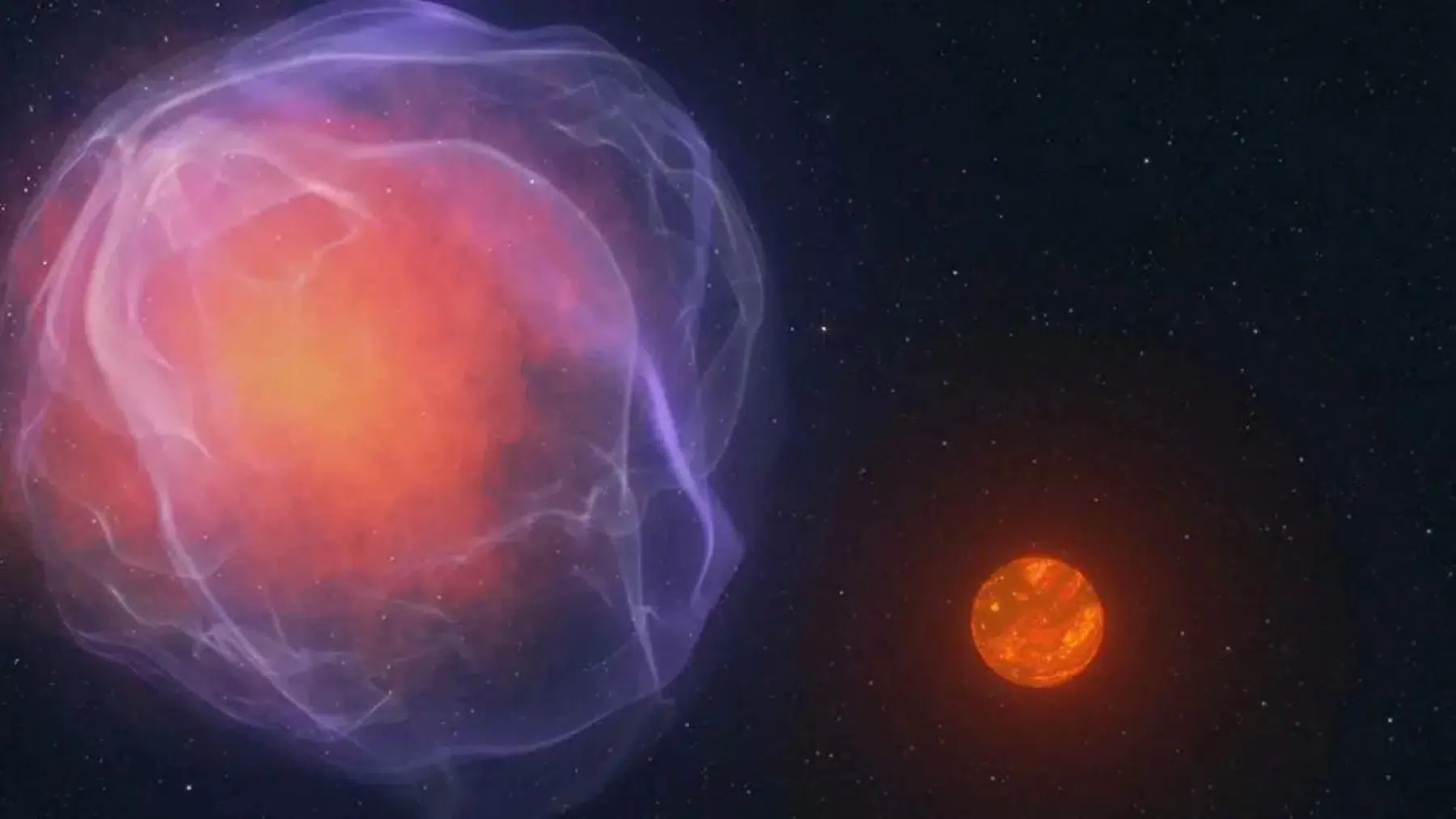
Using images captured by NASA’s Wide-field Infrared Survey Explorer (WISE), scientists from the Backyard Worlds project found an object with the mass of a small star moving at 1 million mph. The study published in the Astrophysical Journal Letters states that the object (named CWISE J1249) is zooming away from the Milky Way. The object has the mass of a small star, but if it doesn’t have fusing hydrogen in its core, it can be considered a brown dwarf – the midpoint between a gas giant and a star. Currently, it is 400 light years from Earth.
The WISE mapped the sky with infrared light from 2009 to 2011. Later, it was reactivated in 2013, but officially retired in August 2024.
What exactly is this object NASA captured?
Brown dwarfs are not something rare in the universe, as the Backyard Worlds volunteers have discovered over 4,000 of them. This one is different because it’s moving away, like it’s abandoning the Milky Way and moving to someplace else.
Another unique feature discovered using the W.M. Keck Observatory in Maunakea, Hawaii, is the unusual composition: much less iron and other metals than other stars or brown dwarfs. NASA suggests that the CWISE J1249 is old, from one of the first generations of stars in the galaxy.
The reason is running away from our galaxy
The reason why it’s moving so fast towards intergalactic space remains unknown. Scientists have suggested that the object is from a binary system where a white dwarf exploded when it became a supernova. Another possibility is that it came from a cluster of stars named a “globular cluster,” and the chance of meeting with a pair of black holes in the region sent it away – the result of a three-body interaction when stars encounter a black hole binary.
The discovery made by NASA was a team effort like no other. Volunteers, professionals, and students were involved in finding and understanding the CWISE J1249. The Backyard Worlds: Planet 9 is a project with participation open to anyone around the world who wishes to help discover space objects. There, you can find other people trying to classify and understand images from the past and see if there’s any discovery to be made.
Read the whole thing?
Get the week's signal, not the noise
Our sharpest reporting on energy, climate and nature — free, once a week.