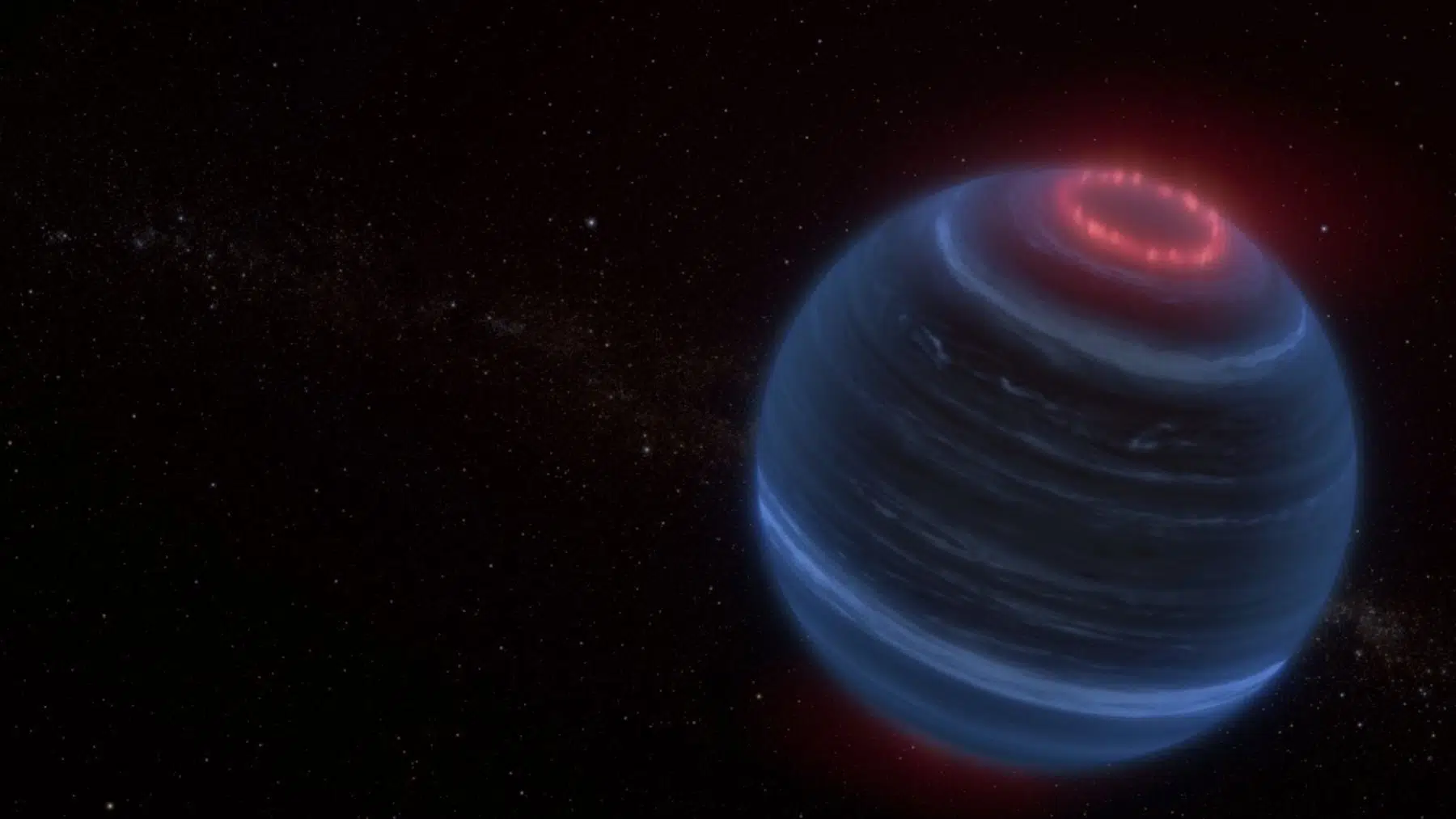
NASA astronomers may be on the verge of making cosmic history. With the aid of the powerful James Webb Space Telescope, they have spotted several curiosities, called brown dwarfs or ‘failed stars’, behaving in a peculiar way. It is the first time these are found outside the Milky Way, and their discovery may lead to some groundbreaking revelations.
What are brown dwarfs?
Brown dwarfs, also somewhat cruelly dubbed as ‘failed stars’, are conceived in the same way as stars, from clouds of gas and dust, but they cannot accumulate enough mass to become stars. Brown dwarfs are bigger than a large planet but smaller than stars.
Where are these newly discovered “failed stars”?
The cluster of brown dwarfs is located in a galaxy called the Small Magellanic Cloud (SMC), one of the Milky Way’s closest neighbors. Well, “closest” in terms of the enormity of the Universe, because this satellite galaxy is located some 200,000 lightyears away. It is the first time brown dwarfs have been spotted outside the Milky Way.
The Milky Way contains many of these brown dwarfs, there are between 25 and 100 billion of them. For comparison purposes, there are between 100 and 400 billion stars inhabiting this galaxy. Therefore, the existence of failed stars is not in and of itself something that rare.
What is so groundbreaking about these particular brown dwarfs?
In the SMC, there lives a star-forming cluster called NGC 602. Astronomers manipulating the powerful James Webb telescope directed its mighty eye to this cluster and came to an abrupt stop. They spotted brown dwarfs, but that is not what made their jaws drop to the floor in wonder. These formations had failed at being stars, but they may succeed at forming planets.
The spellbound astronomers spotted something called ‘protoplanetary disks’ surrounding the brown dwarfs. These are normally found in young stars and contain dust and gas. Over time, the dust and gas start to cluster together, forming planets, moons, and asteroids.
“For decades, astronomers suspected that, soon after a star coalesces within a nebula, planets are born within a disk of gas and dust surrounding the newborn star, known as a protoplanetary disk,” said Kevin Luhman of the Eberly College of Science, Penn State University.
The discovery of the planet-forming disks circling the failed stars means that, like fully fledged stars, the brown dwarfs could also be involved in the formation of planets.
What could be the impact of the discovery?
Astronomers are sitting on the edge of their seats and shaking in anticipation at what this discovery could mean. The environment of NGC 602 is very different from that of the Milky Way. Therefore, the brown dwarfs found there are also different in their composition; they are metal-poor.
One aspect of the importance of the discovery is that brown dwarfs seem to be adaptable regarding the environment they are born in. The environment in NGC 602 is low in terms of metal. So, researchers can evaluate and study the formation of stars under different conditions.
The other aspect, perhaps even more shocking, is that this low-metal environment could resemble the Universe’s conditions shortly after the Big Bang. Elena Sabbi, a scientist at the National Science Foundation’s NOIRLab, the University of Arizona, and the Space Telescope Science Institute, stated:
“By studying the young metal-poor brown dwarfs newly discovered in NGC 602, we are getting closer to unlocking the secrets of how stars and planets formed in the harsh conditions of the early Universe.”
Astronomers using the James Webb Space Telescope may be on the verge of being able to reveal some of the secrets of the early Universe thanks to these recent findings surrounding the curious brown dwarfs. This could shake the foundations of what we think we know so far.
Read the whole thing?
Get the week's signal, not the noise
Our sharpest reporting on energy, climate and nature — free, once a week.