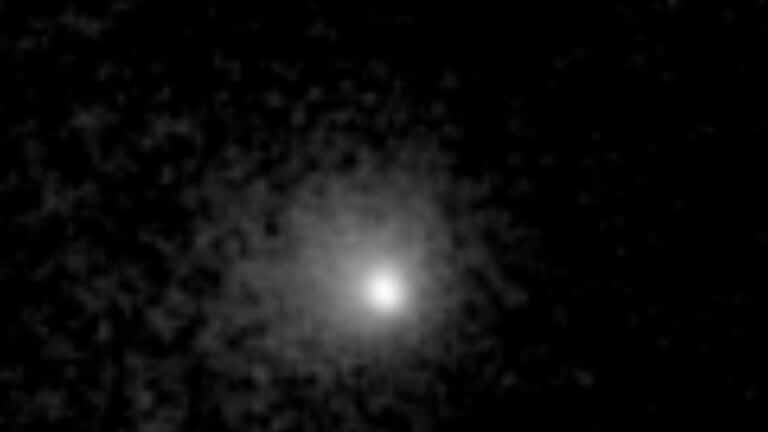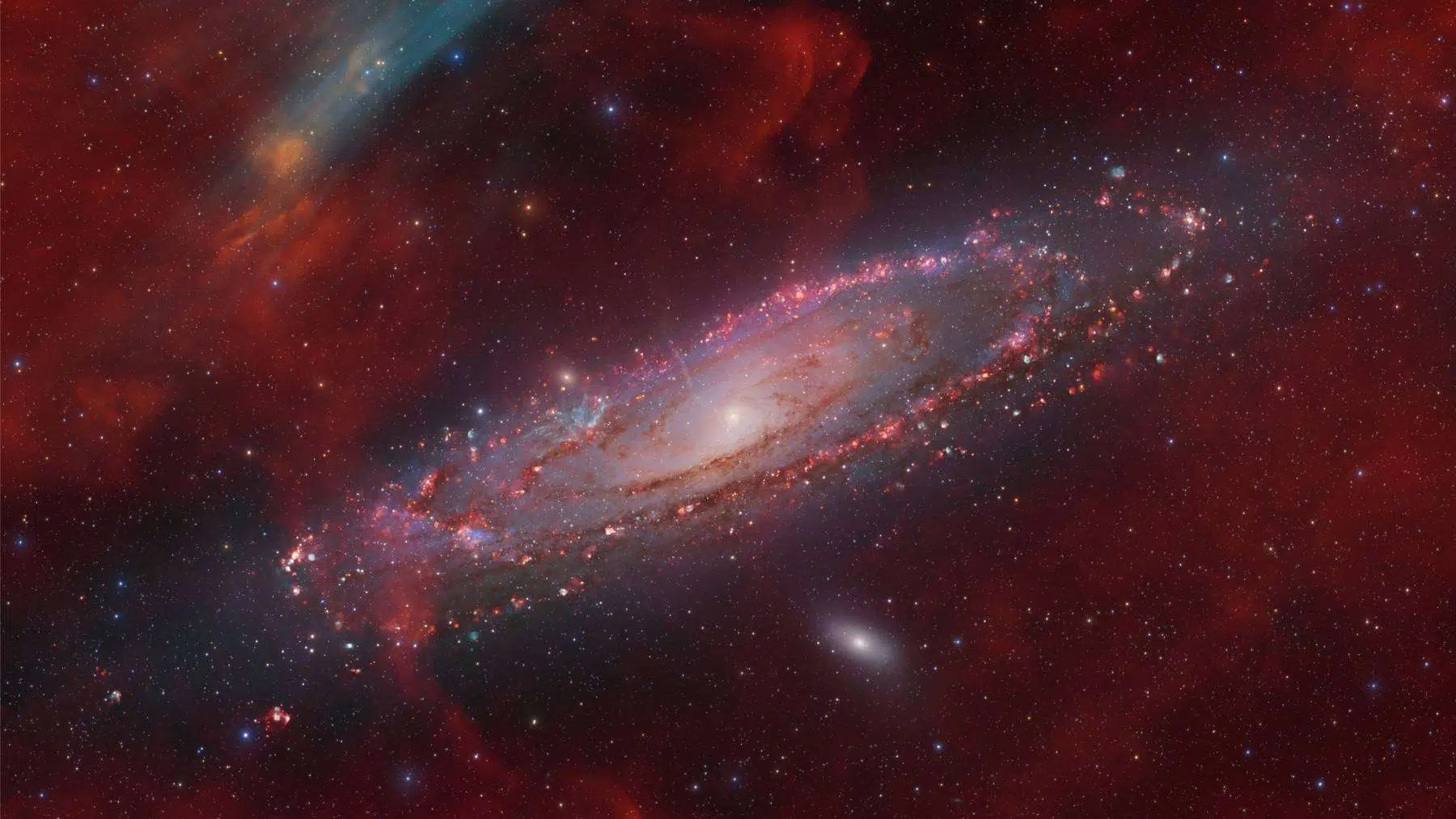
A large, glowing nebula sitting just 1.5 degrees from the Andromeda Galaxy had puzzled astronomers for years. Known as SDSO 1, it emitted a distinctive oxygen signature that made it hard to classify — and harder still to place. Did it belong to M 31, or was it something else entirely?
New deep narrowband images have now offered a clear answer. What researchers found in that faint glow suggests the known life cycle of planetary nebulae may be missing a final, unexpected chapter.
A mysterious glow near Andromeda
SDSO 1 sits centered about 1.5 degrees southeast of M 31, and its strong emission in [O III] — the spectral fingerprint of doubly ionized oxygen — made it an immediate curiosity. That wavelength is commonly associated with hot, energetic nebulae, which deepened the puzzle of what was producing it. Early speculation naturally gravitated toward a connection with the Andromeda Galaxy itself, given the apparent proximity on the sky.
New deep narrowband imaging changed that picture entirely. The clearest view yet of SDSO 1’s structure gave researchers the evidence needed to settle the question of its location — SDSO 1 isn’t part of Andromeda at all. It’s a foreground object within our own Milky Way, with no physical relationship to M 31 whatsoever.
The ghost planetary nebula: a faded stellar relic
With its true location established, the object’s identity came into focus. SDSO 1 is a giant ghost planetary nebula — a GPN — spanning roughly 20 parsecs, expelled by EG Andromedae, a symbiotic white dwarf binary star system that now sits at the nebula’s origin point.
At an estimated age of around 400,000 years, SDSO 1 has been expanding and fading far longer than a typical planetary nebula survives in detectable form. Conventional photoionization — the process by which a central star’s ultraviolet radiation keeps a nebula lit — has long since ceased. The star simply doesn’t produce enough radiation anymore to sustain the glow.
A turbulent tail stretching some 45 parsecs extends in projection directly across the face of M 31, which contributed heavily to the object’s difficult classification. That tail is a key diagnostic feature — and a clock.

Shock waves keep a dead nebula glowing
SDSO 1 was originally launched into the interstellar medium at a hypersonic speed of 91 km/s. At that velocity, the nebula drove a powerful bow shock ahead of it as it moved through surrounding gas — similar in principle to the shockwave that forms ahead of a supersonic aircraft. A reverse shock then rebounds back into the nebula itself.
That inward-facing shock — not radiation from the central star — is now the primary source of the [O III] emission researchers detected. The nebula is being lit from within by the energy of its own collision with the interstellar medium. Ram pressure from surrounding gas has dramatically slowed the expansion over time, yet the shock mechanism keeps the structure visible long after a conventional planetary nebula would’ve faded below the threshold of detection.
A new chapter in the life cycle of planetary nebulae
The researchers formally define what they call the “shock-powered GPN phase“ as a previously unrecognized final stage of planetary nebula evolution — a structural addition to how astronomers understand the complete life cycle of these objects.
Building on SDSO 1 as a confirmed example, the team identified 24 candidate ghost planetary nebulae based on their large angular size and the distinctive shock-tail morphology SDSO 1 displays. Several candidates appear to be giant halos surrounding younger planetary nebulae, possibly material shed by now-degenerate binary companions in earlier evolutionary stages. The implication is hard to ignore: shock-powered GPNe may be far more common than previously suspected, quietly persisting across the sky while going unrecognized.
What this means for stellar archaeology
Ghost planetary nebulae represent a window into stellar histories previously considered permanently inaccessible. Once a planetary nebula fades below the limit of photoionization, the assumption has been that its record is simply lost. SDSO 1 suggests otherwise.
The interaction between an old, fast-moving GPN and the interstellar medium generates shocks that can remain visible for hundreds of thousands of years after the nebula would otherwise disappear — those shocks acting as tracers, markers of ancient stellar events still readable today. EG Andromedae and similar binary systems may be responsible for scattering far more relics throughout the galaxy than current catalogs reflect.
Future surveys using deep narrowband imaging — the same technique that resolved SDSO 1 — could uncover many more such objects. The census of evolved stellar remnants may need to be substantially rewritten.
Read the whole thing?
Get the week's signal, not the noise
Our sharpest reporting on energy, climate and nature — free, once a week.